
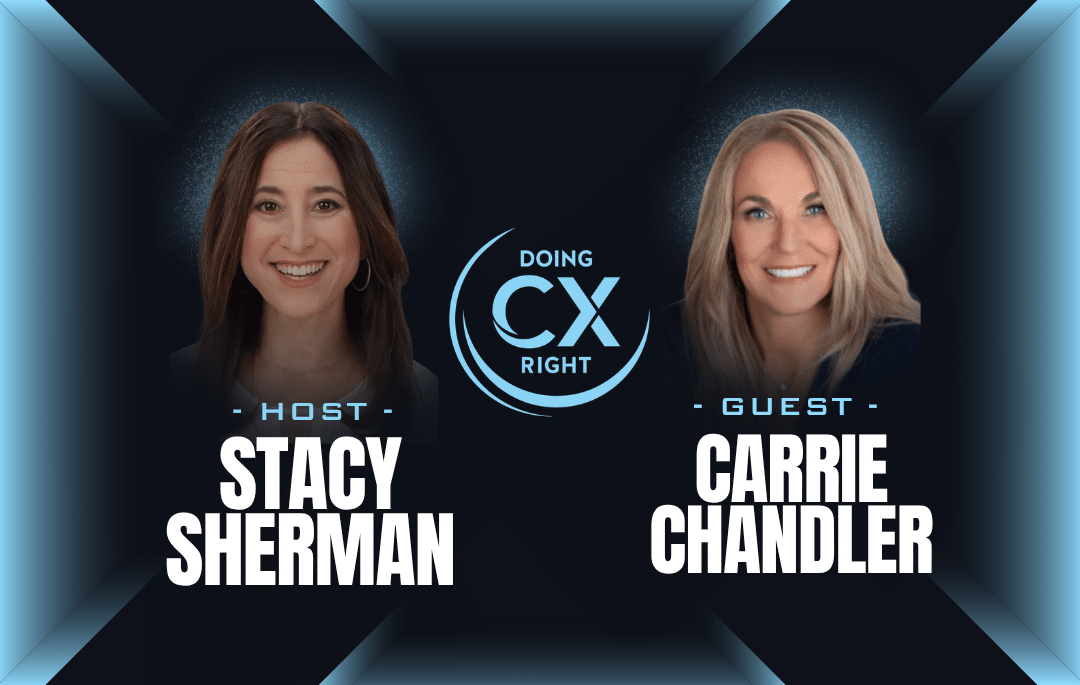




Did you know replacing one employee can cost up to a third of their salary? That expense begins long before anyone quits, and it traces back to how you hire, train, and treat staff behind the scenes. Those decisions then determine how your frontline handles every customer who contacts you by phone, email, chat, or in person.
Human Resources (HR) and back-office professionals often hear an angry buyer or see a lost sale and decide that building positive emotional connections at every interaction isn’t their responsibility. Stacy Sherman and Carrie Chandler explain the reason that mindset is costly, and why every team, regardless of job title, influences how people feel about your brand.
What You Will Learn From This Doing CX Right® Podcast Episode:
- Why hiring for industry experience over behavioral fit puts the wrong people on your frontline.
- Where AI resume screening rejects strong customer-facing applicants, and the safeguard you need to add.
- The critical skill most training programs skip, and why mislabeling it as “soft” damages your bottom line.
- Three words that change a manager’s reaction to a performance decline, before frustration reaches clients.
- The “Venn Diagram” strategy that positions HR as the ultimate bridge between the executive suite and frontline staff.
- How “quiet quitting” impacts your profits and ROI, and what stops employee disengagement quickly.
- An AI practice method, paired with a human mentor, that prepares new hires for their first irate caller.
- The crucial difference between being a “nice” leader and a “kind” one during difficult conversations.
- The gap between your stated values and staff’s reality, and how to close it before it impacts customer perceptions.
Podcast Episode Chapters
0:00 Intro and Meet Carrie Chandler
2:41 How HR Shapes the Employee and Customer Experience
3:51 Why HR’s Customer Experience Impact Gets Overlooked
5:04 Hiring for Customer-Centric Behaviors, Not Just Experience
6:58 Training Beyond Compliance: Empathy and Emotional Intelligence
9:18 Employee Engagement, Quiet Quitting, and Turnover
11:09 Leading with Curiosity Instead of Frustration
13:06 Bringing the Human Back to Human Resources
15:24 AI in HR: Recruiting Risks and Training Opportunities
16:40 Using AI Simulations to Practice Difficult Customer Conversations
17:52 AI for Critical Thinking with a Human Mentor
19:01 Leadership Advice: Do the Right Thing
19:29 Closing the Gap Between Company Values and Employee Experience
20:03 Advice to Your Younger Self: Courage, Kindness, and Authenticity
21:32 Closing Thoughts and Next Steps
Read Full Episode Transcript
Full Transcript: How Human Resources (HR) Actually Impacts Customer Experiences
Humanizing HR for Customer Experience
[00:00:00] Stacy Sherman: Did you know replacing one employee can cost up to a third of their salary? My guest today, Carrie Chandler, an HR senior vice president in banking, argues this massive expense begins long before anyone actually quits. It traces directly back to how staff is hired, trained, and treated behind the scenes.
[00:00:23] Stacy Sherman: HR leaders must hear this conversation, along with anyone supporting the front line. You see, too
[00:00:30] often professionals in the back office see an angry buyer or a lost sale and think, “Eh, customer experience and creating positive emotional connections, that’s not my job. That’s not our department.” Well, Carrie and I reveal why that mindset is costly, and regardless of your job title, you directly influence the buyer journey.
[00:00:54] Stacy Sherman: So what happens to brand loyalty when every single internal team steps [00:01:00] up to drive customer success? How do you create a culture focused on delivering customer excellence? You’ll hear answers to these questions and much more. I’m so glad you’re here, and for those who don’t know me, I’m Stacy Sherman, a certified professional speaker and advisor helping leaders and their teams know exactly what to do to boost revenue, retention, and brand reputation.
[00:01:24] Stacy Sherman: There is a right way. If you need a speaker or advisor to your teams to gain a [00:01:30] distinctive competitive advantage, please reach out to me on my website at DoingCXRight.com. That’s DoingCXRight.com. And subscribe to my show so you never miss an important episode. Now, let’s get started.
[00:01:47] Stacy Sherman: Hello, Carrie Chandler. Welcome to the Doing CX Right show
[00:01:51] Carrie Chandler: Hi Stacy, thank you so much. I’m very excited for this conversation
[00:01:55] Stacy Sherman: Me too. It’s a really important conversation we’re gonna have, and [00:02:00] I want to emphasize that who you are and what you do is really why I wanted to have you on my show, because you are a superstar in your own unique way, and the audience is gonna soon know why. So with that said, share a moment. Who are you?
[00:02:16] Stacy Sherman: What do you do for a living?
[00:02:17] Carrie Chandler: Yeah. Thank you. So Carrie Chandler. currently I’m a senior vice president and director of human resources in the banking industry. And so I oversee the HR function [00:02:30] entirely, including strategy and all the tactical sides of it to include talent management, compensation, onboarding, training, the whole employee life cycle
[00:02:41] Stacy Sherman: So when you hear doing customer CX right, what does that mean to you from an HR perspective and all the roles and things you just talked about?
[00:02:52] Carrie Chandler: I love that question because I think as human resources professionals, often being in the [00:03:00] back office, it is not thought of enough how much of an impact we have on the customer experience. We directly impact that customer experience. We’re the beginning of the employee life cycle, and the employees are the ones that are working with our customers.
[00:03:19] Carrie Chandler: So if our strategy is not set up right, to hiring, onboarding, training, performance management, and the compensation strategies, right? [00:03:30] If those aren’t set up well, we’re not gonna be attracting the right talent. We’re not gonna be hiring the right talent. of course, that’s gonna have a cascading impact on the customer experience as a whole.
[00:03:42] Stacy Sherman: Yeah, cascading impact. Love those words because there is a domino effect here,
[00:03:48] Carrie Chandler: Yeah. Oh, yeah, absolutely
[00:03:51] Stacy Sherman: if it’s so obvious that HR, human resources, has an impact, a cascading impact, why do they not
[00:04:00] necessarily realize that? Why are they not always accountable for the customer experience? And I’m not just picking on HR, ’cause every department has this
[00:04:08] Carrie Chandler: blind spot.
[00:04:09] Stacy Sherman: what do you think?
[00:04:10] Carrie Chandler: yeah. I think sometimes it doesn’t become part of the conversation overall as, within the culture of an organization, and that would start at the top. really using that language of our internal customers how they impact the bottom line, how they are supported to support our customers. if
[00:04:30] we are using the right language and really embodying that, that will help. I also think that a
[00:04:39] Carrie Chandler: lot of times HR kind of gets into this tactical mindset, and they don’t think big picture. And so they’re, just stuck in their emails, and they’re trying to make sure that all the tactical stuff is done within their department. And it’s so heavily compliance, and regulated
[00:05:00] with all of the employment laws That I think also can be a real blind spot
[00:05:04] Stacy Sherman: You talked about hiring and training.
[00:05:07] Carrie Chandler: Mm-hmm.
[00:05:08] Stacy Sherman: How much do you see companies doing that hiring and training with the intention of getting people who are very customer-centric, Servant leadership is a common term now. Do you see that happening more or a challenge within brands?
[00:05:24] Carrie Chandler: I think it’s still a challenge. I definitely think that there’s room for [00:05:30] improvement. I see a lot of focus on trying to hire for experience, and that is very important. I’m not disagreeing that, bringing somebody in with experience is an important factor. But on the other side, the behaviors and the fit for the organization is just as important, right?
[00:05:52] Carrie Chandler: do they bring forward the behaviors that we wanna see exhibited toward our customers?
[00:05:58] Stacy Sherman: So behaviors, how do you know?
[00:06:00] How do you know when you bring someone in or you’re supporting different business lines, I believe?
[00:06:04] Stacy Sherman: What comes to mind to know that you are bringing the right behaviors and nurturing those that ultimately save a customer?
[00:06:11] Carrie Chandler: Yeah, that’s such a great question. think a lot of times companies don’t have a well-defined hiring process,
[00:06:21] Stacy Sherman: and it’s not consistent across departments or managers. And we have a real opportunity as HR
[00:06:30] leaders to advance that disconnect and make it better by supporting them and creating consistent interview guides, supporting them, role-playing, talking about the values of the organization, and really maybe sitting down with the hiring managers and understanding, what are the behaviors that are important to you?
[00:06:52] Carrie Chandler: What do you see on the front line? And backing into that from a hiring perspective.
[00:06:58] Carrie Chandler:[00:06:58] Stacy Sherman: Training. What are companies [00:07:00] actually training for right now? What is the, the big topic?
[00:07:03] Carrie Chandler: you know, lot of times it is getting them in the door, getting them trained on the processes, making sure that they’re in compliance. I mean, obviously I’m in banking right now, and that’s a very heavily regulated industry. But previously I was in private equity, so that was a little bit different that was like a 180, right? And that was really about are you fulfilling your KPIs? So it’s really on a tactical
[00:07:30] side, and I think that we could spend more time developing the skills, and I really have a problem even saying this out loud, but soft skills, because I don’t like that term. I think we need to come up with a new term because they’re just not soft skills.
[00:07:44] Carrie Chandler: There’s gotta be a different way that we can capture that. They’re some of the most difficult skills to train on, and we kinda downplay it by calling them soft skills, but those are very important.
[00:07:58] Stacy Sherman: So are you talking about [00:08:00] emotional intelligence
[00:08:02] Carrie Chandler: Mm-hmm.
[00:08:02] Stacy Sherman: and identifying sentiments more?
[00:08:05] Carrie Chandler: yes. how do you handle a difficult customer? How are you managing through that person who’s in front of you that is exhibiting behaviors that are triggering to you? Are you able to deescalate that situation? Are you able to make them feel,heard? And are you able to solve their problem?
[00:08:30] Do you have the judgment to be able to take what you’ve learned from a process perspective and a compliance perspective and apply it in more of a critical thinking way to be able to solve their problem?
[00:08:44] Stacy Sherman: And empathy is a huge one. we’ve talked about the different experiences from customer service that we’ve had, and empathy is huge.
[00:08:52] Stacy Sherman: Yeah, it is huge, which is a lot about what I talk about. In fact, my research has proven that companies are so focused
[00:09:00] on transactions and logic-based decisions, but people, buyers, and even employees make decisions based on how they feel. So it’s a huge disconnect.
[00:09:10] Carrie Chandler: It really is, and I think it’s just as important for our internal customers as it is for our external customers. I was in my inbox last night and in pops a new Gallup report, and data shows that we are at an all-time low in [00:09:30] the third quarter for employee engagement. It has dropped another several points, just in the third quarter of 2026. so our role as and people who are working with the internal customers is to make them feel just as valued as we do our external customers. They need to feel heard. They need to have the tools to do the job correctly. their ideas should be considered. Their growth should be
[00:10:00] embraced, and we should be developing them to be the best versions of themselves.
[00:10:05] Stacy Sherman: Well, I love that statistic, and it goes in line with my own research that found 60% of customers will leave after one bad experience. So if the internal team is not feeling engaged, how in the world are the customer going to feel that value and that they’re a priority? They’re not.
[00:10:27] Carrie Chandler: absolutely. a lot of us have [00:10:30] heard this whole idea of quiet quitting, and that has become a buzzword in our but it is very true. And the employee, if they don’t feel like they’re cared for, they will become either disengaged or actively disengaged, and that will show directly to the customer.
[00:10:50] Carrie Chandler: And then that impacts our profits and our ROI and our turnover, and we all know that turnover, it’s a third of the salary to replace somebody. It’s a really [00:11:00] expensive, process to go through. So reducing turnover should always be the goal. And to do that, you have to show that you care for your employees
[00:11:09] Stacy Sherman: Yeah, there’s a lot of feeling words here,
[00:11:11] Carrie Chandler: Yeah
[00:11:12] Stacy Sherman: and yet so many companies are saying that’s fluffy. Feelings don’t belong in business. Are you finding that when you’re working with colleagues, no names mentioned, do you have to combat that logical mindset versus people buy based on feelings?
[00:11:28] Stacy Sherman: what’s it like where you [00:11:30] are in this company and overall? h- How do you combat that?
[00:11:33] Carrie Chandler: Yeah, I’ll just speak to it from my career overall. I’ve
[00:11:36] Stacy Sherman: Yeah
[00:11:37] Carrie Chandler: resources 25 years, and I have had to combat that. And I have had to, when I coach managers and even senior leaders, go to curious, not furious. Try to understand what is happening with the employee, because there’s might be something more going on underneath the surface as to [00:12:00] why their performance is slipping. they might not understand the changes that have just been abruptly pushed on them. They might be afraid of how that might impact their job. We all know thatour environments are changing so rapidly. so yes, I think is something that I have experienced over the years, I try to bring in the human side.
[00:12:25] Carrie Chandler: That’s why I got into HR. I did not get into human resources to, [00:12:30] be the policeman or to sit behind the computer with the, cranking out emails all day. It really was to support the employees. And interestingly enough, I was envisioning this last night HR sitting perfectly positioned in,like a Venn diagram, and one of your other, guests actually used th- this term of Venn diagram when I was watching one of your shows.
[00:12:54] Carrie Chandler: But we are perfectly positioned to sit in the middle of that Venn diagram between the executive [00:13:00] team, the middle management, and the frontline employees, and we have such an opportunity to make a lasting impact
[00:13:06] Stacy Sherman: All right, I’m gonna be a little confrontational in a fun way.
[00:13:10] Carrie Chandler: Okay
[00:13:10] Stacy Sherman: All right? So in my 30 years, I like to say 25 so I sound younger, but 30 years in my corporate life in mid and big-sized companies, human resources has been, I would say less human and more finance. I feel like they’re part of the CFO team, not human team.
[00:13:29] Stacy Sherman: [00:13:30] and that’s because, there’s just been some cold interactions. But yet, every company needs the human. They need more Carries. what’s your reaction to what I’m saying? Is it foreign or makes sense?
[00:13:43] Carrie Chandler: It makes sense and it does hurt my soul, right? It really does. I really pride myself on trying to be, uh, break that mold when I go into an organization, and I do feel that over the years, the feedback that I’ve gotten, has [00:14:00] been I have been successful at that, and that it’s made a positive impact on the employees, and I try, when I’m talking with other colleagues, to influence them to really embrace that mindset with the employees.
[00:14:13] Carrie Chandler: But you’re right, I… really unfortunate. I feel like I’m making a positive impact in my career, and I have for many years. if you were to ask me, “Would you choose this profession again?” I would probably have to think long and hard about it, because it’s been an uphill [00:14:30] battle my entire career of fighting past that. And and that’s been, it’s been hard, and I don’t think that it should be that way. I think we need to change that.
[00:14:41] Stacy Sherman: well we can. and it’s by people with your voice. Like I said, people need to hire more Carrie’s out there in the world who are bringing the human back to human resources. Because those engagement scores that you talked about, that would change if there were more caring people [00:15:00] about the employee experience that fuels the customer experience.
[00:15:03] Stacy Sherman: They go hand-in-hand. So I’m optimistic by people hearing your voice and people like you, it will change
[00:15:09] Carrie Chandler: Yeah. Thank you. I, I hope it does, because we definitely have, like I said, the direct line. We walk that. We straddle that line of trust between all of those, areas that I talked about regarding the Venn
[00:15:23] Carrie Chandler: diagram
[00:15:24] Stacy Sherman: Yeah. All right, AI. Can’t have a show without AI in the middle here. So [00:15:30] AI, how is that changing the HR industry?
[00:15:33] Carrie Chandler: Oh, that is a fun and fascinating question, ’cause it is changing our industry at a pretty rapid pace. There are some interesting changes going on with recruiting. I have mixed emotions about that. there’s, obviously some ongoing litigation. We wanna make sure that we’re not having any kind of disparate impact on people with AI scanning resumes inaccurately [00:16:00] and, disqualifying people for various reasons when they shouldn’t be because a human person has not had a chance to really look at what they’re bringing to the table.
[00:16:09] Carrie Chandler: And so that is a risk. I think we always need to have the human side in that process. then there’s training, and training I think is a fantastic opportunity. There’s so much that we can do with training to be able to personalize it for specific roles, even down to the person. training for me is really [00:16:30] exciting. Recruiting, I’m still a little bit on the fence ’cause I’ve seen and just experienced just some things that aren’t fine-tuned yet. We’ll have to wait and see. The jury’s out on that one for me.
[00:16:40] Stacy Sherman: Yeah. Training, one of my favorite use cases, and I’d love to hear yours, is having your frontline practice with an AI simulation with an irate customer and let AI actually examine how well you handled that situation. But you also have to make sure that you know what is the emotion [00:17:00] you want customers to feel about you when they’re interacting with you, and then using the AI to gauge how well did you create that emotion, combat the anger, and then learn from it, and even be able to practice without your boss listening yet.
[00:17:15] Carrie Chandler: Yeah. Yeah, and that’s, I was gonna, that’s exactly where my thought process was going because there is this intimidation factor when you’re first starting a job. You don’t know what you’re doing, and that creates some fear and [00:17:30] anxiety, and you wanna perform well. And so giving them that space, that safe environment to practice those skills I think is fantastic.
[00:17:39] Carrie Chandler: I love that is an opportunity that we didn’t have historically.
[00:17:44] Stacy Sherman: And I know for those listening, there’s some really great platforms and solution providers that help with that. So if you have questions, reach out to me. is there another use case that you find or recommend that people think about leveraging AI with human-in-the-loop?
[00:17:59] Carrie Chandler: [00:18:00] Yeah. So if your company allows it, right? Every company has its own guidelines around this, but even understanding data and analytics and getting a better grasp on the critical thinking side of that and the judgment side of that. So maybe I’m thinking a credit analyst, right?
[00:18:19] Carrie Chandler: In my role, in my industry, and they’re learning how to understand financials and put all the pieces together to support the lenders. they could [00:18:30] use even fictitious data if you didn’t want, if it wasn’t safe to use real data. But you could use fictitious data and have them practice with that fictitious data to see if they’re coming up with the right solutions. are they coming up with the right questions?
[00:18:46] Carrie Chandler: Are they finding any errors? then taking that back, very important from my perspective, that they’re partnered with a mentor, a real human, to
[00:18:55] Carrie Chandler: go back and work with that mentor with what they found [00:19:00] out and learned
[00:19:01] Stacy Sherman: Yeah. Great example. Well, we’re gonna come to some rapid-fire questions as we approach the end. It goes way too fast, but
[00:19:08] Carrie Chandler: Yeah.
[00:19:09] Stacy Sherman: let’s do it. So first of all, leadership. What is the best leadership advice you’ve ever received or given?
[00:19:16] Carrie Chandler: It is not your responsibility to make everybody happy. Your responsibility is to do the right thing and to do the right thing for your internal and external customers.
[00:19:27] Stacy Sherman: We could spend the whole show just on that.
[00:19:29] Stacy Sherman: And [00:19:30] when, people think about this episode and all the conversations we had, what’s the one thing you want them to go do because it’s about doing, not just thinking.
[00:19:39] Carrie Chandler: Hmm. want them to think about the gap what is happening in their organizations with the values that they have defined and what’s actually happening on the ground.
[00:19:52] Carrie Chandler: And I would say that it’s important to communicate with the employees to get that information
[00:19:58] Stacy Sherman: Yeah. Employee [00:20:00] feedback, customer feedback, you’re flying blind without it.
[00:20:02] Carrie Chandler: Correct.
[00:20:03] Carrie Chandler: Yes
[00:20:03] Stacy Sherman: And then finally, my favorite question.
[00:20:06] Carrie Chandler: If you could go back in time and talk to your younger 20-year-old self based on what you know now that you didn’t know then, what would you tell the younger Carrie?
[00:20:16] Carrie Chandler: I would tell younger Carrie to not spend so much time worrying about other people’s perceptions and expectations, that she should trust herself and be courageous to show up in the [00:20:30] rooms as herself, and speak the truth with courage and kindness
[00:20:34] Stacy Sherman: And is that something that came about from an experience you had or something you’ve just always felt and believed and carried through?
[00:20:43] Carrie Chandler: it’s been a part of my journey where,I, because I do deeply care about other that it’s been this journey of finding the balance, between being nice and kind. nice doesn’t always serve people well. Kindness does. [00:21:00] Kindness brings truth, honesty, transparency, and even in difficult conversations, you become courageous, and you up as your authentic self
[00:21:09] Stacy Sherman: Love that. Well, thank you for being on the show, and in the show notes there will be all the links and ways to reach out to Carrie, get to know her. And, I say hire more Carries in your HR team because you are doing so much right, and, I’m so happy to know you and learn from you, and my audience [00:21:30] will too.
[00:21:30] Stacy Sherman: Thank you.
[00:21:30] Carrie Chandler: Thank you, Stacy. It’s been a pleasure
Questions & Answers: What Leaders and Teams Need to Know To Improve Customer and Employee Experiences The Right Way
Q: How does Human Resources influence customer experience?
A: Human Resources influences customer experience through decisions made throughout the employee life cycle, starting with recruitment and continuing through onboarding, training, compensation, and performance management. These decisions affect how employees interact with customers, handle difficult situations, and carry out their responsibilities.
To improve customer experience, HR leaders can work with department managers to identify the behaviors employees need in customer-facing roles. They can then incorporate those behaviors into job descriptions, interview questions, role-play exercises, onboarding, and ongoing training. No single department owns customer experience. Every department that hires, trains, pays, or manages employees affects how those employees treat customers.
Q: How can companies hire employees who deliver better customer experiences?
A: Companies can improve hiring decisions by evaluating candidates’ behaviors alongside their experience and technical qualifications. A candidate may have the right background but still lack the judgment, empathy, or communication skills needed to handle customer interactions.
Start by asking managers to identify the behaviors demonstrated by their strongest frontline employees. Use those examples to create consistent interview questions and role-play scenarios. For example, ask candidates how they would respond to an upset customer or give them a realistic situation to work through. Apply the same evaluation criteria across candidates so hiring decisions consider how people respond, not only what they have done in previous roles.
Q: How can managers improve employee engagement and customer interactions?
A: Managers can improve employee engagement by paying attention to changes in employee behavior and understanding what may be causing them. Employees who feel unsupported or poorly treated may carry those feelings into their interactions with customers.
When an employee’s performance changes, managers can start with curiosity instead of immediately assuming the person is unwilling or incapable. Ask what has changed, listen to the employee’s perspective, and identify whether additional support, training, or clearer expectations are needed. Addressing the underlying issue helps managers support employees while maintaining the service standards customers expect.
Q: How can companies use AI to improve customer service training?
A: Companies can use AI to give employees opportunities to practice difficult customer conversations before handling them in real situations. AI simulations can create scenarios involving frustrated customers, challenging questions, or unfamiliar situations. Employees can practice their responses and receive feedback on how they communicate and manage the interaction.
For example, a customer service employee can practice responding to an irate customer through an AI simulation. A credit analyst can work through a training exercise using fictitious financial data before reviewing the work with a human mentor. AI can provide additional practice, but human guidance remains important for evaluating decisions, correcting mistakes, and developing employee judgment.
Q: What is the difference between being nice and being kind in customer experience?
A: Being nice often means trying to keep people happy, while being kind means acting in their best interest, even when the answer may not be what they want to hear. In customer experience, agreeing to every request or avoiding difficult conversations does not always serve the customer or the business well.
Employees and managers can demonstrate kindness by listening carefully, explaining decisions truthfully, and offering appropriate solutions without making promises they cannot keep. The goal is not to make everyone happy in every interaction. It is to make fair, thoughtful decisions that serve both internal and external customers.
Access More Valuable Research To Achieve Business Growth.
Download the Distinctive Business Advantage research report to discover exactly what top-performing companies are doing to drive customer loyalty and sustainable growth, and what you can do as well. Bring these insights to your company. Stacy is available to present the findings and proven strategies at your events, workshops, podcasts, and training sessions.
About Carrie Chandler:
A Senior Vice President and Director of Human Resources in the financial services industry. With more than 25 years of HR experience across Fortune 500 companies, private equity-backed organizations, startups, and banking, she brings practical insight into leadership, workplace culture, and how employee experiences impact the customer experience. She has shaped corporate values, led employee engagement initiatives, developed leaders at every level, and guided organizations through acquisitions, conflict, and complex workplace change. Carrie serves on the boards of the Northern Nevada Chapter of the Society for Human Resource Management and DisruptHR Reno. She holds a master’s degree in human resources management and the SPHR and SHRM-SCP certifications. She is also a member of the International Coaching Federation. As an executive coach and speaker, Carrie also helps high-achieving corporate leaders overcome exhaustion and lead in alignment with their true identity. Connect with Carrie on LinkedIn and her website.
About Stacy Sherman:
An award-winning international Certified Speaking Professional (CSP) who has delivered hundreds of standing-ovation keynotes and workshops and co-authored best-selling books on Experience Management for sustainable success. She developed a proprietary framework that enables leaders and teams to enhance revenue and brand reputation. Her proven methodology is based on her MBA degree and 25 years of leadership in sales, marketing, employee, and customer experience across diverse industries, including Verizon, AT&T, Schindler Elevator Corporation, Wilton Brands, Martha Stewart Crafts, and LiveOps, generating $2.4 billion in savings and hundreds of millions in revenue. Stacy Sherman has earned widespread recognition for her award-winning “Doing CX Right” podcast, ranked in the top 2% globally with over 200 episodes, and for her courses on LinkedIn Learning, which have garnered hundreds of 5-star reviews. A multi-year Global CX Guru awardee and 2026 ICMI Hall of Fame inductee, Stacy’s insights have been featured in Forbes, Psychology Today, Yahoo News, and other leading publications.
Need help? Let’s talk.