




How to Actually Win Over Skeptical B2B Customers
Most leaders assume that scientists, data-driven professionals, and analytical thinkers make purchase decisions based purely on logic. The research says otherwise. Even in the most technical industries, something else is driving the final call, and most companies are not designing their sales or customer experience around it.
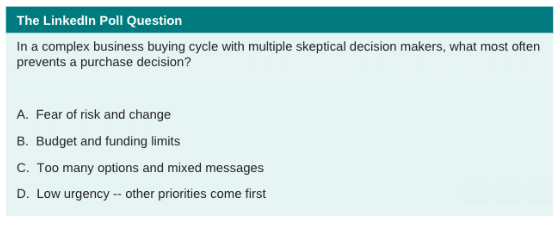
I wanted to test that with data, not just what I was seeing in the companies I advise. So I ran a LinkedIn poll asking business leaders across life sciences, technology, and manufacturing what most often prevents a purchase decision in a complex buying cycle. I then brought those results into my keynote at the Sales and Marketing for Life Sciences conference and collected additional votes from the room. Both audiences ranked the same answer first. It was not budget, too many opinions, or low urgency. What it was, and what it means for how you design your sales and customer experience, is what this episode addresses.
My guest is Andy Bertera, Executive Director of Marketing and Sales at New England Biolabs, a scientist-turned-marketing leader with over 30 years in commercial roles. His buyers are scientists who will keep using the same supplier long after a simpler option is available, because switching means introducing a variable that could invalidate years of their own published research. That is not a niche problem. That is buyer skepticism at its most extreme, and what Andy built to earn trust and grow retention in that environment applies directly to any business working to win over careful, resistant buyers.
What You Will Learn:
- The specific emotional barrier that prevents purchase decisions in complex B2B buying cycles, and why most sales teams are documenting the wrong reason when a deal does not close
- What both a live conference audience and a LinkedIn network ranked as the number one obstacle to a purchase decision, and what that answer requires you to change about how you design the buying experience
- How to identify which of the two instincts a skeptical buyer is operating from, and which one moves them toward a decision
- What one company does to earn trust from buyers who will not write a review, respond to a case study request, or switch suppliers without independent evidence
- Why the touchpoint in your customer journey where the buyer has the hardest time determines whether they return, not the touchpoints that went well
- What happens to cross-functional accountability when every department head sees the complete customer journey in the same room at the same time
- How to tie employee compensation to customer outcomes without building a system where employees optimize for the score rather than the experience the score is supposed to measure
- Where AI produces faster and more accurate customer interactions with skeptical buyers, and where it creates the wrong kind of response at the moment the buyer is closest to committing
Valuable Quotes:
- “Fear is an emotion. A deep emotion. And so many people say emotions don’t belong in business. But fear is driving purchase decisions even in the most analytical, data-driven industries.”
- “You have to design that emotional connection at every single interaction, and that’s where companies miss the mark.”
- “Tie your bonuses and your CX metrics together. However you also have to make sure that no one games the system.”
- “Don’t just measure satisfaction. See if you can actually measure delight, take it beyond the numbers and actually move to that emotional state to leave your customers delighted with that interaction.”
- “Steal with pride. If you see a good idea in another industry, take it, own it and reinvent it for yourself.”
- “Start simple. Don’t try to address everything at once. Pick the smaller ones, the ones that are more meaningful, and then have the feedback loops within that so you can see that improvement and enhancement of customer experience.”
Final Thoughts:
Customer experience is a source of all competitive advantage, but your weakest touchpoint is the one customers remember, not the strongest. Design all of them. For skeptical buyers, data builds the case. And do not stop at measuring whether customers are satisfied. Measure whether they are delighted and other positive emotions.
Listen to the full conversation on the Doing CX Right℠ podcast on Apple Podcasts, Spotify, or wherever you listen. If it is useful, please subscribe and leave a review. It helps more leaders find this content.
Episode Timestamps
- 0:01 — From scientist to marketing leader: how customer feedback led to a career in commercial roles
- 0:03 — LinkedIn poll reveals the real barrier in complex buying decisions
- 0:04 — Why fear of risk and change stops buyers from making decisions
- 0:05 — Scientists as creatures of habit and why switching products feels risky
- 0:06 — Using credible data and curiosity to address buyer skepticism
- 0:07 — Why peer validation and scientific publications build product trust
- 0:09 — The cycle of brand, performance marketing, and customer experience
- 0:11 — Micro moments in the customer journey and why the negative ones matter FAR more than you think
- 0:13 — Combining structured surveys with real customer conversations to capture better feedback
- 0:21 — How AI improves efficiency and effectiveness while human interaction remains essential
Frequently Asked Questions
What does Stacy Sherman say is the real reason B2B buyers do not sign?
Stacy ran a LinkedIn poll at the Sales and Marketing for Life Sciences conference keynote and asked the same question to her LinkedIn network: in a complex business buying cycle with multiple skeptical decision makers, what most often prevents a purchase decision? The four options were fear of risk and change, budget and funding limits, too many opinions and mixed messages, and low urgency. Both the room and the LinkedIn poll chose the same answer: fear of risk and change. As Stacy describes it, the buyer worries the decision could lead to the wrong outcome, and they get blamed if it does not work.
How does Stacy Sherman define the difference between customer experience and customer service?
Customer experience is different from customer service. Customer service is what happens at the contact center. Customer experience covers every micro moment across how someone learns, buys, uses, pays, and gets help. Those are all doorways, and there are multiple micro moments inside each one. As Stacy says directly on the show, you have to design that emotional connection at every single interaction.
What does Stacy Sherman mean by micro moments?
Stacy describes micro moments as the individual interactions that make up the full customer experience: how someone learns about you, buys from you, uses what they purchased, pays, and gets help. Each of those categories contains multiple touchpoints. The weakest one, not the strongest, is what the customer remembers and what drives their next decision. Companies that focus only on the contact center are designing one part of the experience and leaving the rest to chance.
What is Stacy Sherman’s approach to journey mapping?
Stacy recommends bringing every department head into the same room to go through the customer journey as it exists today, with a specific focus on the communication flow because that is where inconsistency creates the biggest problems. Once the current journey is mapped, it gets validated directly with real customers. The process also makes visible the domino effect across every function, from marketing through to the billing experience, so that every department understands how their decisions reach the customer.
What is the customer feedback data problem that Stacy Sherman explains?
Stacy hears three versions of this problem from the leaders she advises: not enough feedback to act on, too much feedback sitting in silos that never reaches the right team, and data that exists but stays within one department. Without feedback, you are flying blind. She works with leaders across all three situations and helps companies to solve each one.
What does Stacy Sherman say about emotions in business decisions?
Stacy pushes back directly on the claim that emotions do not belong in business. Her position is that fear is an emotion, and a deep one, and it is driving purchase decisions even in the most analytical, data-driven industries. When executives tell her emotions are too fluffy to measure, she points to the poll results: the number one barrier to a purchase decision is not price or process. It is the fear of making the wrong call and being held responsible for it.
What does Stacy Sherman say about tying CX metrics to employee bonuses?
Stacy says to tie bonuses and CX metrics together. She is direct about it on the show. She also gives an equally direct warning: you have to make sure no one games the system. How to build that safeguard into the compensation structure is, as she says, a whole other conversation.
What does Andy Bertera say about what kind of data actually converts a skeptical B2B buyer?
Skeptical buyers do not trust data generated by the company selling the product. What moves them is data generated by peers they respect, particularly in published, peer-reviewed form. The approach at New England Biolabs is to build relationships with key opinion leaders in the scientific community and track the citations those researchers publish when they use the company’s products. That citation record functions as an endorsement that puts the science first and the sales pitch second, which is the only order a skeptical buyer will accept.
What did Andy Bertera build at New England Biolabs to stay connected to real customer experience?
Andy set up a system to receive five random customer support transcripts every week, pulled from actual interactions between his team and customers. He reads them unfiltered, looking for the small nuances and specific moments where customers encounter problems that no structured survey would surface. He also runs a brand audit every other year using third-party researchers, so the results are not influenced by internal bias. His view is that balancing structured and informal feedback gives a more accurate picture of the real customer experience than any single measurement approach.
Read Full Episode Transcript
[00:00:00] Stacy Sherman: Welcome to a new season of the Doing CX Right Show. I’m your host, Stacy Sherman, a professional speaker and advisor, educating business leaders how to boost revenue and brand reputation the right way. Too many companies are losing customers and top talent and don’t know why. Well, by listening to this show, you’ll gain valuable insights and precise strategies to close the gap and make experience management your competitive advantage.
I’m diving deep into new research and case studies to help you differentiate your brand in this high tech era. Think of my show as your personal masterclass. By the way, if you’re looking for a speaker at your next event, a content partner or someone to ensure that your team is Doing CX Right. For better results, contact me at Doing CX Right dot com.
Now, let’s get started.
[00:00:57] Stacy Sherman: Hello, Andy. Welcome to the [00:01:00] Doing CX Right show.
[00:01:01] Andy Bertera: Hello, Stacy. It’s great to be here and I should say congratulations on your 200th episode. So, uh, I’m great to be in the the next next hundred let’s say. So
[00:01:10] Stacy Sherman: Absolutely. Yes, it is a big milestone and I’m so excited for my listeners because I’ve got a lot of good special insights and guests like you who, uh, I’m bringing to the show. So, um, let’s start with who can better introduce themselves than yourself. So let’s start there and tell the audience who are you?
What do you do for
a
living?
[00:01:32] Andy Bertera: So, uh, my name is Andy Bertera. I go by Andy, even though, uh, it says, uh, it says Andrew here. Uh, I’m actually a scientist by background, uh, a microbiologist, somebody who studied these very small sort of, uh, bugs, bacteria, viruses and things. Um. I found however, that, uh, I was never really gonna be an acade academic.
Um, I really got a kick out of the more industrial aspects and applied aspects of research. So I moved into industry and, uh, when I was, uh, developing the products that, uh, the company I was working for was selling, I really enjoyed the feedback from customers that were testing out these products and using these products.
So that led me into a [00:02:00] path of getting excited in marketing and, uh, I’ve been in now marketing commercial roles for over 30 years. Uh, I’m in an industry, uh, the biotechnology, uh, industry and a company I work for is a company called New England Biolabs. Uh, we are, uh. Uh, one of the oldest biotechnology companies that actually exist. We’re, uh, 52 years young.
And, uh, maybe just to simplify it for your, uh, uh, listeners here. Uh, We are often described as the office depot of DNA. So DNA is that, uh, molecule that, uh, maybe familiar with at the center of cells that, uh, passes information from one generation of cells to the next. Unlike Office Depot, which sells obviously, uh, uh, glue and photocopiers and scissors to manipulate paper.
We do the same, but, uh, to manipulate DNA, so we have scissors, enzymes that’ll cut DNA in specific, uh, species. We have molecular glues that’ll stick DNA back together as well as enzymes that’ll actually copy DNA. So our customers are scientists in, uh, universities, sciences, in pharmaceutical companies that are actually using, uh, these, um.
Uh, to tools to actually study disease, whether that be, uh, cancer or neurodegenerative diseases or the [00:03:00] like. I work at the company, uh, New England Bio Labs. I’ve been here for 16 years. I head up, uh, marketing, uh, globally. Uh, I also, uh, head up the US sales team and US customer support teams. And what I really like about that is it gives me, as I say, three quarters of the touch point with a customer, uh, the other quarter being, uh, technical support.
So I get that real nice overview of all the, uh, interactions with that customer.
[00:03:13] Stacy Sherman: Yeah.
I wanna highlight for my listeners who are not in this industry, this absolutely applies to you because you probably have skeptical buyers. And so even if they’re not scientists, they’re certainly hard to convince them to buy, buy again and refer. And we’re gonna dig into that a lot more.
[00:03:34] Andy Bertera: Definitely.
[00:03:35] Stacy Sherman: So when we met, uh, I was fortunate to be a keynote speaker at the sales and marketing for Life Science event in December.
And when I was speaking, I had launched a poll on LinkedIn. and I talked about it from the stage and then we, we had a great conversation in the room, and I wanna discuss that for a moment because there’s really good insights from, from that small little poll. Um, [00:04:00] and it proves an important point. So the question that I had asked on LinkedIn at first was, I said,
in a complex business buying cycle with multiple skeptical decision makers, which is life, science, technology, manufacturing, what most often prevents a purchase decision. So there were four answers. I’m gonna say them out loud and then we’ll talk about the, the most common answer that was both on LinkedIn and in the room. So, A was fear of risk and change, meaning the buyer worries, the decision could lead to the wrong outcome and get blamed if doesn’t work. B, budget and funding limits. The buyer does not have the money or approval needed to move forward. too many opinions and mixed messages, meaning the buyer’s given so many similar choices, they just can’t confidently pick one.
And D, low urgency. The buyer doesn’t view the purchase as important right now, and other priorities come first. [00:05:00] when I shared that the room and poll answer. Was a,
the
fact that there is a real emotion here, fear of risk and change, the buyer worries, the decision could lead to the wrong outcome and get blamed if it doesn’t work.
What do you think about that being the common answer? Does that match what you see, uh, where you work?
[00:05:24] Andy Bertera: Very much so as I highlighted, uh, our customers are scientists, and scientists are definitely creatures of habit. Uh, in fact, um, we joked a few years ago when we were reanalyzing our customer journey, that the most typical journey for a customer by a scientist buying products and our products are stored in, in coal.
So they, they go to the freezer. The customer’s journey is, I go to the freezer, I open the freezer, I look at the vial at the tube that the, the product’s in. You see, it’s nearly empty. They read the catalog number and they reorder it. Um, so really, you know, it’s a very simplistic, uh, uh, journey. And the reason that is, is I said customers, uh, sorry, scientists are creatures of habit.
Uh, they’ve been using these products in workflows and [00:06:00] experiments, uh, that they know work and therefore they don’t really want to change it. They publish data on this. They have a lot of historical data using that same product, and they’re concerned that if they change that product. It’s going to, you know, maybe change the results they’re getting and all that history they have will no longer be valid.
So that fear of change definitely exists in scientists.
[00:06:18] Stacy Sherman: Fear is an emotion. A deep emotion, and so many people say to me, Stacy, emotions don’t belong in business. It’s too fluffy and we can’t measure it. So what do you say to those buyers and those skeptics?
[00:06:31] Andy Bertera: Yeah, great question. Well, scientists really have two qualities, you know, um, uh, they’re skeptical, uh, which sort of, uh, leads into that sort of fear of change a little bit. But they’re also inquisitive. And those two things are very interesting in that they, uh, you know, they’re both sort of, uh, you know, human emotions at the end of the day.
And although scientists are certainly very logic, that sort of human aspect is something you can actually play off. particularly the inquisitive aspects. So. If you have a new product, customer may be skeptical as to, uh, whether it, uh, will work or not, but they’re also inquisitive, so they actually wanna learn more.
So if you [00:07:00] can actually put data in front of them and actually challenge their sort of human emotion to uh, uh, to start to think, well, maybe I should look at this, maybe I shouldn’t. That inquisitive aspect they’ll take over and if you provide them the tools to actually test it, they will test it.
[00:07:13] Speaker 3: So you talked
[00:07:13] Andy Bertera: Can I one minute, Stacy.
Something’s pinging every now and again. Do you hear that?
[00:07:13] Speaker 3: Now.
[00:07:13] Andy Bertera: Maybe it’s just, I think it’s my, I wonder it’s my email coming in, but if you can’t hear it, that’s okay.
[00:07:13] Speaker 3: Okay. Okay. So yeah. So you mentioned that data is a way to convince them. What kind of data do skeptical buyers need to be right to get them from No, I don’t think so. Fear to, yes.
[00:07:26] Andy Bertera: Great question. I think in our industry particularly, um, scientists like to see data not generated by the company that produced the Product. Yeah, that data obviously is a good starting point, you know, and it gets Maybe, Uh, their sort of inquisitive juices going. But what they really like to see is data generated by their peers, particularly peers they actually look up to.
So if there are key opinion leaders, as we call ’em, or experts in a certain scientific area, if you can build relationships with them and have them publish ideally in scientifically peered review journals, that data then becomes more valid. But ultimately the [00:08:00] customer still needs to prove it for themselves.
So providing a sample or a way for the customer to actually test that product out so they can generate the data themselves, then takes it over the edge for them to actually purchase that product.
[00:08:11] Stacy Sherman: So in a way I hear you say there’s influencers in the industry that make a difference because they’re trusted sources. And I love hearing that ‘ cause I’m an influencer,
[00:08:22] Andy Bertera: Ha.
[00:08:22] Stacy Sherman: but also it comes to ratings and reviews and Trustpilot and uh, better Business Bureau and Yelp, et cetera, where does that come into play?
[00:08:34] Andy Bertera: It’s a good question. I mean, in our industry, um. For the most part, scientists don’t actually like to make recommendations for products overtly, you know, they, they don’t fill in this, you know, it’s a five star product or, or even write reviews for the, for the, uh, for the most part, there are a few exceptions, but for the most part they don’t.
But the way they actually accomplish it is through their publications. So when a scientist actually publishes their scientific work, their breakthrough in cancer, their breakthrough in, uh, whatever it might be, they’re studying, they actually will list the suppliers of the products they actually use to [00:09:00] generate that experiment.
So they do it through this sort of, uh, um, you know, science first, but you read the detail and you can see how they actually carried out that experiment, how they actually did that research. And that publication then provides a way for their, uh, sort of, uh, uh, audience to actually repeat that experiment.
So they recommend it in a sort of you know, reverse way. In some cases. So in our case, as a, as a supplier, what we will do on our products is list those publications or citations as we call them, to say, scientist X, uh, you did this cool experiment, by the way, using our product. Scientist y did this cool experiment, by the way, using our product.
So it’s a sort of way of, of, uh, having endorsements for the product, but always putting the science first.
[00:09:36] Speaker 3: Yeah. All right. During our conversation, you described a cycle and you talked about brand performance and customer experience feeding each other.
Can you share a bit more about what that means and applying this cycle in any business so customers come back and speak positively of the brand.
[00:09:54] Andy Bertera: Great. Yeah, great. Great comment. It’s something I’ve been sort of thinking more and more about, particularly as the world’s become more digital. I. To me, [00:10:00] the basis of all marketing, and in fact, all business really comes down to that brand. Your brand is what customers perceive as your values. It’s what, how they see you differently from your competition.
And if you are selling a new product, for example, and the customer doesn’t know who you are or know what your brand actually stands for, it’s a much harder sort of, uh, uh, discussion to have with them to convert them to that new product. So to me, brand is a sort of foundation from which you build. Uh, One of the things we do uh, every other year is a brand audit.
We go out to as many customers around the world as we can to actually collect feedback to say, do they still believe that we are the same company? Do they see us in the same way differently to our competition? And that is an important foundation to build from. The second sort of part of this uh, uh, this sort of cycle, then we call it performance or performance marketing.
This is really the active, uh, uh, process of engaging with the customer, marketing to them, selling to them, uh, going back earlier, that sampling process, for example. And I think the key part of this, uh, is really making sure that all your communications are consistent consistent. with your brand, of course, we’re all consistent across the different sort of, uh, messaging [00:11:00] channels.
You know, sales and marketing truly have to be joined at the hip and making sure they say the same things with the same supporting information. Then once you’ve actually, uh, moving to past that sort of performance stage, the last part is then the customer experience. I’m a great believer in customer experience.
I believe it’s the actual source of all competitive advantage and really that customer experience is really what the customer will remember. That’s how you. Tying them emotionally to you as a company and to eventually to your brand. And hopefully if they have the good experience, that then fosters or sort of comes back into your brand, strengthens your brand and the cycle starts again
so there really are sort of three things that come together, which, you know, customer experience is a core part.
[00:11:35] Stacy Sherman: I wanna emphasize the part about customer experience that what people don’t realize is there are so many micro moments.
[00:11:46] Andy Bertera: Mm-hmm.
[00:11:46] Speaker 3: Of that experience. So how someone learns and buys, get, use, pay, get help. Those are doorways and there’s lots of micro moments in that, so, right. So in [00:12:00] customer experience. It’s different than customer service where that’s just the contact center per se, but the customer experience.
So you really have to design the, that emotional connection at every single interaction, and that’s where people miss the mark.
[00:12:17] Andy Bertera: I a hundred percent agree with that. As I said earlier, I really do believe customer experience is a source of all competitive advantage. But the key to it is you have to look at all of those micro moments as you highlight, you know, looking at all aspects of your, uh, customer’s buying journey.
And unfortunately, what you find is the weakest moment is usually the one the customer unfortunately remembers most, not the actual strongest one. So you really have to look at all of them. I often. Often, uh, describe this with, uh, some of, some of my team and colleagues at New England Bio Labs to say, you know, firstly, you know, if the customer can’t find the product on your website or through an interaction, they’re not gonna buy it.
And they have the expectations that your website’s gonna be as good as Amazon’s just ’cause That’s the, that’s the sort of benchmark when they purchase that product. If you’ve packaged it in one of [00:13:00] those horrible. You know, plastic clam shells, and you end up, the customer cuts their finger opening it.
That’s not a good experience. They’re not gonna buy the product. And then if they have a challenge and they, they need to contact somebody, a call center, and they get hung up, uh, having to press, you know, 14 different buttons before they can speak to somebody, they’re not gonna buy it again. And all these touch points make up that, that total experience.
And as I said, unfortunately, it’s always the weakest one that, uh, trips you up.
[00:13:23] Stacy Sherman: Yeah, it’s, it leaves a lasting imprint in your mind, and that’s what you tell others. And I think people really need to understand that and, and I can’t emphasize that enough. Um, you talked about feedback collection in the audit. That is so important and I think that people miss that in, they only look at, for example, surveys, but it’s so much more than surveys.
What are some of the ways that you find feedback collection and also making sure that it’s used to drive strategies?
[00:13:57] Andy Bertera: Yeah.
great question. I’m a great believer, you know, being a [00:14:00] scientist, I guess, uh, I have a sort of experimental mindset, so I actually try and apply experiments and thinking through, uh, everything we do really in that sort of, sort of mindset to collect data and then see how you can use it. So, as I said, we do do, uh, you know, an audit of our brand every other year.
Uh, that’s obviously, uh, a very important touch point for us. But, but it is actually controlled by us, so it’s. Is biased in some, some ways. We also use third parties to actually ask questions for us. So it looks a little bit more, um, independent, let’s say. But I actually find some of the best feedback is that anecdotal feedback.
You know, when I’m visiting a customer, I can ask them one-on-one, what can we do better or what, or things like that. One thing I’ve also found very useful, and this is uh, uh, more qualitative than anything is. I ran, I’ve set up our, our sort of systems to randomly receive, five interactions a week between our customer support team and a customer.
And I look at the transcripts and they’re totally random and it’s, it’s, you know, partly obviously just to see how we’re interacting with them, but also to see how the customer’s responding to those interactions. And although it is random, you pick up these sort of. You know, tiny nuances or [00:15:00] different ways you could even say a certain word or, or convey a different message, that means that interaction can get stronger next time around.
So I try and balance the, the more, let’s say, uh, structured, uh, feedback with the less, uh, less structured informal feedback to get a real impression of how we can improve ourselves.
[00:15:15] Stacy Sherman: I am glad you’re doing that. It’s so important. Otherwise, PE you’re flying blind.
[00:15:20] Andy Bertera: Yes.
[00:15:20] Stacy Sherman: Without feedback. Now, some people say to me, Stacy, well, we have so much feedback. We actually have data silos that we don’t even know how to use that and understand our customers. Others say, we don’t have enough data. Others say, we’ve got it, but it never reaches my department because it’s staying in one team.
And so for all of that. I highly recommend that people call me because I really understand that problem and I have partners who, um, I think as you said, it can be biased if you’re only using your internal team to get customer feedback. And so as [00:16:00] an objective, person, I can help with that. So I wanted to make sure anyone listening who’s like, where do I start?
Give me a call. Alright, right, so now in terms of, this is the Doing CX Right show, not the thinking and pondering. So what would you say to people listening who want to get through skeptical buyers and build that loyalty and that brand preference? What are some things they can literally go do?
[00:16:24] Andy Bertera: I think, um, there’s a number of aspects to this. Um. Uh, you know, as I said, I, I truly believe customer experience is the key. And I think as we were just, just describing, analyzing that customer feedback to me really is the, is the guide or the, the roadmap, if you like, that you can actually build from.
So as you think about your customer interactions, as you think about the different, uh, journeys that your customers go through in terms of the interactions with you as a supplier or you as their sort of. Uh, a provider of a service or whatever you do, really think about how you can get feedback from each of those touch points.
And then cumulatively you can build a plan and some, and start simple. You know, don’t try and boil the [00:17:00] ocean. And so as they speak, uh, uh, to try and address everything. Pick on the small ones, the ones that are sort of more meaningful, and then have the feedback loops within that so that you can see that improvement and that sort of, uh, uh, um, enhancement of your customer experiences.
So to me, it’s, it’s building in those sort of, you know, that, that analysis, uh, feedback and action loop into each other, sort of, uh, interactions that you have with a customer.
[00:17:18] Stacy Sherman: Now, what do you do when you have different teams with different goals? How do you get them to all get aligned because they’re so focused on their their lane,
[00:17:28] Andy Bertera: Mm-hmm.
[00:17:28] Stacy Sherman: right? I’m curious to hear. I know my answer. I’ll go after you.
[00:17:32] Andy Bertera: Um, to me, there’s a couple of elements to it. I mean, I think at, um, new England Bio Labs, our, value proposition is centered around customer intimacy. And I, I put that up first because I truly believe that actually helps us to actually get everybody aligned behind a sort of common goal and a common, um, um, directive
we’d like to support our customers. Our values, the corporate values then actually help to actually put that in place. So our corporate values, uh, number one, a passion, uh, is passion for science, uh, being scientists. But in the commercial world, it’s for our customer’s science. [00:18:00] So we’re trying to actually align our values where our customer’s needs are.
Secondly, it’s humility. It’s not about us, it’s about the customer. And secondly, it’s being genuine. And what I mean by that is, you know, we talked about human interactions a little bit earlier. We have to basically, uh, remember that we’re dealing with humans and they may have questions that go beyond, you know, us as a supplier, but we still gotta try and help them or point ’em in the right direction.
So we believe even if they’re not using our product, we’ll try and actually help them. And then that builds a relationship and maybe they’ll buy our products from, from us in the future. But aligning everybody behind the same core values, I believe is the key to actually achieving that sort of unanimity and focus on the customer.
[00:18:37] Speaker 3: Yes. People also, you’re talking about culture
[00:18:40] Andy Bertera: Mm-hmm.
[00:18:41] Speaker 3: and part of the culture is really getting everybody across every single role from CEO to intern, that you have a need to be accountable for customer experience and help them understand that. ’cause a lot of times people are like, Stacy, no, I don’t touch the front line.
I don’t talk to the customer. I’m not in that role. And I said, let’s sit [00:19:00] down. Let me explain to you how you do.
[00:19:03] Andy Bertera: exactly right. I mean, it’s, it’s, it’s a very good point because I, I, I actually, um, you know, uh, most of my role, uh, my, my sort of, uh, job history has been in marketing, but I really think of marketing with a small m not a, not a large m in that everybody in the company is actually marketing, because whether it’s, uh, the person on the front desk who greets somebody every day, you know.
That could be the first impression that a customer has with a real person. You know, it can be, as we said, people on the telephone. It can actually be people in the warehouse who’s actually packaging those products. You know, if they do a, a, you know, a poor job at packaging that product, that could be the first impression the customer has of you as a brand.
So everybody is actually marketing. Everybody is actually influencing that customer experience.
[00:19:38] Speaker 3: Yes, so another tactical suggestion for those listening in any industry to gain that alignment, get everybody to own that customer experience role is what you talked about journey mapping before is have the different department heads come together, start with them in a room, and literally walk through the customer journey.
What is [00:20:00] it today? map that out, especially the communication flow. Because we know that that is inconsistent and a huge pain point. Map that out and then go validate with real customers that what you’ve designed is what they want. The other thing that that does is make sure that everybody understands the domino effect from those who manage the learn marketing to the buying experience, finance, and paying your bill like everybody understands.
So journey mapping and journey management is so powerful, and I’m glad brought that up.
[00:20:36] Andy Bertera: Yeah, a hundred percent. Uh, one other thing I maybe add to the conversation that uh, maybe a little bit unique to to New England Bio Labs is that, uh, uh, we incentivize people on a, on a sort of profit sharing scheme. And what we try communicate to people, you know, is that, you know. Your incentive, you know, your, you know, your, your bonus if you like, is actually based on how profitable the, the, the, the business is.
And that means every customer’s gotta be happy in buying from you. So if you, uh, actually do not deliver your, your component, however small you might think it is in the, in [00:21:00] the overall interaction with the customer, it does have an implication. And then your good analogy, then that domino effect sort of, uh, uh, you know.
Uh, occurs and effectively you’re taking money outta your own pocket if you don’t sort of, uh, live up to your, your part of the, uh, the process.
[00:21:11] Speaker 3: So are you saying to tie customer experience metrics to bonuses?
[00:21:18] Andy Bertera: I think so, yes. And, and in, and it’s, um, and you know, you know, it may not be immediately evident how those things are connected, but when you educate people as to the importance of their role and the importance of their particular activity and how that does either. Immediately or indirectly have an impact on the customer.
Then they start to connect the dots and say, you know, I need to start thinking about this from the customer’s perspective, not just my perspective.
[00:21:40] Stacy Sherman: So those listening. Tie your bonuses and your CX metrics together. However, you also have to make sure that no one games the system,
[00:21:49] Andy Bertera: Yes, very good point.
Yeah,
[00:21:50] Stacy Sherman: and that’s a whole nother show.
[00:21:53] Andy Bertera: totally. Totally.
[00:21:55] Speaker 3: So before we come to the end, I have to bring up, of course, ai, [00:22:00]
[00:22:00] Andy Bertera: Oh
[00:22:01] Stacy Sherman: how is that affecting marketing and sales and customer experience in your mind and skeptical buyers?
[00:22:09] Andy Bertera: Good question. I mean, I’d be wrong to say I got all the answers ’cause I clearly don’t. I’m sure there are people Um, you know, much smarter than I in this context that, uh, have taken this further. I look at AI very simply in two categories. Uh, efficiency gains and effectiveness gains, efficiency gains, uh, to me are
are there ways that, uh, if you are interacting with a customer, you can use AI to interpret the question the customer’s asked, and rather than just have a robot replaced it, you know, all the information is put in front of the person, uh, to actually help them to answer the customer’s questions as quickly as possible and hopefully as effective as possible.
So, tools like that, we’re starting to use so-called knowledge base sort of systems, which are proving to be very helpful. Um, in terms of the effectiveness aspect, I think the, the opportunities there are to use the data that you have about your customers and use AI to think about how you can improve the interaction with the customer based on the specific needs.
In our case, you [00:23:00] know. Most scientists, we don’t really sort of think of it from the perspective of age or um, you know, certain personal preferences. It’s really their research they’re doing. So, I’m focusing on or talking to a Dr. Smith. I know they’re a cancer biologist. I know they work in this university.
I might know these. These products, so I can tailor the messaging and tailor the communication based on those information. And AI can help you to pull that together, uh, by, you know, mining the publications that I mentioned earlier as an example. So efficiency and effectiveness, I think are the two opportunities.
The only caveat I would argue to this, and I think this is becoming more and more evident, is that even with the best AI in the world, you still need that human interaction. And I think that is actually the key to actually addressing, uh, you know, these skeptic buyers. Because although, you know, AI can actually help interpret data and provide data, uh, to customers, you’ve still gotta put it in the context and they gotta know where that data actually comes from.
And I’m, I’m sure you’re very familiar with the stat that. Greater than 70% of the buying journey is complete before, uh, you know, a, a buyer will actually talk to a [00:24:00] prospective supplier, you know, even if that’s, uh, uh, uh, correct or slightly different from, from your own industry and experience that opportunity to interact with the customer,
that human interaction is the key to actually building that, uh, that relationship. And the key, I think, to, uh, customer experience regardless of where AI goes.
[00:24:16] Stacy Sherman: All right, rapid fire questions as we come to the end. Leadership. What is the best leadership advice you’ve ever received or given?
[00:24:24] Andy Bertera: I will give one that, uh, somebody told me. And, uh, they use the expression steal with pride and what they actually meant, and it’s probably the best lesson I’ve had in marketing, was that if you see a good idea in another industry. Take it, own it and reinvent it for yourself. Um, you know, you know, there are very few ideas that are truly new and, and never been thought of before, but you can reinvent a lot and I think that’s really exciting.
[00:24:47] Stacy Sherman: Yes. And 20-year-old self. If you could go back in time to your younger self, what would you tell the younger Andy?
[00:24:54] Andy Bertera: Great question. I mean, I guess you use this. This was actually a training course I went on with the Center of Creative Leadership and. Just jump into the, to, to the, to the conclusion. You get [00:25:00] feedback at the end and the feedback I got from the, uh, the trainer was on Andy’s, uh, gravestone. It will say, Andy Baterra, rest in peace, if only I’d said that.
And that’s the feedback. Speak up, ask questions, use it as a learning moment. Usually the pe other people in the room got the same questions. For whatever reason, I, at that, uh, age, I was a bit more introverted. I wasn’t willing to speak up. I thought the, uh, the peers in the room knew more than I did, and they all, they had the answers, but very often they don’t, and the questions generate much better solutions.
[00:25:27] Stacy Sherman: And the last thing, what do you want people to remember about our conversation and selling marketing, driving loyalty with skeptical buyers? What’s that one takeaway?
[00:25:39] Andy Bertera: I am not giving you one. I’m gonna give you a summary of one, if that’s okay. But I would say, remember, customer experience I truly believe is a source of all competitor advantage. Sadly, your weakest, uh, touchpoint, uh uh, unfortunately is the one that customers remember in the customer journey. So you’ve gotta focus on all of them.
Skeptical buyers data is the key. Uh, data will actually help to convince customers that, uh, you know, your products are worth it. So build that [00:26:00] into your brand. And I’ve had to say something about, uh, measuring things. Uh, we touched on this a little bit. Don’t just measure satisfaction. See if you can actually measure, delight, take it beyond the, the numbers, and actually move to that sort of emotional state to leave your customers delighted with that interaction.
[00:26:15] Stacy Sherman: A hundred percent. Exactly. Well, thank you so much for being here today and I’ll have all the information about you in the show notes so people can reach out. I know they will, and I appreciate you being on my show.
[00:26:28] Andy Bertera: My pleasure, Stacy. I’ve really enjoyed it.
[00:26:30] Speaker 3: Thank you. I.
[00:26:31] Speaker 2: Thank you so much for joining today. I hope you’ll take what you’ve learned and put it into action because it’s about Doing CX Right, not just talking or thinking about it. If you found this valuable, leave a review wherever you listen to podcasts as it helps others discover this show. And continue learning by subscribing to my newsletter and scheduling time with me to discuss anything on your mind, reach out at Doing CX [00:27:00] Right dot com.
Thank you again to be continued.
Press Play To WATCH On Youtube
About Andrew Bertera
Andy joined New England Biolabs (NEB) in 2009, having previously worked in a variety of R&D, marketing, and senior management positions at Amersham, GE, and Promega. As Executive Director of Marketing and Sales at NEB, Andy is responsible for the development and implementation of NEB’s marketing strategies and tactics across its entire product portfolio. Andy also oversees its US Sales and Customer Support activities and organizations. His role at NEB involves the direct management of the Customer Support, marketing, and sales professionals, covering the disciplines of market research, product management, channel and order management, US sales, digital marketing, and scientific and marketing communications. Andy is also the NEB representative at the Analytical, Life Science & Diagnostics Association (ALDA) Executive Management Meetings and a Board member of the Sales and Marketing Professionals in Science (SAMPS). Connect on LinkedIn
About Stacy Sherman:
Stacy Sherman is an award-winning international keynote speaker, author, and Customer Experience advisor with an MBA and 25+ years leading sales, marketing, and CX initiatives for brands like Verizon, AT&T, Schindler Elevator Corporation, Wilton Brands, Martha Stewart Crafts, and many more.
Drawing on practitioner experience in these roles and academic background, Stacy created the Doing CX Right methodology, educating companies to boost revenue and brand reputation by creating positive experiences at every interaction.
Stacy has delivered 100+ standing ovation speeches and workshops, hosts a top 2% global podcast with 200+ episodes, and is a Certified Professional Speaker (CSP) and ICMI Hall of Fame Inductee. Her insights are featured in Forbes, Psychology Today, Yahoo News, and more.