
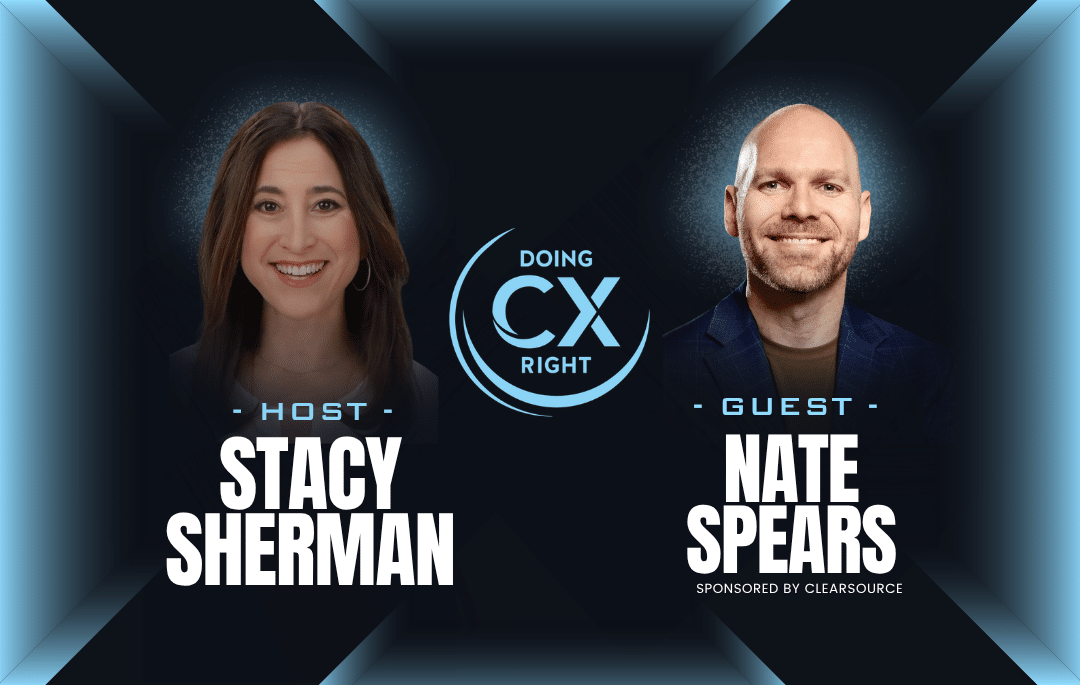




Most companies think investing in the latest technology will set them apart. While AI handles simple, routine inquiries, Nate Spears of ClearSource explains why software alone fails to deliver: everyone now has access to the exact same tools. As automation takes over basic tasks, frontline agents are left to manage complex, stressful customer interactions that require genuine human skill.
So what actually separates companies with deeply loyal customers from those relying on the same equipment as everyone else?
In this episode of Doing CX Right, you’ll learn 5 practical strategies to attract top talent and strengthen your frontline. This episode is for any leader who wants to build the ultimate leadership advantage AI cannot replicate: a winning culture that inspires people to give their best because of how you lead them.
Episode Chapters
[01:35] Defining Doing CX Right through the employee experience lens
[03:39] AI call deflection technology and the rising complexity of remaining calls
[05:08] The five-part formula for building winning teams
[07:38] Aligning the organization on one scorecard to unify goals
[08:21] Reframing average handle time around customer respect, not just speed
[09:28] How KPIs get weaponized, and the check-engine-light alternative
[12:00] Using NPS and verbatim comments to find the root cause of dissatisfaction
[16:02] The Farmer’s Dog story and the definition of discretionary effort
[17:30] The “who is my customer” question applied internally
[22:15] “Everybody has the same equipment”: why winning teams are the real differentiator
Actionable CX and Leadership Takeaways
- Start hiring differently this week. Replace “tell us about your greatest achievement” with “tell me about a time you worked hard for something,” and “tell me about a time you got feedback you did not like.” Listen for humble, hungry, and smart. Then promote the people who exhibit these traits and remove those who set a standard of mediocrity.
- Audit your environment for friction. Walk through the policies and processes your team interacts with daily. Which ones make their job easier? Which ones make it harder? Pick one policy or process that is creating friction and change it this week. Then ask your team what else is in the way.
- Reframe one metric. Pick your most feared KPI, probably handle time. Sit down with your leaders and answer this: What is the right amount of time to actually help this customer well? Make that your target. When someone misses it, ask what got in the way instead of why they broke the rule.
- Measure feelings at key moments. Start asking customers one question at three specific moments in their journey: how do you feel right now? Track the trend. You will find the actual problems, and they will not be where your current metrics point.
- Model discretionary effort for your team first. Commit to one one-on-one per week without canceling. Show up early to solve a problem one of your people is facing. Demonstrate what discretionary effort looks like before asking them to give it to customers.
- And more as you’ll hear in this episode.
Press Play To WATCH On Youtube
Read Full Episode Transcript
[00:08] Stacy Sherman: Hello, Nate. Welcome to the Doing CX Right show
[00:12] Stacy Sherman: I am so glad that we got to connect in person at a wonderful event that your team led, and we spoke, and so there’s so much to unpack there. But before we do and some of those lessons, can you share a little bit of who are you? What do you do for a living?
[00:28] Nate Spears: Great question. You [00:30] know, I started my career when I was sixteen. I used to do outbound cold call telemarketing, and a lot of people hate that work, but I loved it. I was on the phones for about eight years before I joined a vendor operations management team, and then a few years later started ClearSource, which is a business process outsourcing company.
[00:50] Nate Spears: Been doing that for eighteen years, and for the company, I spend a lot of my time in leader development and coaching, um, but I’ve just loved growing the organization.[01:00]
[01:01] Stacy Sherman: Well, I had worked at a BPO, so I know what that means. And for those that are not familiar, when you’re calling a company and you’re talking to customer service, sometimes it’s in-house and sometimes they outsource it because they have so much volume, uh, or peak moments, uh, holidays, for example. And so, uh, it’s a really important business function. So Nate, this is the Doing CX Right show. I wanna start off by asking you, Doing CX Right, [01:30] doing customer experience right, what does that actually mean to you?
[01:35] Nate Spears: Um, I have lots of thoughts, but I’m gonna try and focus on this idea of the employee experience, and there’s a really great quote that I like by Richard Branson. He said, “Train your people so well that they can leave, and then treat them so well that they would never want to.” And I’m a big believer in treating your people so well that they love what they’re doing, they’re giving discretionary effort, and they’re taking [02:00] care of your customers
[02:01] Stacy Sherman: So connect the dots a little bit, because I do believe that there’s no customer without an employee who’s feeling fulfilled. But what makes you so passionate about the employee experience as the connective tissue to the customer experience?
[02:18] Nate Spears: In this industry, a lot of people have the sense that they’re being treated like production machines. You know, at a BPO, every minute is monitored and measured, and they have [02:30] these, uh, three strikes, you’re out attendance policies. And growing our organization, I realized that when people feel that way, they’re just gonna do the bare minimum to avoid getting fired, and in some circles, that’s quiet quitting.
[02:43] Nate Spears: I realized that if we created an environment where people would truly feel like they wanted to give discretionary effort or to go above and beyond, that that had a lot to do with their leaders and the company policies and how they feel supported. And recognizing that [03:00] that decision to really take care of a customer or not, that’s an emotional decision more than anything else.
[03:05] Nate Spears: I realized that if we could create that kind of environment, we would see those results
[03:09] Stacy Sherman: Hmm. Yeah, I’m a big believer in the feelings that humans go through and the experience and how that is so important, not just the transactions that often occur. But
[03:21] Nate Spears: Mm-hmm.
[03:21] Stacy Sherman: let’s go further into challenges. It sounds so intuitive. Of course, if you have a great employee experience, the [03:30] rest will take care of itself.
[03:31] Stacy Sherman: Yet, in reality, that’s not happening enough. So what do you see is the biggest challenge that companies are facing today?
[03:39] Nate Spears: Yeah, right now I think with the proliferation of artificial intelligence technology, we’re seeing a massive shift in the way work is done and in the way people feel even about their work. Uh, I mentioned earlier I started my career when I was sixteen, so I’ve been in this industry now for thirty-two years.
[03:57] Nate Spears: And as I look back, one of the things [04:00] that I’ve noticed is there’s this pattern of new call deflection technology showing up, siphoning off the easier calls, and leaving the harder calls for agents to handle. So to give you maybe some numbers, I would say if we go back twenty, twenty-five years, an agent during their typical shift might have one or two challenging calls, complex calls, angry callers.
[04:26] Nate Spears: Today, I think that number is more like eight to ten. And so [04:30] as they’re dealing with more and more of these challenging calls, because the easy stuff is being handled by chatbots and other call deflection technologies, we’re just seeing a lot of shift in what’s needed for an agent to have the capacity, the skill set, everything they need to continue to create those amazing customer experiences.
[04:48] Nate Spears: And so as the agents start suffering, so too do the customers.
[04:53] Stacy Sherman: Well, agent experience, and I would say all frontline experience, it’s stressful, and some jobs it’s [05:00] really monotonous. So how do you actually, in your opinion, create that environment where they, they wanna be there?
[05:08] Nate Spears: Yeah. Uh, Uh, you know, Stacy, for us, it’s really focusing on five key areas. Uh, we’ll start off maybe with selection. Uh, we’re a big believer in the concepts outlined in Patrick Lencioni’s book, The Ideal Team Player. So we’ll just start there with humble, hungry, and smart. Uh, then we look at upgrading leadership.
[05:25] Nate Spears: And so are we selecting, developing, and if [05:30] needed, letting go of leaders in accordance with our core values? After that, we look at what are the things that we need to do in order to earn that discretionary effort, which I define as the effort that someone chooses to give that’s above and beyond the bare minimum required to avoid being fired.
[05:48] Nate Spears: And then it’s all about creating that environment. I kind of look at my job like a gardener. You know, to a gardener is a, a seed is a seed is a seed, and whether that seed thrives is a function of the environment, soil [06:00] quality, moisture, heat. I’m responsible for the environment that determines whether or not our people thrive.
[06:06] Nate Spears: And then lastly, of course, I know people call it a hygiene factor, but compensation has got to be good enough. You know, if you’re gonna have top-tier people, gotta have top-tier comp. And so we look at all of those things in terms of, uh, a formula for what we call building winning teams.
[06:22] Stacy Sherman: Hmm. Well, what’s the difference between a winning team and a winning company from all the [06:30] different companies out there? Like, what are you seeing that it, it sounds so intuitive, but yet we know the experience it’s not the same. In fact, many companies are creating more frustration and we’re talking about it.
[06:42] Stacy Sherman: We’re going online. We’re writing we- bad reviews. And, and so it sounds so simple, but it’s not
[06:47] Nate Spears: No. Now, like you just said, with the reviews, you know, anybody can go out to Glassdoor and get a sense for what people really feel about the organization that they’re working for. I would also say that as we look [07:00] at what the key differentiators are, it’s showing up in attrition, absenteeism, customer satisfaction scores, employee engagement scores.
[07:08] Nate Spears: And so the first challenge I think that a lot of organizations have is, are they putting tools in place that allow them to effectively monitor and understand the root causes of the key drivers of those numbers? So if you don’t know what’s driving people out, then you’re not going to be able to do anything to fix it.
[07:28] Nate Spears: And so I think first and foremost, it’s [07:30] understanding from a scorecard perspective how you’re actually performing if you want to be able to answer the questions of what’s getting in the way of great performance.
[07:38] Stacy Sherman: I believe a scorecard is essential and everyone across the organization has to be looking at the same scorecard, ’cause they often don’t. Um, the question is And I need to pause ’cause I lost my thought. Eight minutes and 48 seconds. Shoot. My scorecard. Um, oh, yes
[07:41] Stacy Sherman: So the scorecard is really important, and everyone needs to be looking at the same scorecard to unify goals and create that better culture. The reality is that a lot of scorecards are doing the opposite of creating that peak moment, those, positive emotions with a brand. In other words, it’s [08:00] hurry up, get off the phone with the customer versus the Za- the Zappos way of however long it takes until they’re really happy, you stay with them.
[08:09] Stacy Sherman: So h- what’s your advice to all these companies that are working towards efficiency and speed and hurry up and cost, costs, you know, getting those, uh… Start over. And costs that are the focus to remove from the business
[08:21] Nate Spears: I think it’s understanding, Stacy, the core philosophies that are driving the KPI. So you mentioned Zappos, and we’ve all heard stories of [08:30] the Zappos CSR that stays on the phone for eight hours to really get to know somebody and feel like they’ve made a friend. And I love those stories as much as anybody else.
[08:40] Nate Spears: I also recognize that there is value to the customer in minimizing the time and effort that they have to spend to get an issue resolved. And so if I’m looking at something like average handle time, what I’m really trying to figure out is what’s the right amount of time to create an amazing customer experience, not just for [09:00] efficiency, but out of respect for what the customer would ask for if they had a voice in the conversation.
[09:05] Nate Spears: And so then that allows you to benchmark, right? If you were to go through and say, for instance, what is the average customer satisfaction score by average handle time? So you might say, well, everybody that gave us a hundred percent, those calls were about eight minutes. Well, now I know that I can deliver a hundred percent customer satisfaction score on average with calls that are eight minutes.
[09:28] Nate Spears: But how do I address that with my [09:30] team? Some people, if they don’t understand the philosophy behind the number, will weaponize those KPIs in order to drive performance, and they use fear in order to get people to comply with their desired targets. What I like to do is I like to think of it as more like the check engine light on your car.
[09:47] Nate Spears: If the check engine light is on or a KPI is being missed, then that’s an opportunity to dig deep and figure out what’s getting in the way. And I think if we start to look at it from a place of curiosity and what [10:00] we can do to help the agent be successful rather than weaponize those KPIs, it makes a huge difference in that agent’s experience.
[10:07] Nate Spears: Instead of being stressed out because they have a customer who’s taking a little longer, they can keep in mind that the intent is to create that amazing customer experience and know that their leader has their back and supporting them to create that.
[10:20] Stacy Sherman: I imagine you’re in a tough spot where you know the right way, as you just described, in creating that experience, but your [10:30] clients are on the side of, “We gotta save costs. Let’s go. Get off the phone.” So how do you balance that, that tug of war?
[10:38] Nate Spears: Yeah, we try to come into the partnership as a trusted advisor, and so oftentimes our clients working with us are relying on us to have best practices and an understanding of what it would take in order to deliver amazing customer experiences. We also recognize that we live in a capitalist society, and the market is the market.
[10:58] Nate Spears: And so [11:00] if we’re doing our jobs, we’re balancing the needs for efficiency while also emphasizing the importance of creating that amazing customer experience, knowing that in the long run, higher customer satisfaction scores do translate into increased lifetime value. And if we’re doing our jobs right, we’re helping our partners to see and understand the positive impact that high CSAT scores have on their bottom line.
[11:26] Nate Spears: And so again, that goes back to that trusted advisor philosophy [11:30] of we’ve got to know our stuff well enough to help them see that value.
[11:33] Stacy Sherman: All right, so I have to be a little controversial. You talked about CSAT, satisfaction scores, and I truly believe that is mediocre. That’s like if, if I ask my kid, “How was the restaurant?” And they said, “Eh, it was fine.” To me, that’s 50/50 I’ll go back. They’ll go back or I’ll go. So what’s your view on CSAT?
[11:53] Stacy Sherman: ‘Cause you mentioned it a few times. Are your clients actually still measuring that, and do you believe there’s a better [12:00] way?
[12:00] Nate Spears: You know, a lot of people talk about net promoter score, and I think net promoter score is a great way to understand the impact of the customer experience on the bottom line. Obviously, I think that there’s a higher propensity of people who have had a negative experience to stop going to the business or even worse, to go and complain online than someone who’s had a great experience who will probably continue to, patronize that business.
[12:27] Nate Spears: But you’ve got to use customer [12:30] satisfaction verbatim comments in order to really get at the root of what are the things that are driving dissatisfaction, especially if you’re able to see trends. And so if you can dig in, see trends, and resolve the things that are causing friction in the customer experience or that are not contributing to a, as Disney calls it, moment of magic along the customer journey, then you’re really missing out on opportunities to change parts of your system or processes or [13:00] functions in order to create a better experience for customers along that journey.
[13:04] Stacy Sherman: Hmm. Oh, I believe in moments of magic so much. When we talk about creating those peak moments and the positive magical moments across a customer journey, what is your advice when it comes to building a, a winning team? What are actionable steps that leaders listening today might be able to go do?
[13:25] Nate Spears: Yeah. Uh, you know, I, I kind of think of it sometimes like a factory. You’ve got to have really great [13:30] raw material inputs in order to deliver an amazing product on the back end. And so selection is just critical. And early on in our company, we were big believers in the work of Patrick Lencioni, and one of his books is called “The Ideal Team Player,” which focuses on this idea of selecting people who have this trifecta of traits that is humble, hungry, and smart.
[13:55] Nate Spears: So we look for people who are teachable, willing to accept [14:00] feedback, willing to set aside their need to be right in order to open themselves up to information that might help them to improve. And we ask questions in the interview process to help us determine whether or not someone has that trait. We look for people who are hungry, and the way that we ask about that is, “I want to find out what your dream is.
[14:20] Nate Spears: What is it that you’re passionate about? Tell me about a time when you worked really hard for something.” And then we look at smart. Smart is, uh, really rooted in [14:30] EQ or emotional intelligence. Are they people smart? Do they get people and how to work well with others? And beyond just selection, it’s continuing to develop and promote those people who exhibit that humble, hungry, smart traits in the organization.
[14:44] Nate Spears: we also look at top grading. Top grading is a term that was coined by Brad Smart and focuses on this idea of selection, uh, and I would say for leadership especially because it’s a bit more of a resource intensive process. But when you’re top grading for [15:00] the right leaders, focusing on keeping and promoting A players and making sure that you get rid of your C players because oftentimes those C players are setting a standard for expectation that can really bring the organization down.
[15:15] Nate Spears: And when you do a good job of focusing on those people who are doing amazing and promoting them into the right roles and letting go of the ones who maybe you, you don’t hate their performance, but they’re kind of setting a standard of [15:30] mediocrity, uh, then that’s a key thing. And then the environment, you can’t overstate the importance of the environment.
[15:35] Nate Spears: So it’s doing what you need to in order to earn the dis-the discretionary effort of your people. For us, that’s all about developing leaders who are the kind of people you’d want to be led by, the kind of person that you would follow. And I think if we’re honest with ourselves, we can look back over the courses of our careers and we can think of people that we would have followed to any organization.
[15:55] Nate Spears: Why can’t we develop leaders like that within our own companies so that our people [16:00] would not just want to stay but give their all?
[16:02] Stacy Sherman: I think discretionary effort is so important and not emphasized enough in companies. And part of the problem is that the employees are not empowered to go up and beyond. I remember when my dog passed away and I called Farmer’s Dog, a pet food company, and I called and said, “I, I’m gonna reduce my food from, from one dog– uh, from two dogs to one, and so you [16:30] can re- you know, reduce the supply that you send me.”
[16:31] Stacy Sherman: And the agent was very empathetic, as you’d expect. But then the next day, I got a plant with a beautiful note, “Sorry for my loss.” And my point of this story is that I know Chewy is very well known for that, other pet companies. You don’t have to be a pet company to do that
[16:50] Nate Spears: Yeah.
[16:51] Stacy Sherman: So discretionary effort, why is that not practiced enough? Do you have an opinion on that?
[16:57] Nate Spears: Yeah, I think it’s not practiced enough because the [17:00] way people are treated in an organization sets the standard for how they can be expected to show up. And so I would ask the question: Are leaders in the organization giving discretionary effort to the people they lead? I hear about people canceling one-on-ones because they’re too busy, or maybe they might not like one of their team members.
[17:21] Nate Spears: Or if you think about your HR policies and practices, are they making the life of the employee easier or harder [17:30] because they have to jump through a lot of hoops? And so one of the questions that I’m always challenging leaders in my organization and others to ask is: Who is my customer? And you may think that your customer is your boss, but oftentimes it could be someone else who’s in a completely different department.
[17:46] Nate Spears: So to use that HR example, I would say your customer is that customer service representative who’s got a challenge that they’re dealing with, and maybe they need some consideration or something to help them through a tough [18:00] time. When the leaders of the organization get in the practice of giving discretionary effort for their people, then they teach them by example how to take care of their customers
[18:09] Stacy Sherman: I have to repeat the question, who is your customer? That question is so important because people usually only think about someone who’s paying the bill. Yet it’s so true that within the company and in teams, you have a customer, an internal customer, and [18:30] therefore you need to treat them the same as anyone paying your bill because without them you can’t get your work done
[18:37] Nate Spears: Yeah, you know, I, I love how Disney has been such a great example of amazing customer service for organizations everywhere. And in Disney Institute, they talk a lot about the things that they do to create their moments of magic and how they over-engineer every customer touchpoint. And when they interact with a touchpoint, the question they’re asking themselves is: how do our guests feel [19:00] about themselves when dot, dot, dot?
[19:02] Nate Spears: How do they feel about themselves when they’re getting out of their cars in the parking lot? Or how do they feel about themselves when they step into the park on a sunny spring morning? How do they feel about themselves when they’re waiting in line for a ride or taking a bite of a fresh churro? And in those moments, what they’re trying to do is they’re trying to elicit an emotion, an emotion of excitement, anticipation, joy.
[19:24] Nate Spears: And I think to myself, what would it be like if organizations strove to [19:30] create those kinds of feelings within their people, right? And so I think about what does it feel like for someone who works at our company to get out of their car in the parking lot or walk into the office door or sit down in their chair to start their shift?
[19:45] Nate Spears: What do they feel like when they put on their headset? And if they’re filled with frustration or dread or like they’re being burnt out, they are absolutely not gonna have the capacity to create moments of magic or give discretionary effort. And so again, going back [20:00] to that garden– gardener analogy, like it’s my job to make sure that those touchpoints for them are as good as we can possibly make them.
[20:08] Stacy Sherman: Yes. I’m so excited that you talked about the feelings and the questions as a measurement to constantly ask how your customer’s feeling, how’s your employee feeling? It is part of a research report that I’m putting out in July, and it literally proves all this, how important it is, as well as how many [20:30] positive experiences you need to have to make up for one negative.
[20:34] Stacy Sherman: And so there’s some old data on that, but I’ve got new, and so that’ll be, uh, in the show notes pretty soon. So great context for that.
[20:44] Stacy Sherman: Nate, looking ahead, how do you see customer experience and service changing? I mean, life is going so fast and technology is making it hard to predict, but I imagine you have an opinion on how do you really sustain success
[20:59] Nate Spears: Yeah. [21:00] Uh, you know, at the 30,000 foot view, I’m reminded of a quote by Minouche Shafik, who used to be the president of Columbia University, and her famous quote is that, “In the past, jobs were about muscles. Today they’re about brains, but in the future, they’ll be about the heart.” I think that future is now, and so I’m a huge believer in helping people to develop their EQ skill set so they do have the people skills to thrive in this new environment.
[21:28] Nate Spears: Now, we know that with [21:30] the advent of AI technology, everything’s changing, the landscape is changing, and a big change is that the role of the customer service agent, where they used to come in and they would have these easy tier one support calls that would help them to kind of train up to be able to handle tier two, that’s gone away.
[21:50] Nate Spears: That’s being handled by AI bots and chat bots today. And so it’s requiring much higher skill set at the outset [22:00] than it used to. And so that really drives home the point that it’s about who you’re bringing on and what kind of a team are you building. And so as we look around, what else has changed? Well, from a technology perspective, everybody has the same equipment.
[22:15] Nate Spears: We all have access to the LLMs. Everybody’s on, Claude. And so as we look at everybody having the same equipment, what’s the differentiator? It’s your ability to earn the discretionary effort of your people by building those winning [22:30] teams
[22:30] Stacy Sherman: I love that. Everyone’s got the same equipment. How do you differentiate? And I also believe part of that answer is that instead of focusing on experiences that are transactional, understand that emotion is the experience, and to design intentionally for how people feel. We’ll go into that at another time
[22:52] Stacy Sherman: As we’re getting to the end, rapid fire questions here. What is the best leadership advice you’ve ever received or given?
[22:59] Nate Spears: [23:00] You know, I, I think back to early in my career, I, you know, again, I’d been on the phones for eight years and I got my first promotion opportunity, but I wasn’t going to have any direct reports in this new role. And my, my new leader said to me, “Nate, the best advice I have for you is that in this role, you’ll have to learn how to lead without direct authority.
[23:18] Nate Spears: You won’t be able to write anybody up or fire them. You’re gonna have to influence them in order to do what needs to be done.” And, and that was because it was a kind of a cross-departmental role.
[23:29] Stacy Sherman: Mm-hmm.
[23:29] Nate Spears: [23:30] And I’ve always been so grateful for that advice, you know. And I see a lot of people come up in their careers and they have the authority, but they never learned the principles of influence as applicable to leadership.
[23:42] Nate Spears: And so I think, again, looking back, that was probably the best advice I ever got, and it’s something that’s served me well in my career
[23:48] Stacy Sherman: I’d like to add that I’ve learned some of my best lessons from not good leaders. And there’s a time where I would go to my manager and say, [24:00] “You know, I’ve tried A, B, C, and D. I’m at a roadblock, but because of your title and your clout, you can literally move the gate out of the way, and I would appreciate some help.”
[24:12] Stacy Sherman: And that individual’s answer to me was, ” No. You go figure it out.” And in the moment, I really didn’t like this person. But looking back, I’ll say to you that now I figure everything out. So, um, I think there’s a better way to communicate that, but we do learn so much [24:30] from the best, from the worst, and there’s a lot there about creating winning teams
[24:35] Nate Spears: Yeah, couldn’t agree more
[24:36] Stacy Sherman: And what is the key takeaway you want people listening to go do wherever they work? What’s that one thing
[24:45] Nate Spears: Uh, I, I would say to people listening to this cons- conversation, especially if you’re in, you know, a, a leadership role, an executive role, it’s to learn how to hire, promote, and fire by your core values. And, and I’m gonna focus just briefly on that last one, [25:00] fire, because a lot of… You know, I’m, I’m not a fan of just going around and letting go of people because I don’t like them.
[25:03] Nate Spears: But you’re gonna go through and you’re going to evaluate your people by whether or not they’re living your core values, and you’re gonna let go of the people who are getting in the way of that mission. And so I would say read The Ide- Ideal Team Player, read, uh, top grading books, and I’ve, I’ve got a recommendation for you.
[25:19] Nate Spears: You know, the one I would read probably to start off is Who, uh, Who is built on top grading principles by Geoff Smart, who was Brad Smart’s son. And take what, what you learn there in order [25:30] to make sure that your team is comprised primarily of A players
[25:34] Stacy Sherman: Hmm. That’s great. Yes. And my favorite question, if we could go back in time, talk to– do over Now my favorite question. If you could go back in time and talk to your younger 20-year-old self, what would you tell the younger Nate based on what you know now that you didn’t know then?
[25:47] Nate Spears: You know, um, I would tell him to not take it too seriously and enjoy the ride. You know, one of the things that, that I’ve kinda learned at this stage in my life is to look at life more like a video game. Uh, there’s a lot that I’m learning, [26:00] but this isn’t life or death. You know, like, uh, there, there’s a lot to be excited about, and as I interact with things that might be really challenging, the question I’m always asking myself is: Who are you going to become on the other side of this experience?
[26:15] Nate Spears: And if I could go back in time, that’s, that’s what I would tell my younger self, is just say, “Hey, don’t take it too seriously,” but if there is anything to focus on, it’s who you’re going to become on the other side of a challenging experience.
[26:28] Stacy Sherman: Mm. And I would say that [26:30] maybe part of having a winning team is to keep it fun
[26:34] Nate Spears: Absolutely. You know, there’s a lot to be afraid of, I guess, or a lot of doom and gloom around AI and what it’s gonna do to jobs. And, what I would say again is as much doom and gloom as there is, there’s also lots of opportunity, and this is a very exciting time, and it’s up to us to understand how we can take advantage of this opportunity and build with it, uh, rather than fight against it and be curious about [27:00] who we might become in this age of AI
[27:02] Stacy Sherman: Well, thank you for being here. I will have all the information to reach you and learn more about ClearSource in the show notes, and thank you for sharing your wonderful wisdom
[27:13] Nate Spears: It’s been an absolute pleasure, Stacy. Thank you so much for having me on
[27:16]
Questions & Answers: What Leaders Need to Know
Q: What are the three traits of someone who will stay and perform?
A: Humble, hungry, and smart. Humble means teachable: someone who can accept feedback without defending their choices and will adjust when they learn something new. Hungry means driven by something beyond the paycheck. What is their dream? What did they work hard for? A hungry person shows up with energy and does not coast through the shift. They care about outcomes because they care about something deeper. That is where discretionary effort lives. Smart means people smart: emotional intelligence. Do they understand how to work with others and read a room? In a job where every call is complex, and customers are already upset, that capacity to stay present and respond to emotion is everything.
Q: How do you define discretionary effort?
A: Discretionary effort is the effort someone gives above the bare minimum required to keep their job. It is not a policy. It is a choice people make when they feel supported and trusted. You see it when agents take an extra moment with a customer instead of rushing them. You see it when someone flags a problem that is not technically their job to solve. You see it when people stay late to help a colleague. That is discretionary effort, and it only happens when leaders first create the conditions for it.
Q: What should companies measure instead of average handle time?
A: Use average handle time, but first answer this: What is the right amount of time to create the experience this customer actually needs? Make that your target. When someone misses it, investigate what got in the way rather than punishing them for breaking a rule. Also measure how customers feel at key moments in the journey, not just the satisfaction score at the end. Emotion drives what customers do next, so measure emotion directly across each stage.
Q: How do you break down silos between customer-facing teams and other departments?
A: Lead with insight, not blame. Bring data that points to a specific problem: customers are churning because X takes too long to resolve. Name the team that owns the upstream fix. Create a standing pathway for the handoff, such as shared goals or a recurring review. Make the partnership expected rather than renegotiated every time. This requires leaders to position the service function as here to help, not here to blame.
Q: What is the relationship between compensation and retention?
A: Compensation has to be good enough. If you want top-tier people, you have to pay top-tier compensation. But compensation alone will not keep people. People also need to feel supported, to see a path forward, to believe their work matters. Compensation is table stakes. The environment is what keeps people.
Q: How do you promote leaders who model the right behavior?
A: Top-grade your leadership. Actively promote leaders who are demonstrating discretionary effort for their teams: showing up to one-on-ones, solving problems for their people, and creating the conditions where discretionary effort can happen. Let go of leaders who are technically competent but set a standard of mediocrity or self-interest. One great leader changes the culture. One mediocre leader brings everyone down.
Creating Exceptional Customer Experiences

About Nate Spears:
Nate started his career in a call center at 16, not because he had to, but because he was drawn to the challenge of connecting with people and solving problems in real time. What he saw over the years that followed troubled him: an industry that treated its people as interchangeable, relentlessly optimized for cost, yet wondered why service quality never improved. In 2008, Nate and co-founder Rob Goeller built ClearSource on a different premise entirely: take care of your people, and they will take care of your customers. That belief, tested against the pressure of global scale, has proven out. ClearSource now operates across five countries, including the US, Philippines, India, Costa Rica, and South Africa, and counts some of the most demanding brands in North America among its clients.
What makes Nate’s perspective distinctive is that it’s earned. He has lived the challenge of building winning teams at scale, across cultures, time zones, and industries, and he leads with the same curiosity and empathy today that defined him at 16. Connect with Nate on LinkedIn.
About Stacy Sherman:
An award-winning international Certified Speaking Professional (CSP) who has delivered more than 100 standing ovation keynotes and workshops and co-authored best-selling books on Experience Management for sustainable success. She developed a proprietary framework that enables leaders and teams to enhance revenue and brand reputation. Her proven methodology is based on her MBA degree and 25 years of leadership in sales, marketing, employee, and customer experience across diverse industries, including Verizon, AT&T, Schindler Elevator Corporation, Wilton Brands, Martha Stewart Crafts, and LiveOps, generating $2.4 billion in savings and hundreds of millions in revenue. Stacy Sherman has earned widespread recognition for her award-winning “Doing CX Right” podcast, ranked in the top 2% globally with over 200 episodes, and for her courses on LinkedIn Learning, which have garnered hundreds of 5-star reviews. A multi-year Global CX Guru awardee and 2026 ICMI Hall of Fame inductee, Stacy’s insights have been featured in Forbes, Psychology Today, Yahoo News, and other leading publications.