



This podcast was previously recorded in 2022. The actionable recommendations apply even more today!
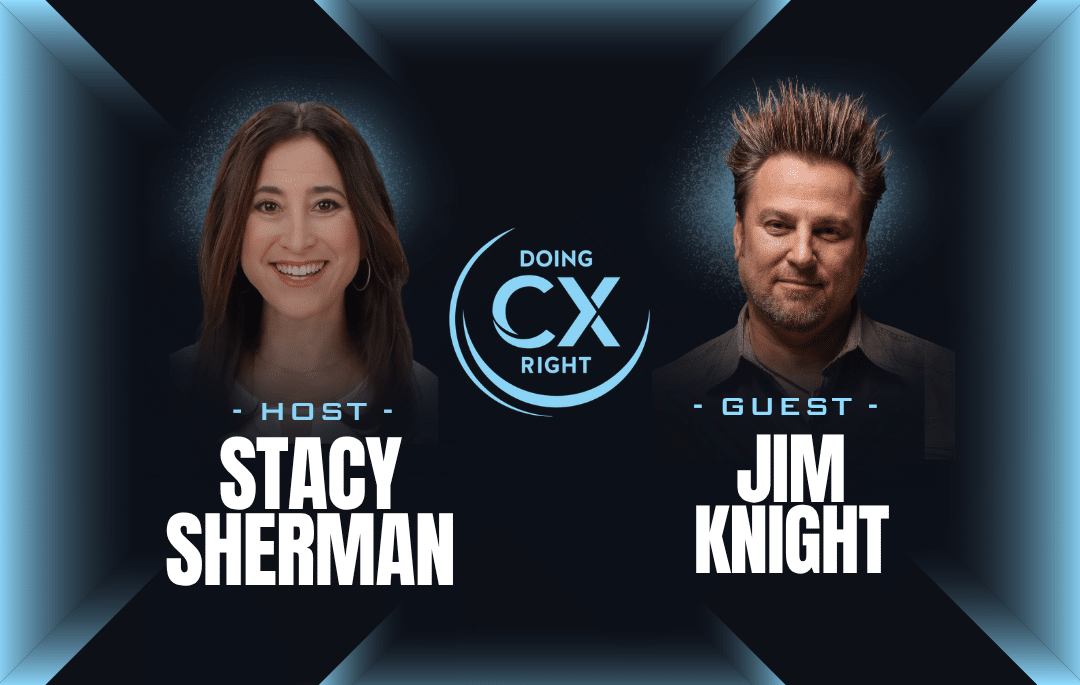
Can you imagine employees and customers loving your brand so much that they’d consider or actually get a tattoo of the company logo? Hard Rock Cafe has documented cases of this happening among both staff and guests, and it is not a marketing stunt. It is the result of a specific, repeatable approach to culture and customer experience that Jim Knight breaks down on this episode of Doing CX Right with Stacy Sherman.
This episode explores what he calls a tattoo-worthy brand and why that level of loyalty forms only when employees and customers feel a personal connection strong enough to mark it permanently. They also make a point directly relevant to any listener in this audience, regardless of title: “You may not be an executive, and you may or may not have direct reports. Yet, you have the power to be a major influencer of your organization’s culture, lighting it up and making it rock from the inside out.” The conversation that follows covers what leaders and individual employees must do day to day to build that level of connection on their own teams, including a specific method Stacy shares for measuring employee and customer satisfaction side by side.
What You Will Learn
- How to redesign your interview process so multiple leaders ask different questions across multiple rounds instead of relying on one conversation to judge fit.
- Why customer experience results need an internal satisfaction score for employees, not only an external score for customers, and how to connect the two at the local office level.
- How to write job descriptions and performance conversations so customer experience expectations are stated up front instead of discovered later during a performance appraisal.
- Where to look for hiring candidates outside your own industry, including tour guides, improv actors, and people with nontraditional work backgrounds who bring adaptability to customer-facing roles.
- Why replacing annual performance appraisals with monthly one-on-one conversations keeps employees clear on what they are accountable for before a survey score arrives.
Episode Chapters
-
[0:56] Welcoming Jim Knight to the show
[2:30] Choosing a career path built on strength, not just interest
[5:11] The one pattern Jim sees across every industry, from funeral homes to banking
[7:49] Defining what makes a brand tattoo-worthy
[9:05] The Hard Rock training story behind employees getting company tattoos
[13:00] Why hiring rigor matters more than filling a role quickly
[17:23] Replacing annual appraisals with monthly one-on-one conversations
[19:02] Where to look for hiring candidates outside your industry
[24:27] Combining an internal and external satisfaction score to find real gaps
[26:42] Why customer satisfaction metrics must connect to employee pay and promotion
Press Play To WATCH On Youtube
Read Full Episode Transcript
Full Transcript: How to Make Your Brand Tattoo-Worthy
[00:00:00] Stacy Sherman: Welcome to the Doing CX Right show. I’m your host, Stacy Sherman, a professional speaker and advisor educating business leaders how to boost revenue and brand reputation the right way. Too many companies are losing customers and top talent and don’t know why. Well, by listening to this show, you’ll gain valuable insights and precise strategies to close the gap and make experience management your competitive advantage.
[00:00:28] Stacy Sherman I’m diving deep into new [00:00:30] research and case studies to help you differentiate your brand in this high-tech era. Think of my show as your personal masterclass. By the way, if you’re looking for a speaker at your next event, a content partner, or someone to ensure that your team is doing CX right for better results, contact me at doingcxright.com.
[00:00:54] Speaker 9: Now, let’s get started
[00:00:56] Stacy Sherman: Hello, Jim Knight. Welcome to the Doing CX Right [00:01:00] show.
[00:01:00] Jim Knight: Thank you so much, Stacy. I’m honored to be here.
[00:01:02] Jim Knight: I know we’ve been, uh, trying to make this happen for a couple months, so thank you for having me on.
[00:01:08] Stacy Sherman: They say patience is a virtue. It must be right.
[00:01:11] Jim Knight: Yeah. Who said that? I want to punch them in the mouth. I don’t, I don’t- I, I’m too, I’m too- Where are they? Yeah, where are they? I’m too impatient.
[00:01:19] Stacy Sherman: They, the famous they.
[00:01:21] Stacy Sherman: Well, forget about they. Let’s get to you. W- what do you do professionally?
[00:01:27] Jim Knight: Well, now I, uh, I sort of have a, a [00:01:30] couple things that are always on the stove. For the most part, I make my living as a keynote speaker. Um, like you, I like to get out there and talk and spread the wealth and try and impact and influence others.
[00:01:39] Jim Knight: So speaker is probably my number one. I’m an author. I have two books out, one on culture and one on leadership. I’m also a podcaster. Um, I do that with one of my rockstar business partners, and we talk about leadership advice. But I also do book marketing, so I have a book marketing company. I have this awesome book- Hmm
[00:01:57] Jim Knight: uh, app, where we are matching [00:02:00] people instead of, like online dating, matching them with other people. We’re matching them with books. I have a certified training program. Um, you know, w- what don’t I do should be the question, Stacy.
[00:02:11] Stacy Sherman: Do you sleep?
[00:02:13] Jim Knight: I, I do sleep. Uh, I’m pretty good at getting four to five hours a night.
[00:02:17] Jim Knight: Uh, every once in a while I’ll sleep in and get six, but, uh, you know, you know how it is in the entrepreneur- Mm-hmm … lifestyle. We are, we are constantly grinding.
[00:02:26] Stacy Sherman: Yes, I, uh, I, I, I’ve heard. [00:02:30] Um, so tell me your why. Why are you so passionate about all these different topics, especially leadership? Because we know that that fuels everything in business.
[00:02:43] Jim Knight: It does. Well, I would say mostly because of my background is really what set the stage for my why, and so I’ve learned from some of my good friends over the years, you don’t actually discover your why, you choose it. And, uh, you know, along the way, I probably figured out that I was, I was [00:03:00] mediocre at a lot of things, but I had probably one strength, I could hold an audience’s attention.
[00:03:05] Jim Knight: So I probably would go back and think when I was in high school, you know, I was in chorus, I was in music. That was sort of my, my background. I thought I was gonna be a professional singer. I actually did go to college and get a degree in music performance and education, but while I was there, I discovered to make a living, you actually had to be good.
[00:03:22] Jim Knight: So I changed careers. Um, again, that’s where the mediocrity set in. I was okay, but I wasn’t awesome. I wasn’t a monster where [00:03:30] I thought I could make a lot of money, so I became a middle school teacher. And so when you think about those two things, music performance, being in front of people, middle school teacher for six years, again, being in front of other people and teaching a curriculum.
[00:03:42] Jim Knight: Then I ran training for 21 years for Hard Rock International, so opening up Hard Rock cafes and hotels and casinos and live music venues all over the world with brand-new people who didn’t know anything about Hard Rock. Now, again, all of that gets into your bones. So hospitality, [00:04:00] music, education, I just sort of sandwiched those together and, uh, have parlayed it into a career now that what I’m doing as a speaker in front of so many different industries is probably, knock on wood, is what I’m gonna do the rest of my life.
[00:04:13] Jim Knight: So my why, I just chose, uh, to, to do the one thing I thought that I am a rockstar on. I’m as close to being a rockstar as I can get, being in front of people. So that’s, that’s my why- Mm-hmm … and, uh, I’m not looking back.
[00:04:28] Stacy Sherman: Yeah. Well, you clearly have [00:04:30] gone forward very fast, and-
[00:04:31] Jim Knight: Thank you …
[00:04:32] Stacy Sherman: I imagine that there’s a student experience that you had to clearly provide, and the listeners who are following the rockstars and the restaurants, you know, the- there’s a whole mishmash of, I guess you’d say, customers and personas.
[00:04:56] Jim Knight: Yeah.
[00:04:57] Stacy Sherman: Tell me, w- what [00:05:00] have you learned most when you think about, reflect all of those different array of customers? What, is there a key learning that stands out to you?
[00:05:11] Jim Knight: Oh, yeah. And you alluded to it in the last question around leadership. I mean, I would say there’s really two things. I have seen now…
[00:05:18] Jim Knight: Because I, I, I thought when I left Hard Rock, when I s- you know, really took the springboard to jump off to do this, it’s been about 10 years now. I thought that I’d be predominantly speaking in front of the world that I [00:05:30] grew up in. It would be food and beverage, a little bit of retail, hospitality. But most of my speaking engagements now are outside of that, and it’s far from it.
[00:05:38] Jim Knight: It’s real estate and insurance and banking, and funeral directors are my number one clients. So I start to think, what in the world does everybody sort of have in the same focus? It- whether it’s a pain point, whether it’s the thing that makes the difference, which is really what your question’s about, and I’ve seen that it’s really two things.
[00:05:58] Jim Knight: That it’s not about the stuff. It’s [00:06:00] not about the thing that you sell. Whatever that product is, whatever the widget is, it’s not about that. And yet I still see a lot of people focusing on that. They miss that it’s the human, it’s the human experience. You know, you talk about customer experience, but that starts really with the employee experience.
[00:06:16] Jim Knight: Like, if you can get the humans to do the things that you need them to do, and sometimes you might have to play some Jedi mind tricks on a couple of them. But for the most part, you hope like heck that you hired the right one to can actually bring something spectacular to [00:06:30] the table. When that experience is created, that makes all the difference in the world.
[00:06:34] Jim Knight: All the rest of the stuff is just really expensive window dressing, I think. So I, I think I’ve learned that regardless of the industry or the company, and regardless of what state, they could be brand-new, a year in, or they could be a legacy brand and, and they’ve been around for 60, 70 years. That end result for the customer, that experience has to absolutely rock people’s face off.
[00:06:55] Jim Knight: So I start with that. But I think to your question, again, the [00:07:00] leadership piece, somebody has to manage all that. Somebody’s got to motivate, inspire, reward, recognize, love on people enough so that they stay with you longer, ’cause there is a direct correlation that I’ve seen between turnover and sales. You get people to stay with you a little bit longer, you’re gonna produce better results.
[00:07:19] Jim Knight: So from a leadership standpoint, you really have to focus on, how do I create this crazy, awesome professional culture and get my people to stay with me longer? If I just focus on [00:07:30] those things, all the rest of the stuff falls into place. So it’s sort of a twofold answer to your, your question. I think that service, the, the experience that has to be created should be, like, priority number one, and that’s only gonna happen from leadership.
[00:07:43] Jim Knight: So it’s those two areas, in my opinion, are gonna outweigh everything else.
[00:07:49] Stacy Sherman: You talk about making a brand tattoo worthy.
[00:07:55] Jim Knight: Yes.
[00:07:55] Stacy Sherman: I love that phrase. What does that mean, first of [00:08:00] all?
[00:08:01] Jim Knight: Yeah, you know, uh, anybody could do this. You could go onto Google and just, you know, put in companies or brand logos on people’s bodies, on tattoos, whatever it is, and you will see some crazy stuff out there.
[00:08:14] Jim Knight: And you know, I was very lucky. I… When I was growing up, and, and I’m probably a little bit older than you are, Stacy, I think I remember the only people that ever had tattoos were people that were in jail or they were in the Navy. It was, like, sailors and convicts, and that was it. And then something happened probably about 25, [00:08:30] 30 years ago.
[00:08:30] Jim Knight: People were getting inked up more than ever before, and I was lucky to work for a company like Hard Rock that allowed you to have tattoos, and piercings, and mohawks, and all that stuff, and it was a cool thing. Now there are so many companies doing it, predominantly because all the humans are doing it. Uh, uh, almost everybody you know is gonna have some tattoo on them.
[00:08:50] Jim Knight: But it’s rare when you see somebody that actually puts a company logo on their body, and some of them are customers. They’ve just fallen madly in love with the brand that they spend their money, [00:09:00] and some of them are team members. They’re employees, and it blows my mind that somebody would do that for all time.
[00:09:05] Jim Knight: And so what started happening, I ran a, uh, a corporate university when I was at Hard Rock called Rock 101. Every company, by the way, does this now. When you onboard somebody, they go through this sort of basic training, and it was the stuff that you would think, how do you hire people? How do you, uh, do an interview?
[00:09:23] Jim Knight: How do you handle guest complaints? How do you read a P&L? Blah, blah, blah, blah, blah. Very tactical, practical type stuff. [00:09:30] But we would also teach other things like the power of the brand, and philanthropy is instrumental, and music appreciation, like, stuff you could not get anywhere else. And so something would happen to these managers.
[00:09:40] Jim Knight: This was a leadership conference, by the way. Some of them would go out to get tattoos together, which completely blew my mind. Like, that was a thing. You’d go out. It was a team-building. Some of them, it was their very first tattoo, and a couple of them would get the Hard Rock logo. And they’d be so surprised to show me in the morning.
[00:09:57] Jim Knight: They’d get the Hard Rock Cafe on their shoulder or [00:10:00] Hard Rock Hotel on their calf muscle, and they’re like, “Look what I did last night.” And I would think, “Dude, that never comes off. You know that, right? What are you doing?” But here’s the cool thing. They, they always responded with something like, “Yeah, man, I’m, I’m in it for the long haul.
[00:10:15] Jim Knight: I’ve interviewed for the last time in my life And so I started to think more about this, and the brand, the marketing department was already focusing on this quite a bit and sharing, you know, tattoos out there of the Hard Rock logo on people. And, and we [00:10:30] discovered that it’s really the mark of somebody who’s committed.
[00:10:32] Jim Knight: They are all in. And when an employee tells you, “That’s it. I, I’ve marked myself. I’ve branded myself forever,” it’s perfect, ’cause I’m also going, “Geez, you’re unemployable everywhere else now,” which is great for me. But it does rock my world that somebody would go and do that, and customers are doing it. So when I talk about being tattoo-worthy, and I would do this from the stage or even in a virtual keynote session, I think if you can position your brand to be tattoo-worthy, that you’re so awesome in the [00:11:00] experience that you’re gonna provide, that somebody is gonna have a love affair with you so much that they’re willing to put ink on their body for all time, that’s when you know you’ve won.
[00:11:09] Jim Knight: That is the ultimate win, in my opinion, internally or externally
[00:11:16] Stacy Sherman: Wow. So people are listening. I’m sure they’re saying, “Wow.” They’re scratching their heads.
[00:11:23] Jim Knight: Yeah. Yes.
[00:11:23] Stacy Sherman: What does it take? What does it take? What did Hard Rock do right, and [00:11:30] other brands that you see? That would make someone even think to do it, even if they don’t execute on the tattoo, but they really actually think about it.
[00:11:39] Jim Knight: Yeah.
[00:11:40] Stacy Sherman: What, what does that look like? What are the formula to that?
[00:11:44] Jim Knight: Well, we alluded to it earlier, um, and I think in the world that, that you s- spend a lot of time, it’s the overall experience. So I’ll go back again. I think you certainly have to do things like have an awesome product, whatever it is. The environment has to be fantastic, and I’m talking about [00:12:00] the lighting and the music and the cleanliness and yeah, yeah, yeah, all of that stuff.
[00:12:04] Jim Knight: You’ve got to make sure that you’ve got tools and processes and, and internally the right forms and, and growth programs and yes, yes, yes, do all that. But at the end of the day, the end user, the consumer, the guest, the customer, whatever we wanna call those people, the clients, they’ve gotta feel like I am seen, I am heard.
[00:12:25] Jim Knight: You’ve created a positive, memorable experience for me that I’m never gonna [00:12:30] forget. You know, and it’s the old Maya Angelou quote, right? It’s not how, you know, the thing that you provided, it’s how you made me feel. And so if you can create moments like that, and by the way, this is not easy. Like the stuff I talk about is probably the hardest thing that some CEO or general manager of some one-off location, it’s probably the hardest thing they’re ever gonna do because it’s, it requires humans.
[00:12:54] Jim Knight: You know? And, and people come with baggage. They come with a lot of baggage ’cause they’ve got this cool thing called free [00:13:00] will. They’re gonna do what they wanna do anyway. So you hope like heck that you actually hire rock stars, which is the ultimate answer to your question. If I can, and it’s tough, but you’ve gotta put some rigor, some real meat behind the interviewing processes.
[00:13:15] Jim Knight: Focus on the cool collateral, the recruiting stuff you’re gonna do, but when they’re sitting in front of you, you gotta make sure that you probably have multiple interviews with multiple leaders asking different questions to get to the ultimate nut, the stereotypical employee that you [00:13:30] need that’s gonna bring the thunder when it comes to the customer.
[00:13:33] Jim Knight: And so if you mess up on that, and by the way, there’s gonna be some that can’t do all of that. They’re gonna be fantastic soldiers. Not everybody’s gonna be a rock star. You know, I, I use the analogy of U2. They can’t all be Bonos. You know, they can’t all be The Edge. Those are the two most famous. We need some, some Adams and Larrys.
[00:13:53] Jim Knight: We need some Adam Claytons and Larry Mullen Jr’s. We need people that are probably a little bit in the backdrop who can still do the [00:14:00] things we need them to do, but the more rock stars that you can populate your business with, you’re gonna get to the promised land. In my opinion, it’s the only way that you can truly get to Nirvana is by having these awesome people.
[00:14:11] Jim Knight: So you’ve gotta be on the hunt looking for them, and when they’re sitting in front of you, do everything in your power to make sure, yep This person’s gonna bring it every day. They’re gonna have some bad days, but on par, they’re gonna bring something spectacular that’s gonna create memories for people.
[00:14:25] Jim Knight: And so I, I- Mm-hmm … I think this is where a lot of companies make a mistake. They’re focusing on the wrong [00:14:30] thing. They’re focusing on the amount of money that they spent on the physical building and the product and the stuff and all that. They miss the secret sauce. It’s human behavior, which is, by the way- Mm-hmm
[00:14:41] Jim Knight: learned human behavior. People learn everything. You and I and everybody on your audience right now, they are not born to act a certain way. They learn everything, from their parents, from school, from their friends, from the playground, from religion, from lack of religion. By the time you come to me, Stacy, as like a 21-year-old wanting a job, you are the way you [00:15:00] are.
[00:15:00] Jim Knight: And if your natural disposition isn’t to, you know, smile at people and have a good personality, sh- y- you’re a problem for me. You’re of no use to me, unless I find a place somewhere in the back where no one will ever talk to you, which is highly unlikely. I need people that need to be around other people.
[00:15:17] Jim Knight: And so I, I know as we get into AI and technology and robotics, I think cultures are gonna change a little bit. But right now, the, the businesses, for the most part, are predicated on awesome learned human behavior. The more that a CEO or [00:15:30] just a, a, a frontline manager can get to that, they’re gonna get to the Promised Land pretty quick
[00:15:37] Stacy Sherman: Well, let’s talk about, you said humans, which is obviously we’re, we’re all people going through a human experience.
[00:15:48] Jim Knight: Yes.
[00:15:48] Stacy Sherman: And yet we do know that data is important How do you actually amp up, to quote you, love those [00:16:00] words- Yes. … amp up your results, meaning satisfaction?
[00:16:04] Jim Knight: Yeah.
[00:16:05] Stacy Sherman: H- h- how do you measure, how do you bring the data into the human component?
[00:16:11] Jim Knight: Yeah. I’ll, I’ll start with this mindset that these companies, I think that have a lot of fun, you know, i- in the brand that I worked in and everything that I talk about now is about edutainment.
[00:16:21] Jim Knight: You’ve got to have not just the, the educational piece, there’s got to be some entertainment as well. So, you know, that’s a mashup word. Uh, I [00:16:30] think quite a bit in these terms, even a company like Hard Rock or Starbucks in a lot of ways, Mod Pizza, sometimes Chick-fil-A, they operate in the gray a lot when it comes to the experience because people have this empowerment where they can make these decisions.
[00:16:44] Jim Knight: But your question is really valid because I still believe in metrics. I believe the more metrics, the better. I want to know if we’re winning or losing. And so when you put a white hot spotlight on things, stuff matters. Things get done. [00:17:00] What gets measured gets done. So tactically, when you’re asking, I would make it absolutely priority number one.
[00:17:07] Jim Knight: My orientation and training, if the experience is important to me, that’s predominantly what I’m gonna focus on. I’m gonna talk about the purpose and the mission and the values and all the rules and what you can and can’t do and all of that, but I’m gonna focus more on my time saying, “Here’s the end result for the customer.”
[00:17:23] Jim Knight: You make that priority number one swinging, coming right out of the gate. You put it in the job description. You measure it in the [00:17:30] performance discussions, not just the performance appraisals that I do one time a year to fill out the form, to go in the file, to get more money because HR told me to. Like, I want to have one-on-one conversations with people on a regular basis, and that might take ten minutes once a month.
[00:17:44] Jim Knight: But I am crystal clear as to what I’m supposed to be working on because my boss talks to me all the time. So then when I actually do get measured and I get rewarded and recognized and bonus or promoted, like that’s a key component of it. If you don’t have any of that in there and it’s just laissez-faire and, geez, I hope we [00:18:00] get better, and then you get all upset because some customer survey result comes back and it’s not that great.
[00:18:06] Jim Knight: Well, if you’re not measuring it, if you’re not making it a part of the regular metrics, then shame on you. It’s your fault as a leader. So I would absolutely make that mission number one. And again, I’ll take a step back and say, you know how you get there? You hire rock stars who have this unbelievable thirst to, to have a great work ethic.
[00:18:24] Jim Knight: Those rock stars are going to do it anyway. Like in lieu of leadership, they’re just gonna bring [00:18:30] it. But yes, there’s a role for leaders, for those that are in the middle, ’cause you know, you don’t have to worry about the ones at the top. You’re constantly focused on the ones at the bottom, which is the wrong thing to do.
[00:18:40] Jim Knight: You ought to focus all of your energy on the ones in the middle and get them to suck up to the rock star status. So those people need to be led. They need to be motivated and inspired and reminded about the metrics that we’re looking for. But the more that you can hire rock stars instead of Lip syncers and, and not put people that are just sort of going through the motions beside me, I got a better [00:19:00] chance of getting to Nirvana.
[00:19:02] Stacy Sherman: Hmm. Well, when someone is hiring and recruiting, and you say, “Hire rock stars,” who are they? What should be part of their description when they’re looking?
[00:19:14] Jim Knight: Yeah, I think it’s up to the brand. I mean, I use rock stars because, you know, I’ve used every iteration of rock and roll you can think of. You know, that music orientation, band and brand analogies, that just, that runs deep in my DNA.
[00:19:25] Jim Knight: But if people wanna use the word top talent, I think they know what they’re looking for. [00:19:30] But sometimes the horse is out of the barn, they’re already down the path, the business is so big, it takes forever to come back and redo and clean up all of their collateral. But if you could start at the beginning and say, “What is it that we wanna hire?”
[00:19:46] Jim Knight: Because all of the things will lead to that then. How we do our orientation and our training and our communicating and our rewards and our recognition, down to the job descriptions and performance appraisals. This is the human resource in me coming out, ’cause that’s what I reported up through. [00:20:00] I think these rock stars, you have to, number one, know where they hang out.
[00:20:03] Jim Knight: Where are they? Are, are they perhaps outside of the industry that you’re even looking for? You know, a lot of times we’re just, we’re, we’re shuffling people back and forth between like businesses. But perhaps they’re outside in a different area. I think about tour guides. I think about improv actors. I think about hanging out sometimes in tar- uh, tattoo parlors.
[00:20:24] Jim Knight: I go to rock shows and I look at people that want flexibility. They wanna, they wanna work with live music at night, but they’d be an [00:20:30] awesome employee during the day. What about veterans? What about people coming out of jail? There are brands now that are focusing on people that have been incarcerated.
[00:20:38] Jim Knight: And let me tell you, you give somebody a job, I mean, again, a little bit nervous for some people, and, and maybe there’s some baggage with them, but for the most part, you know what you give with them? Loyalty. ‘Cause somebody gave them a chance that nobody else would. So I would go- Mm … down a laundry list of, of potentially people that are outside the sea of sameness.
[00:20:56] Jim Knight: So that’s where I think rock stars could be. But then you still gotta put [00:21:00] all of that rigor that I talked about in how you recruit, how you interview, how you ultimately hire, and just look for the top talent. And, and, and don’t settle for it. I am begging brands to, to suck it up and leave the position open a little bit longer to get the right person.
[00:21:16] Jim Knight: And believe me, I’m an experiential starved consumer. Me personally, Jim Knight, I am on the hunt for people to do anything different with me. When I go to eat, drink, shop, stay, play, whatever it is, I’m looking for different. You give me same old, same old vanilla ice [00:21:30] cream, it’s just not gonna cut it anymore.
[00:21:32] Jim Knight: People need a little bit of chocolate in their life, and I’m willing to spend some money to get that I can’t be
[00:21:38] Stacy Sherman: the only one I also… No, absolutely not. I would say I also like to infuse questions in the interview process to really test for trust is a huge one.
[00:21:51] Jim Knight: Sure.
[00:21:52] Stacy Sherman: And you give them examples and scenarios and have them explain and demonstrate without having to [00:22:00] say directly, “I’m trustworthy.
[00:22:02] Stacy Sherman: I’m customer-centric.”
[00:22:04] Jim Knight: Yeah.
[00:22:05] Stacy Sherman: And that’s a science and an art, the questioning.
[00:22:09] Jim Knight: It is totally an art form. In fact, it’s one of those things, I, I believe that doing role plays and practicing to interview people is one of the greatest skill sets you could ever do. So that corporate university that I talked about, we will spend an entire day on that.
[00:22:24] Jim Knight: Giving them the, the hour of here’s the things you should do, that’s one thing. But the actual role play of practicing [00:22:30] on each other before you actually practice with real humans you’re gonna bring on board, it is absolutely an art form. And great human resource professionals will obviously teach you how to ask open-ended.
[00:22:41] Jim Knight: You’re talking about behavior-based questions. What would you do if, and you can put them in hypothetical situations. I’m even willing to ask them cultural questions. I wanna know what’s, what’s the last rock concert that they went to? What’s their favorite artist? Now, in my world, that’s perfect. Uh, not every company would do that, but what are some [00:23:00] culturally relevant questions that I don’t care how much they’ve prepared for, they could be a professional interviewer, they’re not prepared to answer that.
[00:23:06] Jim Knight: And so I see a lot of things. Are they even music fans? Have they ever been to a rock concert before? Can they eloquently talk about something they were not prepared? That’s why tour guides and these improv actors, like, I love people that have the wherewithal that can, that can spin on a dime and give you an answer.
[00:23:23] Jim Knight: And so I think when you’re asking these type of questions, and again, I said this earlier, multiple interviews, multiple interview [00:23:30] guides with different questions. Interview number two is gonna be completely different than interview number one, but somewhere along the line, I’m gonna ask them some questions that they probably aren’t prepared for.
[00:23:39] Jim Knight: And by the time we’re all said and done, we can look at each other as leaders and go, “Yep, I’m willing to take a chance on this person.” Mm-hmm. Most of the time, somebody shows up, they’re doing the whole breathe on the mirror. You got a pulse, yep, you’re going in, because somebody’s gotta make the donuts. And as a leader, you can’t every day feel like you’re rolling up your sleeve and you’re doing all the work on your own, and you fill [00:24:00] the position.
[00:24:00] Jim Knight: You make silly, stupid, short-term decisions, and it comes back to haunt you. You create a vicious environment that sometimes takes eons to get out of. That’s why I say suck it up, leave it open a little bit longer, use the art form that you talked about of interviewing because that is so critical. And when you hire the rock star, then on the back end, you gotta do everything in your power to love on them to get them to stay with you longer.
[00:24:22] Jim Knight: Those two ends- Mm-hmm … of the employee life cycle, super critical
[00:24:27] Stacy Sherman: So I wanna share a tip going back to the [00:24:30] data conversation. Something I love to do and recommend is while you’re measuring customer satisfaction, you also obviously will con- apply the same. If you use NPS, for example- Mm-hmm … you can do an internal NPS score.
[00:24:47] Stacy Sherman: But then don’t stop there. You marry the external customer and the internal customer down to your local-
[00:24:57] Jim Knight: Yeah …
[00:24:58] Stacy Sherman: sales office or [00:25:00] frontline staff and back office, and that’s… You could really see the synergy to what we’re talking about ’cause when that local team is unhappy, the results transfer-
[00:25:11] Jim Knight: Of course
[00:25:11] Stacy Sherman: over to the customer.
[00:25:12] Jim Knight: Absolutely. I, I used to do this all the time along those lines. I would look at the top 10 restaurants or top 10 cafes, and not just engagement, the ones that were producing year-on-year results. So I’m not talking about they were hitting budget. You know, budget, that’s a one-time [00:25:30] year number.
[00:25:30] Jim Knight: I would like to hit that as well ’cause that’s probably how you get bonus, but the ones that had a trajectory that were constantly going up, every year they were doing better than the year before. That doesn’t happen by accident, but if you go look at the meas- metrics, they happen to be the ones that had the lowest rolling 12 turnover.
[00:25:47] Jim Knight: And again, the only way you get people to stay with you is to spend all this time and energy in developing them, growing them, put in a mentorship program, looking them in the eye, knowing about their hopes and fears, caring about them as a person, [00:26:00] throwing your arms around them. That’s why people stay. And so if you can get them to stay with you longer, that’s a direct correlation to constantly producing sales.
[00:26:08] Jim Knight: So I, I’m 100%. Again, the more metrics, the better. I wouldn’t totally focus on just that because I think they all tell a story. Just like a profit and loss statement, you can look at a P&L. It is all about the past, but if you look at it the right way, it’ll tell a story. It’ll be like that thing in Aliens jumping up on your face.
[00:26:27] Jim Knight: You’ll be able to see right away, “What do I need to do in [00:26:30] the future to fix whatever the issue was?” But again, this is all predicated on human behavior. I’m gonna forever go back to that because I’ve just learned over the years all the other stuff is just tactical and practical. It’s not enough
[00:26:42] Stacy Sherman: Do you believe that employees need to be linked to the customer satisfaction metrics?
[00:26:49] Stacy Sherman: Totally. I know this is a debatable topic, but
[00:26:52] Jim Knight: what’s your view? Yeah, who’s debating that? I, uh, of course. Like I said, what gets measured gets done. You’ve got to put that stuff in place. If you don’t make it important, if it’s [00:27:00] not measured in any way, well, then what’s the point? You may as well be rolling the dice in period 12, hoping like heck you get to hit a number.
[00:27:07] Jim Knight: You know? And, and then it’s just a shock, it’s a surprise when you actually do or don’t hit it, and it’s just not that important to the employee. I, I absolutely believe team members have to be tied to that. Now, I know you used the word bonus, but it could be anything. Tied to that in pay, performance discussions, promotability.
[00:27:24] Jim Knight: But for sure, extra money, yeah. And, and if that’s important to you as a business, as a leader, [00:27:30] why wouldn’t you do it? And, and sometimes- Hmm … somebody has inherited the business where somebody didn’t do it, it wasn’t started at the beginning from the founders, and they feel like they don’t have any say so, and they do.
[00:27:41] Jim Knight: I think if people are honest with themselves, that they sit back from the table, not be caught in the thick of the day-to-day. If they could sit back and just think strategically for a second and go, “What’s most important? Oh, yeah, bringing something awesome to the customer.” Well, we’ve got to, we’ve got to tie performance to that.
[00:27:56] Jim Knight: If not, then it’s a crapshoot, and you can’t complain. [00:28:00] When, when, when there’s no leadership, people are gonna fill in the blanks and do what they want to do anyway. Like I said, it’s free will, until you start to impose some things that are important to you.
[00:28:10] Stacy Sherman: And all of it goes back to being that tattoo-worthy brand.
[00:28:16] Jim Knight: That’s right. That’s right. Let’s go get tattoos today, Stacy.
[00:28:21] Stacy Sherman: And which brand will it be? I, I- Hmm. What w- what would you say to that? What- It, well- That’s such a good question. If you could put one brand, who [00:28:30] would it be?
[00:28:30] Jim Knight: Hmm, that’s a great question. I guess it wouldn’t be fair to say my own brand. Uh-
[00:28:36] Stacy Sherman: No, that’s not fair.
[00:28:37] Jim Knight: Yeah. You know, I probably have a love affair with, uh, Chick-fil-A probably more than anything else. They’re just doing so many great things. But would that be worthy enough? I’d probably put, uh, like, a band, like something I grew up, Genesis, Rush, Yes-
[00:28:52] Stacy Sherman: Hmm …
[00:28:53] Jim Knight: um, Journey. Something like that would probably be a little bit more if I was to put a, a, a brand or a [00:29:00] band on my body.
[00:29:01] Jim Knight: Mm-hmm. But, uh, who has completely crushed it for me? I know there are some companies out there right now that a lot of their companies, like Rackspace, uh, you know, that, that’s an, a back office server company, yet there are people putting brand logos on their body. It just blows my mind. Chick-fil-A- … maybe there because I spend, you know, so much money there.
[00:29:19] Jim Knight: I’m there three times a week. I got a problem right now eating chicken sandwiches all day.
[00:29:25] Stacy Sherman: Well, that is such a fun question, I have to say. And you know what? A band is [00:29:30] fair to say because a band is a brand. That’s
[00:29:33] Jim Knight: right.
[00:29:34] Stacy Sherman: And they’re delivering a l- you know, an audience experience.
[00:29:39] Jim Knight: Totally.
[00:29:39] Stacy Sherman: My God, without fans, you’ve got no one.
[00:29:42] Jim Knight: That’s right. Exactly. Look, look at you coming around. That’s awesome. I dig it.
[00:29:47] Stacy Sherman: Yes. I learned from the best.
[00:29:49] Jim Knight: Yeah.
[00:29:49] Stacy Sherman: Well, as we are going to conclude here, I have two final questions. Sure. If you had one takeaway, if [00:30:00] listeners only remember one thing today, what would you want them to remember? Imagine that there’s CEOs and leaders and entrepreneurs in my room right now listening.
[00:30:10] Jim Knight: Yeah.
[00:30:11] Stacy Sherman: What do you want them to remember?
[00:30:12] Jim Knight: Well, I would probably say the same thing if I was on stage, almost regardless of whatever the topic is. The experience deliverer matters most, and I know I’ve alluded to that earlier. I just think a single person who can bring the thunder [00:30:30] when it comes to an experience, they’re the ones that are gonna make the difference.
[00:30:33] Jim Knight: So if I was in front of a, a room full of CEOs, I’d say, “Yes, keep doing all the other tactical things that are important.” That sets the stage. But the deliverer, the rock star, the- the- the ones that are absolutely gonna produce these positive, memorable experiences, that’s the most important. So you might have to shift your energy.
[00:30:52] Jim Knight: You might have to spend a little bit more time and effort and money and rigor and all the stuff that I talked about. The absolute single person that can bring something [00:31:00] spectacular to the table, they’re the ones that are gonna make the difference for the brand. They will help perpetuate the company for all time.
[00:31:06] Jim Knight: That would probably be- Mm … my singular message.
[00:31:09] Stacy Sherman: Mm. I love it. And last one, a fun one. If you could go back in time and speak to your younger 20-year-old self, what would you tell younger Jim that you didn’t know then that you know now?
[00:31:24] Jim Knight: Oh, man. I would say, uh, you know, I was… If I had… 20-year-old [00:31:30] self? Yeah, so I was a trainer.
[00:31:32] Jim Knight: Um, I was one of these guys that followed the rules implicitly. I was a company guy. I showed up with a briefcase. You know, I was a hardcore trainer, and I think maybe don’t focus so much on the rules and the procedures. Like, those are important. Um, I would say- Mm … maybe a little bit broader. Just focus on the values.
[00:31:50] Jim Knight: Get that part right, but focus on the experience, the stuff that we now talk about. I think in service of rocking people’s face off, if I could get people [00:32:00] to just do that versus here are the things that you have to work within or else you’re gonna get fired or something’s gonna happen. Most of those rules and procedures are in place, uh, because somebody did something silly a long time ago and, and not that rules are made to be broken.
[00:32:15] Jim Knight: I’m just a big believer, if it isn’t broke, break it anyway. See if you can figure out a way to make it a little bit better. So if I could go back to myself, I’d say, “Don’t be such a hardcore trainer. Like, have a little bit more fun. Think about the totality of the [00:32:30] experience, um, and, and parlay that over to the people that you’re responsible for.”
[00:32:34] Jim Knight: Um, that- that’s probably- Mm … if I had to think right off the cuff, that would be my, my one thing to myself.
[00:32:40] Stacy Sherman: Mm.
[00:32:40] Jim Knight: And, and maybe let your hair get higher. Can’t see, but I got the- Start earlier. Oh, I
[00:32:46] Stacy Sherman: love it. Uh, start earlier. It’s never too late. Let’s say that. Well, where can people find you? I know they’re gonna want to.
[00:32:54] Stacy Sherman: I’m gonna put the links in the show notes, but what’s the best way to connect?
[00:32:58] Jim Knight: Oh, awesome. Thank you for that [00:33:00] opportunity. Um, I would say for the most part, all roads lead to my website, which is Knight Speaker, so my last name, K-N-I-G-H-T, knightspeaker.com. People can see everything there, the books, the podcasts.
[00:33:13] Jim Knight: Um, if you do like podcasts, I mean, obviously since you’re listening right now, uh, the one that I do with my rockstar business partner, Brant Menswar, is called Thoughts That Rock. Uh, we basically only ask two questions, “What’s the best piece of leadership advice you’ve ever been given, and how did that change your life?”
[00:33:29] Jim Knight: And we’ve had some [00:33:30] pretty big- Mm … celebrities on there, and it just sort of takes on a life of its own. Um, so that’s… Those are probably the two main areas to, to get ahold of. And I will say our new company, called BookieCall, which is, again, we took the, uh, the psychology of online dating, like eHarmony and Match, and you fill out a profile if you’re a reader at all, and we match you to books that you would like, and the algorithm gets smarter all the time.
[00:33:53] Jim Knight: So we’ve got about 250,000 people that have downloaded the thing, and it’s just blowing up like, like crazy town. So [00:34:00] BookieCall is a pretty fun app if they’re interested in something like that.
[00:34:03] Stacy Sherman: Fantastic. I’m gonna check it out myself as a reader. So thank you for all of that. Thank you for being here and being so awesome.
[00:34:12] Stacy Sherman: And, uh, I’m gonna be thinking about that tattoo, at least- Yes. … not putting it on my body, but I’m gonna think about who I would- Who you would get … if I did.
[00:34:21] Jim Knight: Yes. And I think you could ask that of anybody. That might be an ongoing question for you from now on. I love it.
[00:34:25] Stacy Sherman: It, it, it is. You ignited it, so thank you.
[00:34:28] Jim Knight: I had a lot of fun. Well- [00:34:30] Thank you so much, Stacy, for having me on the show.
[00:34:32] Stacy Sherman: Oh, thank you.
[00:34:34] Jim Knight: We’ll talk to you soon. Rock on.
[00:34:35] Speaker 10: Thank you so much for joining today. I hope you’ll take what you’ve learned and put it into action, because it’s about doing CX right, not just talking or thinking about it. If you found this valuable, leave a review wherever you listen to podcasts as it helps others discover this show, and continue learning by subscribing to my newsletter and scheduling time with me to [00:35:00] discuss anything on your mind.
[00:35:01] Speaker 10: Reach out at doingcxright.com. Thank you again. To be continued.
Questions & Answers: What Leaders Need to Know
Q: Why do some employees and customers get a company logo tattooed on their body?
A: That level of attachment forms when a company consistently delivers a customer or employee experience that feels personally recognized rather than transactional. A permanent mark like a tattoo signals full commitment, described in the episode as, “it’s really the mark of somebody who’s committed. They are all in.” The tattoo itself is not the goal. It is a visible sign that the underlying experience, built through hiring, training, and daily leadership, was strong enough to create lasting loyalty.
Q: What needs to change about the interview process to hire better customer facing employees?
A: Interviews need to move from a single conversation to multiple rounds, each conducted by a different leader asking different questions. The episode recommends including behavior-based, open-ended questions and at least one cultural question the candidate cannot prepare a scripted answer for in advance, since the goal is to see how someone responds when they do not have time to rehearse. Looking outside the immediate industry also widens the candidate pool, since people in roles like tour guiding or improv acting already practice responding to unpredictable situations in real time.
Q: How often do customer experience expectations need to be discussed with employees?
A: Rather than waiting for an annual performance appraisal, the episode points to short, regular one-on-one conversations, describing a cadence of roughly ten minutes once a month. This keeps the employee clear on what they are accountable for well before a formal review or a customer survey score arrives, and it gives leaders a chance to coach in real time instead of reacting after results are already in.
Q: Do customer experience scores need to be tied to employee pay or promotion decisions?
A: Yes. The episode states directly that employees need to be tied to those metrics through “pay, performance discussions, promotability.” The reasoning is that a metric that carries no consequence for the employee will not receive consistent attention, and leaders who skip this step have no basis to react with surprise when results come in low.
Q: How can a company measure whether its employee experience is actually connected to its customer experience?
A: The episode recommends applying the same measurement method used for customers, such as Net Promoter Score, to employees internally, then comparing both scores at the local office or team level rather than only at the company-wide level. This makes it possible to see directly where a struggling local team is producing weaker customer outcomes, since, as the episode explains, “when that local team is unhappy, the results transfer over to the customer.”
About Jim Knight: Making Your Brand Tattoo-Worthy and Employees Feel Like Rockstars
As a keynote speaker, author, podcaster, and entrepreneur, Jim Knight teaches organizations of all sizes how to attain their own “rock star” status. Although his illustrious career started at Gatorland Zoo (he has the scars to prove it), Jim cut his teeth in the hospitality industry and eventually led Global Training for Hard Rock International for two decades. His customized programs show how to amp up organizational culture, deliver world-class, differentiated service, and build rock star teams and leaders. Connect with Jim on LinkedIn
About Stacy Sherman:
An award-winning international Certified Speaking Professional (CSP) who has delivered hundreds of standing-ovation keynotes and workshops and co-authored best-selling books on Experience Management for sustainable success. She developed a proprietary framework that enables leaders and teams to enhance revenue and brand reputation. Her proven methodology is based on her MBA degree and 25 years of leadership in sales, marketing, employee, and customer experience across diverse industries, including Verizon, AT&T, Schindler Elevator Corporation, Wilton Brands, Martha Stewart Crafts, and LiveOps, generating $2.4 billion in savings and hundreds of millions in revenue. Stacy Sherman has earned widespread recognition for her award-winning “Doing CX Right” podcast, ranked in the top 2% globally with over 200 episodes, and for her courses on LinkedIn Learning, which have garnered hundreds of 5-star reviews. A multi-year Global CX Guru awardee and 2026 ICMI Hall of Fame inductee, Stacy’s insights have been featured in Forbes, Psychology Today, Yahoo News, and other leading publications.