
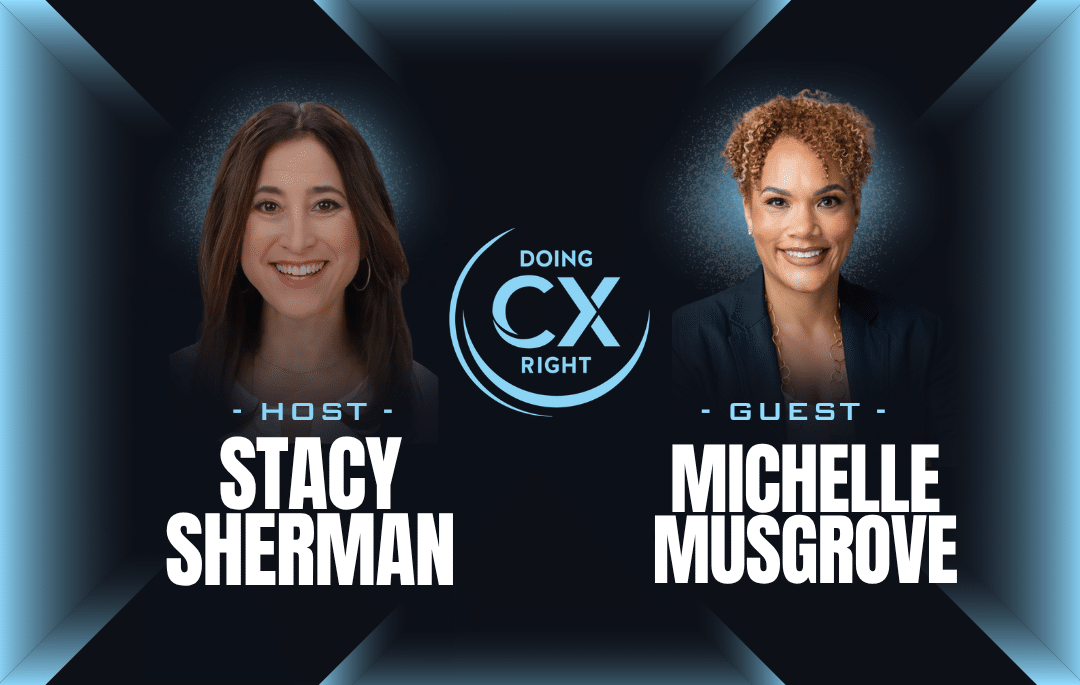




Most leaders assume their customers won’t leave as long as the price is fair and the service works. Michelle Musgrove of Washington Gas and I agree that is a dangerous assumption. A customer with no other option is not the same as a loyal one. Confuse the two: the process keeps serving the company instead of the customer, nobody follows up directly, and the first real alternative wins them over. So what separates the companies that retain customers for years from those that lose them as soon as a competitor enters the market? This episode is for leaders in both situations: those already competing for customers, and those whose industry has never had them until now.
What You Will Learn
- Why adding more AI at the customer experience problem is not the answer, even when your technology budget is growing
- What the difference between customer experience and customer service actually means in practice, and why companies that confuse the two stay in a reactive cycle
- How to get CX right the first time by identifying which issues repeat, what drives them, and where the process breaks before a customer ever contacts you
- Why progress on first-contact resolution matters more than waiting for a perfect solution, and how to build on incremental gains
- How to build a business case for CX investment in a regulated environment where every dollar requires justification
- Why CSAT alone does not give an accurate picture of the customer experience, and what NPS open-ended responses, customer effort score, and third-party benchmarks reveal that a satisfaction score cannot
- How to get every employee across every role to take accountability for the customer experience, regardless of whether they interact with customers directly
- Where AI helps frontline teams serve customers faster by handling routine work, and where leaders are confusing automation with culture change
Episode Chapters
- 00:00 – Introduction and Michelle Musgrove’s background at Washington Gas
- 01:13 – The flywheel approach to customer listening and experience vision
- 03:08 – How emerging choices force long-standing brands to earn customer loyalty
- 04:30 – The NYC taxi lesson: what happens when customers with no choice get one
- 05:43 – The LinkedIn poll: honesty vs. digital tools
- 08:10 – Front-of-mind brands vs. back-of-mind brands, and managing trust during a problem
- 10:36 – Making it easy for developers to choose gas over electric
- 13:47 – Getting CX funded without a competitor pushing you to
- 15:26 – The line between customer service and customer experience
- 17:10 – Automating pricing calculations to remove sales friction
- 19:36 – Rapid-fire advice on authentic leadership and career growth
Press Play To WATCH On Youtube
Read Full Episode Transcript
Full Transcript: How to Retain Customers Who Never Had a Reason to Leave Until Now
0:08 Stacy Sherman
Hello, Michelle. Welcome to the Doing CX Right show
0:12 Michelle Musgrove
Thanks for having me. It’s good to be here
0:14 Stacy Sherman
Oh, I’m so happy to see you. I got to meet you in person, and now it makes that much better, special, when you really know the person. So I’m super excited for people to get to know you who might not know you already. let’s start off with a bit about who you are. What do you do for a living?
0:31 Michelle Musgrove
So I, am the vice president of customer experience at Washington Gas, which is the natural gas utility in the DMV, which means DC, Maryland, and Virginia.
0:42 Stacy Sherman
customer experience is important to you. Why?
0:45 Michelle Musgrove
I’ve been doing customer experience for, I guess well over a decade now, and, I believe that it’s one of the critical components of a company’s success, right? So happy customers means you have retained customers, means you have growing sales, means you have loyalty. And so, it’s critical for the business, but it’s also a lot of fun to put yourself in the shoes of the customer and understand what value they are, trying to extract from the business, and how to deliver that value.
1:13 Stacy Sherman
let’s dive into customer experience. Doing CX Right. You probably have seen a lot of companies do it wrong, and you are spearheading your company to do it right. So what does that even mean to you when I say those words?
1:29 Michelle Musgrove
for me, it’s pretty formulaic. Like I always think about customer experience in terms of a flywheel that is, it just keeps going and going, and at the core of it, it’s listening to the customers, right? So I think it’s really critical to have some sort of systemic approach to tapping into the voice of the customer, and understanding, not only what it is that they want you to deliver, but how they want you to deliver it. And then mining that information for customer experience optimization. So listening for what’s working, listening for what’s not working, and addressing those friction points, and then going above and beyond in what we call, of course, surprise and delight or breakthrough, to do things that they weren’t even expecting. But I also think it’s critical, that’s a very sort of transactional approach to customer experience. I also think it’s important to have a vision for customer experience. Who do you wanna be, right? So every brand has a personality. Every brand has, a sort of a, attributes about how they wanna show up, and the easiest to think about is, like, a Southwest, right? So they were one of the first to think about breaking through in the airline industry with this fun, family-like, jovial atmosphere, and that’s how they wanted to show up. And so every interaction that they had has to pay off on that vision. And so that’s how I think about the customer experience. It’s setting the vision of who you want to be, how you want to show up, and then mining the data and mining the voice of the customer to ensure that every interaction with the company is paying off on that vision.
2:52 Stacy Sherman
so when I think about industries, utilities, electricity, gas, why care? I mean, it sounds so easy to retain customers who never had a reason to leave, yet now it sounds like the game’s changing
3:08 Michelle Musgrove
Yeah, absolutely. And so, you know, in the natural gas industry, we are a monopoly, right? So we have what’s called a tariff, which is our right to operate, our, license to operate in the jurisdictions that we serve. And you typically will see this in heavy infrastructure companies. You don’t want companies putting up competing pipe because it becomes overly expensive for the customer. And so i-i-in that way, our customers don’t have a choice, so to speak, but they do, because increasingly energy is a part of our everyday conversation. people are talking about various energy sources, from, renewables to electric, to electrification, to natural gas and fossils. And so the customer really does have a choice. And, we are now in a world where, the customer is making more of a conscious choice, more so than they have done historically. And for that reason, it is critically important that our customer experience is impeccable. And I always think about old industries, and I kind of love working in old industries. I do, because I think building a customer experience in a natural gas industry is very different than, say a technology startup from ten years ago. And so in our, in these old industries, you have to constantly reinvent yourself, or you can be blindsided by a disruptor. So I think about the taxis in New York. I lived in New York for many years. Taxis could be a bit challenging. Wouldn’t take me to Brooklyn. They had archaic payment systems, but they were the only game in town until they weren’t, right? And so, without having worked to build that loyalty, it was very easy to an alternative. And so that’s what I’m trying to do. I’m trying to build loyalty for a long-standing brand, for a very, a viable product that offers the, one of the safest, most reliable, most cost-effective means to, provide energy to your home
5:00 Stacy Sherman
So when I was at your event, I had done a LinkedIn poll, and I thought it was really interesting, the results, and I wanna talk about it here with you. I had asked my followers: What is the number one factor that earns your loyalty to a utility provider you depend on daily, assuming competitor pricing and reliability are the same? And the results were forty percent said consistent, honest updates was most important. Twenty-nine percent said helpful support with empathy. Twenty-four percent said easy billing and payment. And only seven percent said clear usage insights and app tools. And then in the room, It complemented the LinkedIn poll. So
5:43 Michelle Musgrove
Mm-hmm.
5:43 Stacy Sherman
my question to you, forty percent saying consistent, honest updates, that’s an emotion-based response over clear usage insights and app tools. Did you anticipate emotion would be a leading answer?
5:57 Michelle Musgrove
having been in this for a while, I think a lot of people really just focus on the transactional, right? Do we have an app? Can I understand what my bill is? or is my usage going up or down? and so I think that is what most sort of customer service people focus on. I think in the realm of experience, you are managing emotions, and so I’m not surprised to hear that that’s the case. you know, it is difficult, I think today in particular, people get a lot of different information, right? And they’re just trying to get dependable, trustworthy information when they need it. Because the other thing about natural gas is you don’t wanna talk about it all the time. You want to turn on your stove and have it work. You want to turn on your shower and have it be hot, and that’s it, right? you might wanna have a fireplace, right? or something like that, but you don’t wanna think about it all the time. You just want it to work. And so that then puts the onus on us, as that poll just said, to provide information to them on a consistent basis about our product, and all elements of that product, about the, safety of the product, the cost of the product, the emissions profile of the product, and to do it in a really, user-friendly, easy way. but I think what they’re saying is, “Make me feel safe,” right? and make me feel like you are acting on, or let me know that you’re acting on my behalf. and then I trust the rest to just happen.
7:23 Stacy Sherman
Mm. And it validates my core belief that emotion is the experience.
7:29 Michelle Musgrove
Yes
7:30 Stacy Sherman
goes wrong, how are you making me feel? Are you going to hurry up and come see what the problem is? Are you going to reassure me? And as you said, safety is a huge, natural fear. Fear is a big feeling
7:46 Michelle Musgrove
right. Yeah, I mean, our technicians, work in, very dangerous positions sometimes to ensure that these pipes are, safe and, taken care of and updated and refined and optimized and all the things that need to happen in the ground. and folks are aware that in doing so, things can go awry. and so it’s our job to be overly communicative about the safety of the system and what we do to work toward that.
8:10 Stacy Sherman
Yeah. Well, the other thing you’re reminding me of is when I worked in telecom, there was dial tone at that time, and so you just expected it to work. It was almost like the best customer service was no service needed
8:24 Michelle Musgrove
Exactly. Yeah. It’s like you have front-of-mind brands and back-of-mind brands, right? And so the front-of-mind brands are the things that we interact with every day. It’s our Amazons, it’s our, Apple technology. It’s those sorts of things, that is really front and center for us. But for, the things for utilities, and telecom is like the fourth utility, you just want it to work, which is a very different customer experience. Because the way you think about that, I think, is, stay out of sight, out of mind, make everything as seamless as possible. However, if something goes wrong, or not as expected, that is the part that you need to manage very well
9:02 Stacy Sherman
Yeah. I’m surprised by the result that only 7% ranked digital tools as a top loyalty driver. Most organizations are pointing to technology investments as proof that they’re improving the customer experience. What does that 7% tell you about what leaders are actually spending versus what customers say earns their loyalty?
9:25 Michelle Musgrove
I see it is that, something like an app or technology is really critical It’s the equivalent of someone expecting a customer to say, “I expect my company to have a call center.” Right? Like, it is just what it is. “I expect my company to have a website.” Right? Like, that’s not up for debate. It’s not, at all a differentiator, and so it’s not top of mind for customers. I think what’s more interesting, where the investments are happening, are how can technology be sort of seamlessly embedded into the interactions that already happen to improve those interactions, not technology for technology’s sake. So for me, the app isn’t interesting. It’s potentially, you know, conversational AI that the chat can have on that app that can make your life easier. So that’s sort of how I parse that out, but I increasingly would never expect a customer to say anything in terms of a digital interface. Is it all important to them? It’s just what they expect
10:22 Stacy Sherman
Yeah. Now, you and I talked about the importance of getting CX right the first time. How much does it matter to a customer’s decision to stay when they finally do have choices? Is that even possible in your industry?
10:36 Michelle Musgrove
Yeah, absolutely. I mean, it, there are hurdles certainly to switching your energy, right? Like, if you wanted to convert your natural gas home to an all-electric home, that’s an extreme expense, right? But, you know, if you are a builder and you’re building from scratch, you, you might have options. And so for us, the sales experience is really critical, and that’s something that’s an area of focus for me this year. So, that’s a B2B experience, which is critically important. But when a developer decides that they wanna build a multifamily unit, and they are deciding whether or not to put in natural gas, let’s say it’s a high-end unit, and they want to have, natural gas stoves, right? that’s a luxury that they want, but they are indeed making a decision. And so how easy it is for them to put in that request, to understand the status updates, for us to move quickly to meet their deadlines, that becomes a customer experience that says, “Yes, I’m gonna continue working with this utility,” or, “No.”
11:32 Stacy Sherman
Mm. So listeners here, some will be working in companies that have a lot of competition and they’ve been used to competition, and others will be in cultures like yours, that are getting used to other alternatives and really have to be on their game even more. So what’s your advice? What are some tactics that leaders can actually go do when they weren’t used to competition and now they’ve gotta be on?
12:01 Michelle Musgrove
Yeah.I mean, it’s hard, right? And I think, one of the things that you hear pretty consistently in our industry is it has to start at the top, right? So it’s very difficult to build a grassroots movement over CX, right? Like, I think it’s really critical to have the support of the executive suite, and for that, you need to understand what their motivators are and why it would be important to do something like this, right? So for us, we want to build loyalty as customers have more options, right? Like, that is a burning platform. and understanding the why for your company is critically important. I almost think sometimes it’s easier to do CX in a competitive market, because all of what we do, typically anytime you’re looking for investment dollars, you’re gonna need a business case, and when you are in a competitive marketplace, that business case gets to be a little bit easier to write, because the swings in the customer activity based on what you offer are so strong, right? So if you offer X or make X improvements, you can pull in, some market share, where it’s a little bit sort of longer phases for my industry
13:07 Stacy Sherman
You’re raising a really good point. I just launched an episode with Lisa Osweld. She is a customer service leader at Travel Zoo, and was literally about how you prove that customer service and experience is a revenue driver because so many companies are cutting it and looking at it as a cost. so what you just said is fascinating because we spent the whole episode helping leaders justify and prove to the C-suite, “Don’t cut the support.” now for you, I believe that the government in a way is holding you all accountable
13:47 Michelle Musgrove
Yeah. So absent a competitor, it’s not that we get to do whatever we want, right? So the, commission, so every state has a, public service commission that oversees the activities of the utilities. And so we are required to maintain a certain level of standards in our customer experience and customer service operations. And so we submit monthly to these commissions how we’re performing on various KPIs to prove that we are doing right by our customers. So we absolutely have that check and balance. But, you know, I also always want to encourage people to get really comprehensive in their business cases, right? So if you make an enhancement, are you reducing calls? Are you driving loyalty? Are you reducing repeat visits, right? So if I have a customer who has an issue, I have to take a literal, like a truck, an equipment truck with a service operator out to their home. I only want to do that one time. If I have to start doing that multiple times, that drives costs up, right? And so you look at everything comprehensively, and it’s not just for the good of the customer. Typically, when you’re doing this well, you are either driving sales or you’re reducing costs. That’s how the system should work
15:00 Stacy Sherman
Mm-hmm. Well, I also want to compliment you, because you had brought me to your leadership meeting to speak, and you had brought people from all different roles together and really encouraged and educated everyone on how they have an important customer experience role and accountability. And I believe that everyone listening needs to do that continuously
15:26 Michelle Musgrove
Oh, yes. It is really critical for older industries to get educated that customer service is not customer experience. Like, that is the first teaching point, right? And so service is completely downstream. It’s what happens when you have an issue, you have a question, and you need to reach out to my company and I need to address it. Customer experience is everything that happens before that point, which is typically involving multiple functional areas, right? And so if you are looking at how your customer experiences your company, usually it is not a one-on-one with one department. It is the coming together of multiple departments, and it’s really important that everybody understands their role in that experience. typically the best way to educate cross-functional, teams is through a journey process.” So thinking about the one thing that a customer is trying to do or needs to do with your organization one step at a time. So in my business, one of those things could be start service or stop service, right? And so we literally would walk through and understand how operations, or collections and billing, or credit, or all those components each contributed to that customer journey so that we perfect it together
16:43 Stacy Sherman
I love that because not enough companies are mapping out their customer journey, validating with real customers that what they change is actually meeting their real needs, and that’s so important.let’s go a little bit more into that. So when you’re mapping the customer journey, I assume you’re bringing the right people to the table across the company, and are you looking at where does AI belong? Where does humans belong?
17:10 Michelle Musgrove
yeah, so one of the things that we’re working on in depth now that I’m really excited to introduce to our customers, hopefully in, in early 2027, is a revamp of the sales process.so much of what we do is about,calculations, right? So, we have a pricing calculator. So based on how far your home is, for example, away from our main pipes or, how much, load you need in your house, that determines the price of an installation of natural gas. Like, you can see things like that that could really benefit from AI, where we are leveraging a bot to collect and calculate information so that my team can spend the 20% on the things that are really hard that require human intervention, right? So we’re going through the sales journey collectively as a company to figure out where we can take the friction points out for our developers. and really excited about the opportunities there. And it’s anything that’s rote, right? Anything that folks are doing again and again and again, I was gonna say without complexity. it can take a fair amount of complexity, but that doesn’t need human interaction
18:17 Stacy Sherman
With that said, I want listeners to realize that there’s a sales component, how customers buy, but every single micro moment in how they learn, buy, get, use, pay, get help, service, all of those are so important to dig deep into because the whole thing is the experience. So journey mapping, journey management is your competitive advantage
18:41 Michelle Musgrove
Oh, absolutely. I think, I described a full, some end-to-end process, but each of those has separate, you know, you can think about a fish bone almost, right? Like, it, it has, branches of customer journeys off of main journeys, right? That you have to optimize as well. and companies get really creative in terms of how they manage around it. I remember years ago, I don’t know if they still do it, but I did a, a site visit with Citibank. I think they have journey managers for each of their key journeys. and that was something that gained popularity. And so, ultimately, I think we will start to, do something very similar at Washington Gas, where you have owners of that end-to-end experience, and they’re charged with bringing together those key functional areas.
19:23 Stacy Sherman
Ooh, that is a beautiful way to break silos
19:26 Michelle Musgrove
Yes. Customers don’t like that. They don’t like silos.
19:30 Stacy Sherman
no.
19:30 Michelle Musgrove
don’t want to feel them,
19:32 Stacy Sherman
no, they feel it. So rapid fire questions here as we’re coming to the end.
19:36 Michelle Musgrove
One, leadership. What’s the best leadership advice you’ve ever received or given? The best leadership advice I’ve received is to, be authentic. you know, I think that we, as sometimes women leaders, try to force ourselves to show up in a certain way to fit in. but I think you miss something. You leave a lot of your personality on the table, a lot of your strengths on the table. So I always like to tell people that, you know, work is long, the hours are long, show up as yourself, and bring your whole self to work. And I think that’s particularly important in CX, where we are representing a whole swath of customers, that need a voice at the table.
20:15 Stacy Sherman
And leaders need to be able to provide a psychologically safe environment for their team to be authentic and real. So those listening, make sure that you are creating that culture. And key takeaway, what do you want people to literally go do? Wherever they work, what’s the most important thing for you, you want them to remember
20:36 Michelle Musgrove
I think it’s so critical to, no matter how long you’ve been in an organization, to maintain an outside-in perspective, and just constantly be looking at your organization from the perspective of the customer. I think you can very easily start to lose sight of that. And so it’s important to have tools, be it call listening or voice of the customer programs, that really force you to see your operations as they do, not as you do as a leader
21:01 Stacy Sherman
Mm. And my favorite question, if you could go back in time to your younger 20-year-old self based on what you know now that you didn’t know then, what would you tell the younger Michelle?
21:12 Michelle Musgrove
I think I would say it is okay to be opportunistic and feel your way. I think sometimes young people have a lot of pressure to have their whole career mapped out, and I’ve had some fun twists and turns that I never could have expected, right? And I think that I would probably say relax into that, versus feeling like I had to have, like, a 50-year career all planned from day one.
21:34 Stacy Sherman
Ooh, twists and turns. Isn’t that the truth? It’s really what it felt like for me too.
21:42 Michelle Musgrove
Things you don’t expect, and that’s just okay
21:44 Stacy Sherman
And buckle up your seatbelt ’cause it’s a ride. Well, thank you
21:47 Michelle Musgrove
Absolutely. Absolutely
21:49 Stacy Sherman
Well thank you so much for being here. I will have in the show notes the best way to reach you, on LinkedIn and about the company, and you’re amazing, and I know that firsthand, so thank you for being here.
22:00 Michelle Musgrove
Well, thank you, Stacy, and thanks for the work that you’ve done with my team thus far. We really appreciate you
Questions & Answers: What Leaders Need to Know
Q: What is the difference between customer experience and customer service?
A: Customer service is what happens after the experience breaks down. It is the contact center interaction, the escalation, the technician dispatched to fix a problem that shouldn’t have occurred. Customer experience is everything that happens before that moment. As explained in this episode, if you do customer experience right, the service element gets smaller and smaller because fewer problems reach the point where a customer has to call.
Q: My industry has had limited competition for years. Where do I actually start building a CX program?
A: Begin by accepting that your customers have been tolerating you, not choosing you. That is not a criticism. It is the reality of any low-competition environment, and it is useful because it tells you exactly what you are building toward. You are not fixing a broken experience. You are building a chosen one.
The first move is a journey audit. Map every touchpoint a customer has with your company from first contact through ongoing service and document two things at each step: what the company intended the experience to be, and what customers actually report it feels like. In low-competition industries, these two maps rarely match because the intended experience was designed around operational efficiency, not the customer. The gap between them is your roadmap.
The second is honest communication infrastructure. The poll results reveal what customers will value most when they have a choice: consistent, honest updates. That means proactive outreach when something changes, clear explanations when something goes wrong, and follow-through after a problem is resolved. Most low-competition companies are reactive communicators because they never had to be anything else. Building that muscle before competition arrives is the single highest-return CX investment available right now.
Q: What does getting CX right the first time actually require?
A: It starts with data. Before any company can reduce repeat contacts, it has to understand which issues repeat, what drives them, and where the process breaks before the customer ever picks up the phone. Michelle’s approach is to baseline the current state, identify the patterns behind repeat contacts, and make incremental improvements rather than waiting for a comprehensive solution. Progress built on and measured continuously is what moves the number.
Q: How do you build a business case for CX investment when finance controls every decision?
CX investments that reduce repeat contacts, lower call volume, improve dispatch efficiency, or cut manual process steps tend to fund themselves. When the case for a CX improvement is expressed in terms of cost reduction rather than experience improvement alone, it moves through approval faster. Starting with a pilot, designing the ideal experience for one customer before scaling to one hundred, produces the evidence that makes the broader case.
Q: Why use multiple CX metrics instead of relying on CSAT alone?
A: CSAT has a known limitation. Customers who interact with a helpful representative will often rate the interaction highly even when the underlying process caused the problem. That produces a score that reflects sentiment toward a person rather than the quality of the experience that person had no control over. Michelle tracks CSAT alongside NPS open-ended responses, customer effort score, and JD Power benchmarks to get a fuller picture of what customers are actually experiencing across the full journey.
Q: How do I measure the emotional experience at each touchpoint, not just whether the interaction resolved correctly?
A: Resolution and emotion are not the same measurement. A customer can get their issue fixed and still leave the interaction feeling dismissed, confused, or worn down. That gap is where loyalty quietly erodes, and a CSAT score will not show it to you.
At each major touchpoint in your journey, measure emotional altitude: the shift in how the customer feels from the moment they arrive at that interaction to the moment they leave it. A customer who calls in already frustrated and leaves feeling heard has had a positive emotional arc even if the problem took two calls to resolve. A customer who called in neutral and leaves feeling like a burden has had a negative one even if the ticket closed on time.
The practical way to capture this is through open-ended NPS follow-up questions, sentiment analysis of contact center transcripts, and verbatim review comments, read together by touchpoint rather than in aggregate. Look for where customers consistently arrive with one emotional state and leave with a worse one. Those interactions are costing you loyalty regardless of what your resolution rate says.
Q: How do I use AI to improve CX without mistaking automation for a culture change?
A: These are two separate problems and companies confuse them constantly. Automation removes friction from routine interactions. Culture change is what determines how a frontline employee handles a customer who is scared, angry, or repeating themselves for the third time. No automation fixes the second problem.
Use AI to handle status updates, appointment confirmations, routine information requests, and data collection before a live interaction begins. That frees your team to be fully present for interactions that require judgment and emotional skill. Then use AI simulation for training. Agents and sales reps can practice difficult conversations against a simulated customer before they face a real one. The simulation can play an angry customer, a confused one, a customer who has already been let down twice. It grades the response and flags where the rep deflected instead of listened. That means your team arrives at high-stakes interactions more prepared, and it surfaces coaching needs before they show up as lost customers.
Q: How do I get non-customer-facing employees to take more CX accountability and deliver excellence?
A: Most employees in finance, engineering, operations, and IT believe they are already serving the customer by keeping systems running and costs controlled. They are not wrong that it matters. They are missing the human layer on top of it.
Bring cross-functional leaders into a room and walk through the customer journey as the customer actually experiences it, not as the process was designed. Play a real call recording from a customer who got transferred three times. Show a journey map that marks every point where the customer had to repeat themselves. Read verbatim survey comments aloud, not percentages, but actual words from actual customers. When people hear it in the customer’s voice rather than a metric, the mindset shift starts. Then tie CX outcomes directly to each team’s goals. If engineering owns uptime, connect uptime failures to the contact volume they generate. If billing owns accuracy, connect billing errors to the repeat contacts and escalations that follow. Accountability follows measurement, and measurement has to connect to the work each team actually does.
Q: Where does AI fit into customer experience at Washington Gas?
A: Michelle uses AI to automate the routine, repetitive parts of her team’s work so that customer-facing employees have more time for interactions that require human judgment. In the contact center, that means improving self-service so that straightforward requests are resolved without a representative. In the sales process, it means giving developers and builders access to project status without requiring a human to retrieve and relay it. The principle is consistent: automate what a person should not have to spend time on, and save the person for the moment the customer actually needs them.
Q: What does Stacy Sherman’s LinkedIn poll reveal about customer loyalty in low-competition industries?
A: Before speaking at a Washington Gas leadership event, I ran a LinkedIn poll asking what earns loyalty to a utility provider when competitor pricing and reliability are the same. Forty percent said consistent, honest updates. Twenty-nine percent said helpful support with empathy. Twenty-four percent said easy billing and payment. Only 7 percent said clear usage insights and app tools. Combined, 69 percent ranked communication and empathy above everything else. That result applies beyond utilities. Any leader in healthcare, insurance, telecommunications, or higher education operating with limited competition should read those numbers as a direct signal about where investment priorities need to shift.
About Michelle Musgrove:
Michelle is the Vice President of Customer Experience for Washington Gas, overseeing sales, marketing, and service for all US utilities. She has over 20 years of specialized marketing experience, including marketing strategy, segmentation, loyalty program management, relationship management, and customer experience design. While she has a breadth of experience in all facets of traditional marketing, Michelle is most passionate about customer experience.
Before joining Washington Gas, Michelle was the Senior Vice President of AARP’s customer experience function, leading the organization through a CX transformation. In this role, Michelle supported the customer experience management function’s launch, focusing on change management and experience redesign. Before joining AARP, Michelle led successful marketing programs at AOL, American Express, and JPMorgan Chase.
Michelle received her Bachelor of Arts degree from The University of Pennsylvania and an MBA from The University of California at Berkeley. When not working, Michelle enjoys spending time with her family and planning her next international trip. Connect on Linkedin.
About Stacy Sherman:
An award-winning international Certified Speaking Professional (CSP) who has delivered hundreds of standing-ovation keynotes and workshops and co-authored best-selling books on Experience Management for sustainable success. She developed a proprietary framework that enables leaders and teams to enhance revenue and brand reputation. Her proven methodology is based on her MBA degree and 25 years of leadership in sales, marketing, employee, and customer experience across diverse industries, including Verizon, AT&T, Schindler Elevator Corporation, Wilton Brands, Martha Stewart Crafts, and LiveOps, generating $2.4 billion in savings and hundreds of millions in revenue. Stacy Sherman has earned widespread recognition for her award-winning “Doing CX Right” podcast, ranked in the top 2% globally with over 200 episodes, and for her courses on LinkedIn Learning, which have garnered hundreds of 5-star reviews. A multi-year Global CX Guru awardee and 2026 ICMI Hall of Fame inductee, Stacy’s insights have been featured in Forbes, Psychology Today, Yahoo News, and other leading publications.