




Companies often focus on designing logical, frictionless transactions, but customers base their loyalty on emotion. This fundamental disconnect is driving customer loss. The latest data proves it, and this episode reveals exactly what to do to shift the trend at your workplace.
Across the U.S., customer experience scores recently hit historic lows after four straight years of decline. While 2026 shows a marginal increase, only 26 percent of companies have actually made progress, with the vast majority remaining completely flat. Forrester’s Customer Experience Research Leader, Rick Parrish, joins Stacy Sherman to explain the underlying reasons behind this multi-year decline. They discuss what top-performing companies do differently and how to use concrete data to convince budget holders to fund crucial CX initiatives.
What You Will Learn From The Customer Experience Research:
- The Frictionless Trap: Why making an interaction incredibly “easy” still won’t guarantee your customers come back.
- The “Delight” Backfire: Why the popular goal of surprising and delighting your customers is usually the wrong target, and which subtle emotions you should be designing for instead.
- Creepy vs. Helpful: The single “inside-out” mistake executives make that instantly turns a personalized experience into a liability.
- The ROI Paradox: The bizarre reason leadership teams routinely dismantle CX programs that are actively generating a positive ROI.
- The Reporting Structure Reality: What a year-long study reveals about where CX leaders actually get the most done and why the most coveted seat in the C-suite can actually delay your progress.
- Scaling the Voice of the Customer: An emerging technological approach to qualitative research that lets you multiply your customer listening without adding a single new staff member.
Podcast Episode Chapters
[03:56] Why easier processes do not raise how customers feel, and how the CX Index scores effectiveness, ease and emotion.
[06:36] How a one point CX Index gain can equal about $400 million for the average bank.
[08:42] Why banks and utilities reversed changes that had a positive return, and how to protect yours.
[11:50] How to take driver level data to budget owners and name the few drivers that change customer behavior.
[14:13] How to choose one specific customer feeling and get every department to agree on it.
[16:43] Why only 58% of customers report an emotionally positive experience, and who must lead AI enabled journeys.
[21:50] Where CX should report, and why reporting directly to the CEO can limit long term work.
[25:48] How to audit personalization so one “Dear X” email does not undo your other CX work.
[27:36] How AI reads reviews and calls, and how AI moderated interviews scale qualitative research.
[29:39] Why clear communication is a top driver, and how to learn which words your customers understand.
Press Play To WATCH On Youtube
Read Full Episode Transcript
Full Transcript: How to Use New Research to Drive Massive Business Growth
[00:00:00] Stacy Sherman: Hello, Rick. Welcome to the Doing CX Right show
[00:00:03] Rick Parrish: Great to be here. Thanks for having me
[00:00:05] Stacy Sherman: I’m so glad we’re together. I have been watching, reading, listening to some of the research that you’ve put out, and it is so good. And the most recent findings between you and your team members, it’s so… insightful, important, and all those adjectives. So I don’t wanna keep the listeners waiting.
[00:00:26] Stacy Sherman: we’re gonna dive into it. Before we do, Rick, [00:00:30] can you share a little bit about who are you? What do you do professionally?
[00:00:33] Rick Parrish: My name’s, Rick Parrish, and I, lead the customer experience research practice at Forrester. I’ve been here for about 14 years. I’ve been leading the practice for about, five years. and it’s great fun.
[00:00:45] Stacy Sherman: Hmm. What made you get into research and customer experience as a focus?
[00:00:50] Rick Parrish: Well, this is my third career, and in my first one as an academic political scientist, I found myself more and more interested in the effects that [00:01:00] policies were having on people rather than the policy-making process. Then in my second career in government, I found myself more interested in how the organization served or attempted to serve its customers than, anything else. so that’s when I started to get into, into CX. And so I joined Forrester originally as a government customer experience specialist to help other government organizations improve the way they serve their customers. and so it’s just been a process for me over the years of going from thinking [00:01:30] inside out to thinking outside in.
[00:01:31] Rick Parrish: and of course, it’s just a jump from serving government to serving, other complex, heavily regulated industries if you can help government organizations improve CX, you can help anybody improve CX.
[00:01:43] Stacy Sherman: Does the government ever think about customer experience?
[00:01:46] Rick Parrish: Not often enough, but they should because it has the same enlightened self-interested benefits as it does for any other organization, right? Thisthis is not about charity. ThisThis is about driving results, you know? And if you’re in the private sector and you wanna grow revenue, CX [00:02:00] is a way to do it.
[00:02:00] Rick Parrish: All right, so this show is not about thinking. It is about Doing CX Right, the customer experience in the right way. When I say that, what does that mean to you?
[00:02:13] Rick Parrish: Doing CX Right. doing CX right, think ultimately for me means actually understanding your customers as people, and understanding the win-win between improving the experience and improving business results, finding the overlap in that [00:02:30] Venn diagram focusing relentlessly there.
[00:02:32] Stacy Sherman: I have found that companies are designing experiences based on transactional, logical interactions, but customers are literally saying they’re buying emotionally. There’s a huge disconnect and a gap. I wanna talk a little bit about that. what are you seeing today, the biggest challenge companies and customers are facing, in that regard?
[00:02:57] Rick Parrish: a decade and a half of research from our customer [00:03:00] experience index shows that emotion is the most important aspect of the customer experience. We divide it into what we call the three E’s: effectiveness, ease, and emotion. And by the way, they are all independent variables. Some people think, “Well, if I am make things easier and more effective, obviously it’s going to improve emotion.” That’s not true. are three independent variables, and emotion is the most important of the three. And, uh, very easy for organizations to forget about that, especially when they’re focused on [00:03:30] improving the quality of digital experiences.
[00:03:32] Rick Parrish: Because it’s one thing to infuse a person-to-person experience with emotion, it’s a very different thing to design digital experiences for emotion. Luckily, this year we’ve seen a slight uptick in the quality of, customer experiences from an emotional perspective. Not a huge improvement, but an uptick, and I’ll take it.
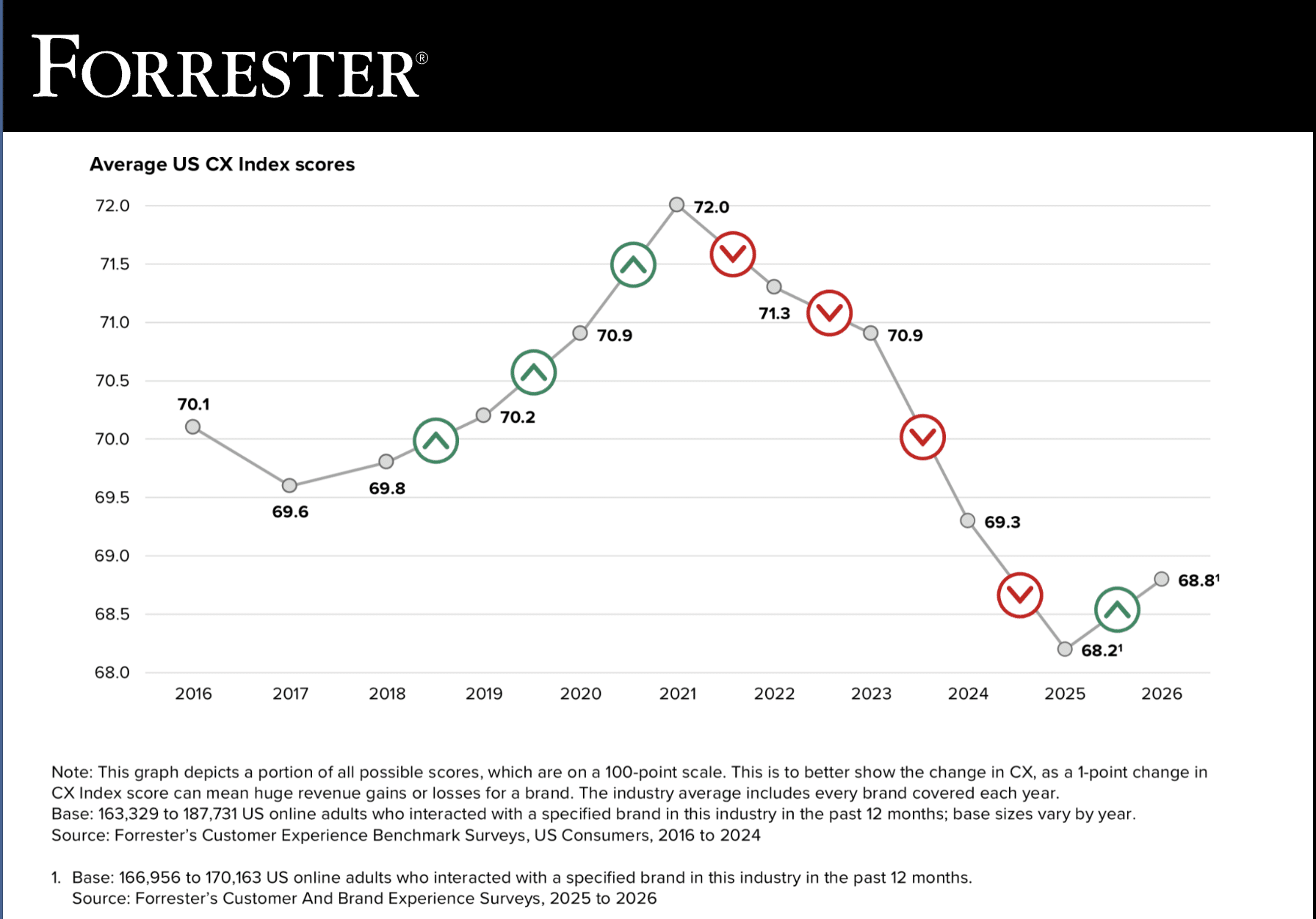
[00:03:53] Stacy Sherman: We started the CX index in, 2016, and the lowest [00:04:00] score ever on average for the US was last year. highest was actually 2021 and had been on a decline from 2021 to 2025, four years of decline.
[00:04:11] Rick Parrish: that includes declines on all three of those Es, effectiveness, ease and emotion. And, since I mentioned that, uh, is the CX index, rather than simple customer satisfaction or something like that, I’ll just say a word about it, about what the index is. This is a compound metric that [00:04:30] studies how well the quality of a customer experience drives loyalty. So it’s a zero to 100 scale at the top line. If customers love you, but they don’t love you in a way that drives loyalty behaviors, you score low. in order to do well in the index, you have to not just create good experiences, but create experiences that drive loyalty. I said, we saw the lowest score we’d ever seen, last year
[00:04:55] Rick Parrish: Why? Yeah.
[00:04:56] Stacy Sherman: let me pause with why, and then I wanna go back a little [00:05:00] bit to say, is this because of COVID? Is this because of… I have my own beliefs, but let me hear yours first.
[00:05:08] Rick Parrish: Sure, sure. yeah, we saw the highest scores ever. So ba-back when we started, I’m talking the average score in, US, right?
[00:05:15] Rick Parrish: Canadian numbers tend to move in unison with US ones. Other parts of the world, a little bit different.back in 2016, the average score was seventy point one on our 100-point scale, which is, youknow, is all right, but there’s room for improvement, right? Then it was a little flat, went up a little bit, started climbing up, climbing [00:05:30] up for sort of three years in a row, and then hit a high average of a seventy-two in 2021.
[00:05:36] Rick Parrish: so that’s a high from 70 to 72. You might say that’s only two points on a 100-point scale. H-how much could that really mean? it’s a really finely tuned instrument, so depending on industry, one-point improvement can mean hundreds of millions of,dollars or even billions of dollars in incremental revenue growth.
[00:05:56] Rick Parrish: So if you’re the average, say, the average, uh, bank, one-point improvement [00:06:00] means something like four hundred million dollars in revenue, So two points a big deal. Plus, we’re talking about hundreds of brands, and so any statistical movement requires an awful lot of movement at the brand level, right?
[00:06:13] Rick Parrish: But then from that high in 2021,down to a low of sixty-eight point two in 2025, right? So the lowest scores we had ever seen. so you ask why? what’s going on here, right? So when we look at the data, we can see a few things. We can see [00:06:30] all three of those E’s went down, effectiveness, ease, and emotion. Drivers, we studied dozens of different drivers so that we can actually say, here’s a lever you have to pull to, to improve, right? We saw declines on all the top drivers, just steady settling of scores. And when we look behind that to try to figure out why, we come with, some big systemic things.
[00:06:50] Rick Parrish: Because you know, if you’re seeing, year over year declines in a swath of industries, then this isn’t about some scandal one brand had or [00:07:00] some problem in one industry, right? this is systemic economy level stuff. and this high we saw in 2021, sure, it had something to do with the pandemic, right?
[00:07:09] Rick Parrish: Companies were doing things to improve the quality of the experience and doing them rapidly, right? It’s hard to remember back to that time now, but if you think, companies were iterating quickly, coming up with all kinds of new things, right? it was a feeling everybody was in this together or working.
[00:07:24] Rick Parrish: But it’s important to remember that growth to that, that historic high in ’21 didn’t come out of the [00:07:30] blue. It had been the culmination of a few years of improvement. But then what happened? Why the four years of decline to 2025 since then? as the, the pandemic started easing, companies rolled back some CX improvements that they’d made.
[00:07:43] Rick Parrish: Even, and this is really interesting, even when those improvements showed positive ROI, the inertia of business took over again. And for example, many banks, I- I’m just gonna pick on banks for a second, but it’s– this is about more than that. many banks had cut [00:08:00] fees. Or I can pick on utilities too.
[00:08:02] Rick Parrish: Many utilities had put in, flexible payment plans, right? Other industries did other things. Many of those had a positive ROI. For example, many of the banks that cut fees in the name of we’re all in this together during the pandemic, drove more assets under management, right? So it was a positive ROI.
[00:08:20] Rick Parrish: And yet, again, when the pandemic started to ease and business leaders felt there wasn’t this emergency anymore, they cut these things. They cut these CX improvements [00:08:30] even though there was a positive ROI, right?
[00:08:32] Stacy Sherman: I have to add one thing there. You’re reminding me, ’cause I was working in the brand, and we would do outbound “are you okay calls” to our customers. So instead of, a traditional survey that we did, we would literally outreach and say, “We’re here for you. How can we help you?”
[00:08:51] Stacy Sherman: I mean, that was brilliant, and it stopped after that.
[00:08:54] Rick Parrish: That’s right. Exactly. and so that’s one cause, right? One cause is back to the [00:09:00] sort of nickel and diming business as usual. other causes are things like, do you remember the burnout among employees back in ‘ 22, ’23, right? it was intense, and it was across all businesses. we have a whole other line of employee experience research at Forrester that showed this, right?
[00:09:18] Rick Parrish: And so companies and individual employees, whether customer facing or behind the scenes, just weren’t at their best. Nobody was at their best. And so again, CX just settled a little bit more. And then [00:09:30] there was the drive for, cost cutting, right? And, this is where, the difficulty that many CX programs have in showing, not only showing positive ROI of their work, but in then telling a convincing story about the positive ROI, meant that they were unable, in too many cases, to argue against the people who were saying, “Cut this, it saves money.
[00:09:52] Rick Parrish: Cut this, it saves money. Cut this, it saves money.” and so the cuts were made, CX suffered, CX and loyalty associated with [00:10:00] CX continued to decline until we hit rock bottom in ’25.
[00:10:05] Stacy Sherman: Mm. So it’s going up slightly now.
[00:10:08] Rick Parrish: Slightly. Yeah. so the average, in the US went up less than a point from sixty-eight point two to sixty-eight point eight. But as I said, the CX Index is a finely tuned instrument. That number is both statistically significant and meaningful in the real world companies are providing a noticeably slightly better experience [00:10:30] on average.
[00:10:30] Stacy Sherman: Yeah.
[00:10:31] Rick Parrish: actionable findings
[00:10:32] Stacy Sherman: Rick, the information, the trending is so valuable. Now I know listeners are asking, “Okay, what do I do with that? How do I bring this insight to my team and those with power of the purse to convince them and get buy-in for some of the CX activities we wanna do?
[00:10:51] Rick Parrish: Yeah. that’s the real point, isn’t it? is to drive action and not just to show an interesting trend. And so one thing you can do, even with just the top line numbers, is to take this [00:11:00] to decision-makers and say, “Customer experiences are, on average, relatively weak across the economy and in a given industry,” and perhaps even, at the individual brand data level.
[00:11:11] Rick Parrish: and say, “We have an opportunity here to drive additional loyalty efficiently by improving the quality of the experience.” if the average score was ninety out of a hundred, at that point, making further improvements is difficult and probably expensive.when the average score is [00:11:30] less than seventy, and, only last year, twenty-six percent of brands improved at all, the vast majority remained flat. There is a huge green field out there of basic bread-and-butter improvements that can drive meaningful CX differentiation. And then take that to, to the next level, the more actionable level, to the driver level, and look at individual drivers to say, “Here are the most important drivers for a given industry, you know, for our industry, maybe even for our brand.
[00:11:58] Rick Parrish: And, here’s the middling performance [00:12:00] you see on these drivers.” These are the levers to pull to improve efficiently, right? Because that’s always the trick about CX work, is to not just do a lot of CX stuff, but to do the right stuff to improve efficiently for positive ROI. And so it’s the driver-level data, that is really where the actionability comes in once you open the door with the top-line data that shows how not so hot, things are.
[00:12:24] Rick Parrish: Sometimes that data surprises some senior executives who are used to getting a [00:12:30] rather rosier picture from their own data.
[00:12:32] Stacy Sherman: So let’s talk about the drivers and actionable solutions. Now, in my own framework, and I wanna highlight something, from what my study has shown that why this is so important, which includes the fact that 60% of customers leave after one negative interaction. That is a huge recovery requirement.
[00:12:57] Stacy Sherman: Also, the fact is 54% [00:13:00] actively tell others when they had a negative experience, and 29% never, ever even tell you. So you can’t even fix the challenge, the problem, to get them back.
[00:13:12] Rick Parrish: Ja
[00:13:13] Stacy Sherman: so you have to get it right. You have to do CX right at the beginning. Now, let’s talk about how you do that. My own framework, it literally starts with defining what is the emotion that you actually want customers to feel, and make sure that every [00:13:30] single person from HR, IT, marketing, sales, product, that they’re all aligned and agreeing on that key emotion.
[00:13:38] Stacy Sherman: Because if you don’t set that, then you’re never gonna be able to create that, design that, and measure against that. So that’s something that is the beginning of my model. But I’d love to hear some of yours.
[00:13:52] Rick Parrish: Yeah. I really agree, right? It has to start with emotion, very specific emotions, as key parts of your CX vision and [00:14:00] strategy.
[00:14:00] Rick Parrish: This is something we do with a lot of our clients as we help them with their CX visions and strategies, because a lot of times they stay at a surface level and just think about the ease or the effectiveness of something without thinking about the emotional component.
[00:14:14] Rick Parrish: And if they do think about the emotional component, sometimes they do that only at a very surface level. They pick an emotion out of a hat. for a long time it was, it was delight. Everything was about delight. I’ll tell you,if this is a mortgage lender, nobody wants to be surprised and overjoyed [00:14:30] right?
[00:14:30] Rick Parrish: That is not the key emotion, If you’re paying your taxes, delight is not the emotion that you’re looking for, right? so we study a couple dozen different emotions in the CX Index, and we can say for each industry and each brand we study, what are the most important emotions to evoke and to avoid. andsome keep coming up, again and again. And oftentimes it’s not the most extreme ones. It’s not delight, nor is it rage. it’s the softer ones. It’s things like feeling confident, feeling [00:15:00] respected, feeling appreciated. Similarly ones to avoid, feeling, unappreciated, disappointed, frustrated, right?
[00:15:08] Rick Parrish: it’s the, the subtler ones that linger rather than the dramatic ones that, spike and fade. so yeah, I’m all about it coming down to emotion and, and coming down to specific emotions.
[00:15:20] Stacy Sherman: So once a company defines that core emotion that everybody is aligned to and harmonized within the company,
[00:15:28] Rick Parrish: Mm-hmm.
[00:15:28] Stacy Sherman: what I’d [00:15:30] say then is actually you need to go look at what are customers saying about you and those sentiments so you can see where’s the gap.
[00:15:39] Rick Parrish: Yeah.
[00:15:39] Stacy Sherman: What’s your view on that, and what other additional steps do they need to take?
[00:15:45] Rick Parrish: Sure. Yeah. as we, we started our conversation, by saying that you’ve got to really understand your customers, right? And understanding them at a deep level as people, and that means fundamentally understanding them emotionally, In 2026, only [00:16:00] 58% of customers say that their last experience with a brand was emotionally positive.
[00:16:04] Rick Parrish: Only 58%. That’s less than two-thirds. And so,it’s up, 1% from last year, so that’s good news. but, companies can do a lot better here. And as I said earlier, it gets even trickier when you’re thinking about designing digital experiences for emotion. It can be done, but frankly, what it really takes is taking your design program seriously rather than allowing your developers to lead the [00:16:30] development,which we see, too often. And it’s becoming even trickier with AI-driven digital experiences. We’ve all seen the headlines about, some patients, think that the LLM is more empathetic than the doctor, right?
[00:16:42] Rick Parrish: That’s not a claim about how great LLMs are at empathy. It’s a claim about how bad doctors are at empathy, right? it’s very easy, especially when we think about beyond the interaction level, but to the journey level, which is where experiences really happen. Designing emotionally [00:17:00] resonant journeys that are either enabled by or at the customer facing level use AI more and more.
[00:17:06] Rick Parrish: We’re seeing emotion considered less and less,as that happens, although there’s very interesting things going on between the sort of melding of the designer developer tasks that, is an opportunity there. it’s a danger if it goes in one direction, but it’s also an opportunity to pull more, human focused, emotionally focused design elements in,earlier and more frequently.
[00:17:29] Rick Parrish: So there’s a real [00:17:30] opportunity here. as I said, we’ve just got to stop the dev teams from running away with it.
[00:17:33] Stacy Sherman: Well, you said something important I want to emphasize for our listeners, is that it is about designing positive emotional connections at every interaction. There is a journey, and your customers may be on a journey to your retail store or your physical location, and there is the digital journey.
[00:17:51] Stacy Sherman: And where the human goes versus the AI enablement, you’ve got to include that in your journey and [00:18:00] measure those emotional peaks, highs and lows, very meticulously. So I can’t say that enough
[00:18:07] Rick Parrish: Absolutely, and, designing the emotional arc of a journey is so important, End on an emotional high,to raise the sort of in people’s memories the emotional level of it, and thinking about those journeys as broader than we often do. We did a separate study,earlier this year, since you mentioned retail is what made me think of it, you said people may be on their journey to your brick-and-mortar location.
[00:18:26] Rick Parrish: we did a study about the importance of, [00:18:30] things outside of the normal CX driver zone in the quality of the brick-and-mortar retail experience. For example, people who perceive that the quality of the environment, is good have a better retail experience than people who don’t think that the quality of the natural environment is good where they live.
[00:18:46] Rick Parrish: Or similarly, people who say they generally don’t worry about their physical safety have a better brick-and-mortar retail experience than people who say they do generally worry about their physical safety. People who say they have bad v- vehicular traffic, have a [00:19:00] worse brick-and-mortar retail experience than people who say traffic isn’t so bad.
[00:19:04] Rick Parrish: so… Now, those are not, the first things to focus on if you’re a retailer. There are other things to focus on. You know, as shown in the CX Index, top drivers, answers my question the first time I contact them, has convenient store hours, other stuff like that.
[00:19:15] Rick Parrish: But I raise this because we need to think about those customer journeys as more expansive than we usually do. And there’s a point at which,it makes less sense to put more money into your mobile app, and makes more sense to transfer [00:19:30] some of that money into subsidizing something that alleviates traffic congestion outside your parking lot Or something like that, right?
[00:19:38] Rick Parrish: Doing CX right is a broader thing than we often think it is.
[00:19:42] Stacy Sherman: Well, we also need to make sure that Leaders are focusing on what’s in their control. You cannot fix everything. So what we’re talking about here are really lasering in on what is in your capacity to control so that you can elevate [00:20:00] that emotion for your buyer, for your prospects to choose you over and over again.
[00:20:05] Rick Parrish: Absolutely. Absolutely. and, th- this is, of course, always the challenge with CX leaders is what’s within your control, right? We all know that, CX team’s responsibility is vastly broader than CX team’s, authority, right? It’s all dotted line work in CX, And so that’s why having the right data, and then being able to use that data to tell a convincing story and build a coalition is vital d- to the work
[00:20:29] Stacy Sherman: With [00:20:30] the companies that you’ve worked with, what has been the best organization? I’ve been in CX roles in so many different companies, and I’ve sat in where I reported directly to the CEO. I’ve reported into marketing. I’ve reported into product. If someone’s coming to you to say, “How should we set up?”
[00:20:49] Stacy Sherman: What would you say, what would you suggest?
[00:20:51] Rick Parrish: Yeah. we did a really interesting study on this. the study took over a year because we wanted to make sure that we addressed all the potential variables and [00:21:00] really narrowed this down to something specific. And what we found, in a nutshell, is first of all, companies can succeed or fail on CX with any wiring diagram. It’s not the most important thing, However, you’ve gotta make some choices about it, and it is important. a couple of the things that are, essential to get right are, one, moving CX close enough to where the real power centers of the organization are. In some companies, that might be the chief operations [00:21:30] officer.
[00:21:30] Rick Parrish: In other companies, it might be, the chief marketing officer. different companies have, different power centers, right? Because so much of getting CX done is about showing how you can help things that the company already considers important, rather than saying,no, here’s a whole other separate thing that’s important.”
[00:21:46] Rick Parrish: And so getting yourself close to those power centers and then,identifying the right sort of, operating model for your team, which can be different depending on different organizations, So there’s a lot of it depends here. I think one of the most interesting findings of our [00:22:00] study, of the, the handful of variables we came up with to figure things out was, getting close enough to the CEO, but not too close to the CEO.
[00:22:09] Rick Parrish: What we found was that in many companies, not all companies, of course, there’s always exceptions to this stuff, right? But we found in many companies, CX leaders who were direct reports to the CEO were less able to get stuff done than if they were a direct report to some other C-suite leader. Again, not always, and of course, we [00:22:30] know that CEOs need to be champions of CX and all that, right?
[00:22:32] Rick Parrish: And so that was sort of the assumption. let me get right next to this CEO, and then we can make them a champion.” But what also ended up happening there was the CX leaders, in many cases, ended up less able to focus on the long-term improvements that needed to get done and ended up more subject to the sort of,day-to-day back and forth of what the CEO might be interested in that morning.
[00:22:54] Rick Parrish: and so it wasn’t always the most effective move. In other cases,it was, right? but so there’s a lot of it depends here. Getting [00:23:00] close to the power structure, finding the right personality. maybe, you know, this chief digital officer is great, but the next one, not so much.
[00:23:07] Rick Parrish: You’re better off trying to get yourself shifted over somewhere else. So there’s a lot of it depends.
[00:23:12] Stacy Sherman: I would say from my experience, two key success factors. One is to make sure no matter where you sit, you have a seat at the table where decisions are being made at the top. Because it’s very different when I had someone represent my [00:23:30] recommendations and try to play like the game of operator, like, and try and translate it, was not as effective as me being at the seat with the people that are the leaders of the different teams, and we were able to align.
[00:23:42] Stacy Sherman: So that’s one. And two, everyone has to have the same customer metrics, because when only my team was measured on is that emotional high happening? Is that not just NPS, but like the [00:24:00] comments around the NPS and all those other scores. If everybody’s aligned to it, then they would take the recommendations that my team would give and actually implement them in the business lines.
[00:24:13] Stacy Sherman: So those are my two additions.
[00:24:16] Rick Parrish: yeah, if we’re thinking about the, beyond structure and thinking about other methods for alignment, right? making sure everybody’s,focused on the right metrics. Although focused on the right metrics can oftentimes be very tricky because it’s easy to go it’s easy to just become metrics obsessed and worry about the numbers [00:24:30] rather than about what the numbers mean.
[00:24:31] Rick Parrish: Having the right vision and strategy. As you say, that seat at the table,that’s what I meant by, power center. if you can get yourself connected to where work actually gets done in the organization, decisions get made, that’s really the most important thing of a handful of areas.
[00:24:43] Stacy Sherman: So before you said to me, something about personalization, that it was a little contradictory.
[00:24:50] Rick Parrish: Oh, yeah. yeah. I may have exaggerated when I said about half of consumers don’t want it,
[00:24:55] Rick Parrish: but a substantial portion of consumers, think personalization’s creepy. and, the [00:25:00] data really shows when we put the consumer data next to the data we ask of business leaders, business leaders, by and large, even admit that when they personalize in an inside-out way. They personalize based on what the company wants people to do, not in a way that helps people do what they want to do, right?
[00:25:17] Rick Parrish: So most business leaders, recognize that of themselves, and yet year after year, they don’t change it. And so the, the personalization they’re doing is in many cases not helping customer loyalty and in some cases, harming [00:25:30] it for those consumers who find it creepy. one of this thing about knowing your customers is knowing which ones want personalization and which ones don’t,
[00:25:38] Rick Parrish: this is something that, that is, it’s become a sort of, I don’t know, a sort of truism in CX and marketing work that everybody wants personalized experiences. It’s just, that’s just not accurate. unless we say for some people, personalization means don’t personalize.
[00:25:52] Rick Parrish: Yeah, we could play it that way.
[00:25:53] Stacy Sherman: last thing on that is I got a couple emails recently that said, “Dear X,” which was a [00:26:00] placeholder for my name.
[00:26:02] Stacy Sherman: Like, you have to audit your technology ’cause
[00:26:05] Rick Parrish: please
[00:26:06] Stacy Sherman: it’s noticeable. that’s worse than spelling my name wrong, but that’s another topic another day.
[00:26:13] Rick Parrish: Yeah.it’s totally the thing. If you’re gonna do it, if your customers want you to do it, and you’re gonna do it right. Do it in ways that are going to drive loyalty. when you, you make a sort of a ridiculous mistake like that, it takes a whole step backwards, right?
[00:26:27] Rick Parrish: and all of the design for [00:26:30] emotions and proper metrics and all the other, CX work in the world can be just erased by Dear X
[00:26:38] Stacy Sherman: And people are probably saying, “Okay, so how do I really know what our customers are saying and feeling, and do they want personalization?” That all comes from really understanding your customer, the voice of customer insights. You get them from your structured surveys, but you also get it from the unstructured, what they’re saying online about you.
[00:26:58] Stacy Sherman: And [00:27:00] AI is a really good tool to help you gather and not have read one by one by one
[00:27:05] Rick Parrish: A-a-absolutely. You know,it’s that unstructured data and other types of qualitative research that have really been lacking in companies because it takes more bandwidth to do, so AI can be very helpful, on that front, for looking at unstructured data, you know, the sentiment on social media and verbatims and things like that.
[00:27:22] Rick Parrish: Also, some of the contact center call analysis and things like that. But,one technology that’s, still new but, can [00:27:30] really help on this front as well is AI-moderated interviews. there are some best practices for using it, for sure. doing qualitative interviews has been one of the things that is the most resource intensive for companies, and so that’s why they haven’t done it.
[00:27:42] Rick Parrish: But it’s the source of so many of these really good insights. But now with AI-moderated interview technology, that can supplement your expert interviews. Again, y- you don’t wanna go too deep in here. There’s definitely some things to avoid and some best practices, but it’s a way to scale your qualitative research to get deeper [00:28:00] insights in ways that you couldn’t do that before.
[00:28:01] Stacy Sherman: Ooh, that’s a great tip. And I’m gonna have to talk to you later about who are some of those players, because I haven’t paid enough attention to them, and I’m going to.so rapid-fire questions here as we’re at the end. What is the most important key takeaway you want listeners to go do? Not think,
[00:28:21] Stacy Sherman: but literally go do tomorrow at their workplace
[00:28:24] Rick Parrish: Find out, no kidding, what the most important driver is for CX in your company. [00:28:30] And not just to improve satisfaction, but to improve ROI, and focus there first.
[00:28:34] Stacy Sherman: Say that in terms of someone who’s not in CX to understand that, ’cause there’s some of those listeners.
[00:28:41] Rick Parrish: Oh boy. Between the hours of nine and five, I only speak CX. What actually makes your customers more loyal? What one thing doesn’t make them just say they like you more, but actually makes them behave differently? What one thing? If you’re not focusing the lion’s share of your resources on that, what are you [00:29:00] doing?
[00:29:00] Stacy Sherman: And what would you say, give them an example that you see as a common
[00:29:04] Rick Parrish: Sure. One of the most common ones across so many industries is clear communication
[00:29:10] Stacy Sherman: Okay.
[00:29:11] Rick Parrish: So many business executives say their company communicates clearly. Their customers disagree. Do the research, figure out what language your customers actually understand, what words, what phrases, and then what formats they actually understand That is [00:29:30] oftentimes the top driver and a top driver on which companies perform most poorly
[00:29:37] Stacy Sherman: Mm-hmm. Best leadership advice you’ve ever received or given
[00:29:41] Rick Parrish: Best leadership advice, I’ve ever received was one of my first jobs working at a movie theater as an usher, and the manager said, ” Part of the job is to smile. Doesn’t matter how you actually feel, part of the job is to smile.”
[00:29:52] Stacy Sherman: Oh
[00:29:52] Rick Parrish: I thought about that, and I took that away and rattled it around for a minute, and what I took away from that is really, if you can’t show [00:30:00] enthusiasm for the work you’re doing, why should anyone else care?
[00:30:04] Rick Parrish: Luckily, I’ve had a good run of jobs that I’m actually enthusiastic about, so I don’t have to pretend. but even if you are the sort of person who is enthusiastic but doesn’t show it, I have no poker face. but get it out there because if you don’t show people you’re enthusiastic about something, they’re not gonna be enthusiastic about it either
[00:30:22] Stacy Sherman: Yeah. Which is why I also tell the call center agents, even though you’re not seeing the customer, dress as if you’re [00:30:30] going to see them, talk with a smile. They hear it
[00:30:34] Rick Parrish: They hear the smile. Yeah. I got that advice from, my work study job in college when I was calling prospective students. They said, “Smile, because people can hear a smile.”
[00:30:44] Stacy Sherman: 100%. final question, my favorite. If we could go back in time and talk to younger Rick, 20-year-old Rick, based on what you know now that you didn’t know then, what would you tell the younger you?
[00:30:57] Rick Parrish: The 20-year-old Rick thought that being right [00:31:00] was better than being kind. The 51-year-old Rick knows that not necessarily the reverse, being kind is better than being right, but you can be kind and right at the same time, and that’s the best way to be both.
[00:31:12] Stacy Sherman: So maybe that’s good advice, or maybe it’s just an admission that it’s taken me 30 years to get someplace that other people got a lot sooner.
[00:31:20] Rick Parrish: Well, with age comes wisdom Well, thank you for sharing such amazing wisdom here personally and professionally. With your permission, [00:31:30] I’m going to share the trend report, statistics that is so eye-opening, and you gave some great context for it, and I encourage people to dig into the report, download the report, connect with Forrester to understand this in-depth, because it really is important to your business.
[00:31:50] Stacy Sherman: And, in the show notes, there’ll be, ways to connect with Rick. So thank you, and, I didn’t want it to end.
[00:31:58] Rick Parrish: It’s great talking to you. Thanks so [00:32:00] much
[00:32:00] Stacy Sherman: You too. Thank you
About Rick Parrish:
Rick is a research director in Forrester’s customer experience (CX) practice and the coordinator of research on customer obsession companywide. Rick’s team conducts cutting-edge research and client engagements to help CX leaders improve CX quality reliably and efficiently. Rick’s own research focuses on government CX and corporate values strategies.
https://www.forrester.com/analyst-bio/rick-parrish/BIO7424
Connect with Rick on LinkedIn.
Questions & Answers: What Leaders and Teams Need to Know To Improve Customer Experiences The Right Way
Q: Why did customer experience scores in the U.S. decline from 2021 to 2025?
A: Scores fell across dozens of industries due to system-wide factors rather than single-brand mistakes. As the urgency of the crisis eased, companies rolled back customer-friendly policies, such as fee waivers and flexible payment plans, despite proven positive ROI. This was compounded by employee burnout and cost-cutting pressure that teams struggled to counter with traditional metrics. On this Doing CX Right® episode, you will learn how business inertia takes over and how top-performing brands overcome this trap to drive growth.
Q: What are the three qualities that make up a customer experience?
A: Customer experience consists of effectiveness, ease, and emotion. Crucially, these are independent variables, meaning that making an interaction easier or more effective does not automatically make customers feel better. Among the three, emotion has the strongest statistical impact on customer loyalty. On this Doing CX Right® episode, you will hear how designing digital touchpoints for emotion differs from human interactions and how to measure both accurately.
Q: Which emotions keep customers coming back?
A: Subtle, sustained emotions drive long-term retention. Feeling confident, respected, and appreciated creates true loyalty, while feeling unappreciated, disappointed, or frustrated pushes customers away. Chasing extreme reactions, like delight, often backfires in high-stakes industries such as banking or taxes. On this Doing CX Right® episode, you will learn how to define and harmonize the exact core emotion every team across your company must deliver.
Q: How do I get executive leadership to approve customer experience spending?
A: Start by showing overall market weaknesses with benchmark trends, then present driver-level data that proves which specific levers directly impact loyalty behaviors and revenue. Additionally, position CX near key operational power centers and align every business unit to shared customer metrics. On this Doing CX Right® episode, you will discover how to structure your pitch and align stakeholders to secure executive buy-in.
Q: What is the most common driver of customer loyalty that companies get wrong?
A: Clear communication. Executives almost always believe their company communicates clearly, but customers strongly disagree. The fix is to conduct qualitative research to identify the exact words, phrases, and formats your customers actually understand. On this Doing CX Right® episode, you will hear practical steps for auditing your messaging and eliminating internal corporate jargon across all channels.
Q: How can AI help a small team understand what customers feel?
A: AI synthesizes unstructured feedback at scale, analyzing reviews, social media comments, survey verbatims, and support call transcripts without manual effort. Beyond text analysis, teams are now using AI-moderated interview technology to scale qualitative research without adding headcount. On this Doing CX Right® episode, you will learn how to deploy these modern tools effectively while avoiding common design traps.
Access More Valuable Research To Achieve Business Growth.
Download The Distinctive Business Advantage research report to discover exactly what top-performing companies are doing to drive customer loyalty and sustainable growth, and what you can do as well. https://doingcxright.com/research. Bring these insights to your company. Stacy is available to present the findings and proven strategies at your events, workshops, podcasts, and training sessions.
About Stacy Sherman:
An award-winning international Certified Speaking Professional (CSP) who has delivered hundreds of standing-ovation keynotes and workshops and co-authored best-selling books on Experience Management for sustainable success. She developed a proprietary framework that enables leaders and teams to enhance revenue and brand reputation. Her proven methodology is based on her MBA degree and 25 years of leadership in sales, marketing, employee, and customer experience across diverse industries, including Verizon, AT&T, Schindler Elevator Corporation, Wilton Brands, Martha Stewart Crafts, and LiveOps, generating $2.4 billion in savings and hundreds of millions in revenue. Stacy Sherman has earned widespread recognition for her award-winning “Doing CX Right” podcast, ranked in the top 2% globally with over 200 episodes, and for her courses on LinkedIn Learning, which have garnered hundreds of 5-star reviews. A multi-year Global CX Guru awardee and 2026 ICMI Hall of Fame inductee, Stacy’s insights have been featured in Forbes, Psychology Today, Yahoo News, and other leading publications.
Need help? Let’s talk.