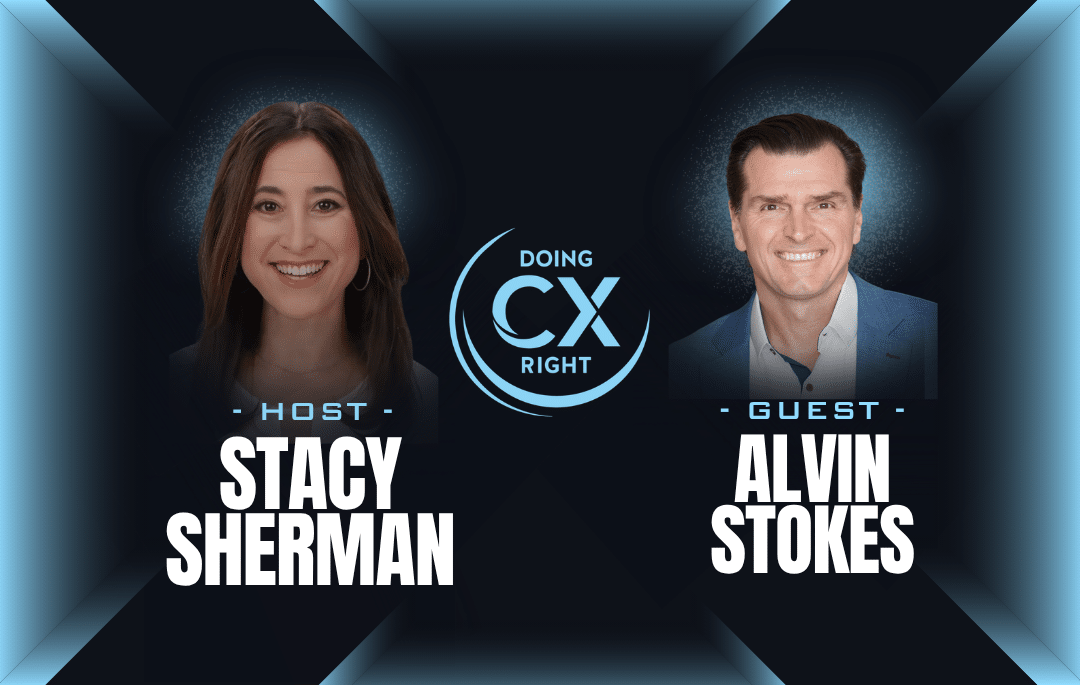




Most companies are rushing to deploy AI faster than their competitors. Alvin Stokes of Princess Cruises says that is exactly the wrong instinct. Speed without emotional intelligence does not create better guest experiences. It creates tools your frontline team will not use, prototypes your customers will not trust, and revenue you will not recover.
So what separates AI programs that improve service, gain frontline adoption, and generate measurable returns from those that do not? This episode is for any leader who wants to move fast with AI without breaking the customer relationship in the process.
What You Will Learn About AI, Guest Experience, and Emotionally Intelligent CX:
- Why emotional intelligence is the missing ingredient in most AI deployments, and how Princess Cruises builds it into every tool before agents ever touch it
- The blueprint Alvin’s team uses to prototype fast, pilot heavily, fail quickly, and scale only what actually works, producing a nine-figure revenue gain in 12 months
- How AI is changing what “listening to customers” means, from three-month-old NPS surveys to real-time sentiment analysis across every channel interaction
- Why the frontline agents who resist new tools are your most valuable source of feedback, and how to use their input to drive faster adoption across the team
- How Princess Cruises’ Smooth Sailing Squad uses AI-generated daily reports to surface policy and process friction points before they damage the guest experience
- What new KPIs are replacing NPS as the primary measure of guest loyalty, and why tracking sentiment over 10, 50, or 200 interactions tells you important information that a single survey never can
Actionable Takeaways From This Doing CX Right℠ Podcast Episode:
- Before building any AI tool for your frontline team, study the top five percent of performers. Understand what they do differently and use that to define what the tool needs to replicate.
- Run pilots with real agents before scaling any AI program. Their adoption signals, not your demo results, are the proof that the tool will work.
- Build listening mechanisms directly into your pilot process. Agents who reject a tool are telling you something specific. Find out what it is before you build further.
- Stop relying on a single post-interaction survey as your primary CX signal. Start tracking sentiment trends across every interaction a customer has had with your company.
- Create a cross-functional mechanism, like the Smooth Sailing Squad, that uses AI-generated insight to surface friction points and routes them to the team that can fix them.
- When presenting AI pilots to the C-suite, pair the vision with early results. A prototype alone does not earn budget. A prototype with data does.
- Give agents visibility into customer sentiment history before and during an interaction. A guest who has had 200 interactions needs to be handled differently than one who has had four.
- Build your AI vendor relationships as carefully as your hiring decisions. The right partners determine whether you can move at the speed your blueprint requires.
- Do not scale an AI tool until your frontline team emotionally believes in it. Adoption rate is a leading indicator of whether the tool will actually improve the customer experience.
- Set an aggressive six-month vision for what AI needs to accomplish, then build the test-and-learn muscle to pursue it without overpromising to leadership along the way.
Press Play To WATCH On Youtube
Doing CX Right Podcast Topics with Timestamps
[01:00] What “doing guest experience right” actually means
[00:02:00] Why emotions are the foundation of every customer interaction
[00:03:00] The biggest challenge companies face: tech debt and pressure to move fast
[04:00] The blueprint: prototype fast, pilot hard, fail fast
[05:00] How to get agent adoption without losing hearts and minds
[07:00] Why real-time voice transcription replaces the three-month-old NPS survey
[08:00] How team culture and peer passion drive agent performance
[09:00] Using AI to route agents to their most skilled peer during a live call
[10:00] The give-to-get strategy for breaking departmental silos
[12:00] How the Smooth Sailing Squad turns daily AI reports into process fixes
[13:00] Speed as a competitive position, not just an operational goal
[17:00] Studying the top 5% of agents before building any AI tool
[18:00] Personalized service across every loyalty tier using the same tools
[21:00] Why NPS alone is no longer enough and what comes next
[23:00] Leadership advice and the entrepreneurial mindset inside a corporate structure
Read Full Episode Transcript
Alvin Stokes: Hi there. Great to be with you
Stacy Sherman: I’m excited to get deep into some customer experience and leadership topics with you, especially because I haven’t had any brands like where you work, and I think there’s so much to learn, even if you’re in other industries. This is gonna be very exciting. So rather than tease the audience, please share, Alvin, who are you?
What do you do for a living?
Alvin Stokes: Well, I work in the cruise industry for Princess Cruises. I’ve been here for two years and a few months, and, to your point, it’s the first time I’ve been in this industry. Done hospitality and about 10 other industries in the past, but very exciting space and very guest-focused
Stacy Sherman: Guest focused. That is exactly why I’m so [00:01:00] excited to talk to you, and listeners are going to learn incredible gems. So take notes everybody. Guest experience, because that is all about a customer experience said in a different terminology. So first of all, when I talk about doing CX right, doing guest experience right, what does that mean to you?
Alvin Stokes: People have so many ways that they try to express this. With me and, and the time that I’ve spent here at Princess, it’s been all about trying to deliver emotionally intelligent interactions, building a team that can deliver that and find ways where you can bring technology together to empower our team members to do just that, emotional intelligence and make the customers happy.
Stacy Sherman: I have chills because I always say emotions is the experience. So you’re saying emotional intelligence. Say a bit more when it comes to doing guest [00:02:00] experience right, what the heck do emotions have to do with that?
Alvin Stokes: So much. I mean, you know, I had a transformational experience about 15 years ago when I was in consulting and I was working with loyalty, companies worldwide, and went through some training to, to make sure that we understood both the client that we were serving and their customers. The customers’ perceptions are important, and when we have interactions that don’t go well or do go well, all of our team members that, you know, that service and sell to our guests, it’s important that they understand that guest perception so that we can deliver on what they need.
If we can’t do that, then, we’re not doing it right. And so we focus hard on the emotional side of that. We’re, we’ll talk about this later, I’m sure, but we’re doing deep work in AI, right? On the artificial intelligence and trying to use that to empower. But we can’t lose the fact that, customers and guests are happy when they have real experiences with people that make them feel good
Stacy Sherman: So let’s dive into [00:03:00] the core problem. What do you see as the biggest challenge that customers are facing today? and it could be in your industry, but I imagine it’s very common among others too.
Alvin Stokes: Yeah, I think, um, and I have worked, as I said, in so many industries. Every place I’ve ever been has a lot of tech debt, and they’re trying to catch up, and now they’re trying to go, there’s pressure to go faster than ever because people believe that AI can make it happen now. So we’re trying to bring it together, and we’re trying to make sure that we can, we can really go fast.
The empowerment of the team members that are helping the guest is important. I think that it’s been a challenge to make sure that we don’t overdo it. That pressure of trying to basically build something that could actually damage the guest experience is something that we all have to watch against, and we’re being very careful
Stacy Sherman: So you mentioned speed. there’s the opportunity for speed, yet we also need to account for the emotions and the sentiments [00:04:00] and that intelligence, and everybody needs to be accountable for that. So do you see that all blending? Do you see it as a paradox?
Alvin Stokes: Yeah. You know, it’s really interesting. I am the biggest proponent of speed is important, I preach that and my team, we’re all on the same page. We want to be the first. We want to be revolutionary, to do things in a way that, enables the business to succeed in a format that the guests are happy.
We have our own blueprint on how we’re doing that, it goes a little bit like this. The blueprint is in today’s world, right, if you have the world’s best engineers, you can prototype so fast, you could get ahead of yourself. You could get ahead of the skis on the requirements, and if you build too fast before you’ve proven that it actually works, you could end up with a product that’s servicing or a tool that’s servicing the guests that, our team members don’t emotionally believe in and they don’t use it.
And so we build the prototype super fast, but we do heavy, heavy piloting. We fail fast, and then we learn from the [00:05:00] failures so that we can in turn build requirements and build new tools that can hit the mark on the emotional intelligence because our, people that are servicing the guests believe in the tools faster.
Adoption is better
Stacy Sherman: What are some of the things that you’ve come up against to get everybody to adopt, not be fearful of the technology, and that it’s really enabling the better customer experience?
Alvin Stokes: Yeah. A really important one. When you think about sales, it’s so important to all of the businesses I’m sure that you talk to. They wanna make sure that the trending is going right. If you take a team that has already really good success and they have highly tenured sales agents or sales people, men and women in the company, you wanna be careful that you don’t lose the hearts and minds because you do too much change too fast, or that the change management slows them down.
And so we, we have a lot of listening mechanisms that we build into the piloting process, and we use a lot of transparency about AI, um, especially [00:06:00] how we are focused mostly now on building tools that empower and help us. I mean, it also helps within Princess Cruises. You know, a lot of our, our guests tend to skew a little bit older.
And so naturally speaking, we wanna make sure that we provide all channels that are great for them to be sold or service, but let them pick the right one across those.
Stacy Sherman: Listening obviously is a key word here, and listening has become more complicated on one hand because their conversations are happening on social media, rating and reviews,
Alvin Stokes: Yeah.
Stacy Sherman: beyond surveys. Yet AI is helping us be able to sift through all of the conversations and grab the sentiments. What’s your view?
Is this becoming harder or easier to listen?
Alvin Stokes: So what you just, uh, mentioned to get us into is probably where, I intend to spend the majority of my time for all of the new tool sets that we’re going to be working on to help our agents service our guests for the rest of [00:07:00] this year and perhaps next year. In today’s world, we have the opportunity that we’ve never had as customer experience, guest experience practitioners, we’ve never had the opportunity where you can now quickly get across all channels, the historical interactions, the real voice transcriptions, and if you do it right, scientifically with a lot of listening, you can analyze a full trend of all the interactions.
You can understand the difference in a guest who’s only had four interactions and one who’s had 200. and instead of a world where, an NPS survey could be three months old and it might have a false positive, you can understand the trending. We’re working very hard to come up with our own set of new metrics, so that we can utilize that and actually deliver actionable results in real time to our agents.
Stacy Sherman: Ooh. How do you make people really care? I mean, especially customer service agents, that’s a monotonous job
Alvin Stokes: It goes back to the culture that you build within a team. People get really inspired when they’re trying to do something together. [00:08:00] I’m a team sports, always a football player and an athlete when I was younger in my life, and I just learned early on that you wanna do things together.
That’s a big part of it. So we try to recruit and hire people that have that passion. I was fortunate when I came to Princess that I had a really deep bench of people who had been in the cruise industry and been with Princess for a very long time. So was able to do both, rely on the people who had just a passion for cruising.
A lot of the people that work on our teams, they’re some of the world’s greatest travelers, right? They’ve been on our ships, and they understand both us and, hospitality worldwide. So then we bring in new people with new ideas, and we just build a culture together. I think the other part is, there’s really no levels when it comes to the spirit of innovation and us working together.
Every member of my leadership team is working with all aspects of the different lines of business, and trying to basically spend time to understand, both the things, the ideas that every agent or customer service salesperson has, or every [00:09:00] sort of ideas or issues, and then take those back.
Stacy Sherman: Yeah, I love those answers. I also, having led agent experience, created a community for them, almost like their own in-house Facebook, but not Facebook, where, they could actually get peer-to-peer support and ask each other questions. And so when you create a community for them, they really lean into that.
Do you find that true?
Alvin Stokes: Oh, absolutely. one of the many pilots and programs that we’re working on is, where the AI system, as it’s understanding and hearing the transcription of a call that’s going on, it could actually recommend to an agent another of their peers so they can immediately go into Slack or Teams channel, not bother them when they’re on a call and say, “Hey, I see that you have a really high score on this skill disposition.
Can you help me with this?” Just another way different than knowledge management system, but a way that we’re trying to do what you said, using tools to help our, our team members
Stacy Sherman: [00:10:00] Yeah. Now, silos exist everywhere. Every company I’ve worked in for 25 years and companies that I’m advising today, silos is just impossible to get rid of. However, I do think that customer service teams, customer experience teams are the glue to the organization. But how do you find, what’s been effective to make everybody across the organization, every role, to care, to actually own that customer experience because they want to?
Alvin Stokes: Yeah, several components to this. I think early on when I came here, nobody knew who I was, and, to earn trust and respect from my peers and the other teams, you know, I focused a lot on a give to get strategy, finding ways to give help to the other departments. I would also tell you that what I’ve learned over the years is if any team can be a major component for [00:11:00] building out extreme diagnosis with different types of data that can be helpful to the other departments, you can then move to a level where you can finally go… if there are goal problems where if you see that different departments have siloed goals, you can begin to bring those together. That’s actually one of the things, some of the best mentors and leaders I’ve ever had did a remarkable job of bringing together their really large teams and having a one big outcome or two or three big outcomes that all the departments went together on.
You have to kind of do all those together but the data component is a really big piece. I would say that’s where we’ve made the most progress here at Princess, and, and we’re going to start making huge step functions because of the AI ability to analyze the deep, you know, channel transcriptions.
It’s gonna make us, bigger helpers to all departments
Stacy Sherman: I also think what’s valuable is we used to send the recordings of the agent conversations to the business lines so they could hear directly what the conversations are.
Alvin Stokes: Yeah. So [00:12:00] absolutely love that. We have a new mechanism that we’ve built. We have a really wonderful partner called Harpin AI and, and one of the new tools that we have as a part of the extreme diagnosis, my team can, can create prompts for anything that they need to know across the lines of business.
And on a daily basis, it’ll spit out a report that says, “Hey, here’s exactly what’s going on. You know, your agents are, they’re mentioning this the wrong way,” or, “This is what they’re doing well.” But it isolates and calls out things that we know we need to look for, to help. You can do it at an individual, agent basis, or you can do it broader scale, but that’s been a huge success.
And from that, we’ve created kind of a smooth sailing squad because out of that comes a lot of the policy or process friction points that are picked up from all the interactions, and now we’re moving faster to go work on the process changes
Stacy Sherman: Smooth sailing team. I love the sound of that
Alvin Stokes: Yeah. I can’t take credit for it. You know, I’ve got a wonderful team who has taken that one and run with it. For your previous question about bringing the teams together, you know, it does a good [00:13:00] job, both it’ll point out when our contact center teams are not doing things the right way.
If we’re not positioning a promotion or a policy the right way, it’ll tell us, “This is where you focus.” But at the same time, it’ll isolate where we have, things that our e-commerce team can help us with, or the people on the ship can help us with, because, there’s a chain, and there’s different components where an interaction goes wrong.
It helps isolate that, and we can, like you said earlier, we can give the feedback to, to partner with our other teams.
Stacy Sherman: So is speed really the core goal this year, or is it something else? I heard you say quick, fast s- Yeah
Alvin Stokes: I keep
Stacy Sherman: a few times. Yeah
Alvin Stokes: Look, I believe in the first mover’s advantage, you know? We want to be sure that we’re doing the right thing. I believe in our blueprint the only way we can do that is through an extreme amount of test and learn, and always having lots of pilots. But then building the muscles and the mechanism with, engineers that can do the work of 20, 30, or 40 people using AI tools so [00:14:00] that we can then take the requirements that have worked and go really fast.
I’ve listened to a lot of your other great podcasts, I think some of my favorites talked about their failures, and I think our largest success that we’ve had in the last 12 months is a nine-figure incremental gain on revenue from AI programs. It was because in the early days we tried so many things.
We learned fast the ones that didn’t work, and then we doubled down on the ones that did, and it made a massive skyrocketing performance improvement
Stacy Sherman: Ooh, that is amazing. I want to reinforce the pilot programs, because A, that was a way that I was, able to get the executives and the board members to say, “Okay, we’ll give you some money to try this out. Prove it to us,” instead of a flat no.
Alvin Stokes: Yeah, that’s right. Same thing. Like I would tell you, go back a year, the one thing I would say is, there’s a lot in social media from some of the largest brands in the world, both tech and corporate, where they’re now saying, “Hey, be careful, not to [00:15:00] overpromise on what you do with your pilots or with the, the demos that you build.”
Because you can build, anybody, can build a demo really fast. That’s why I say we have a blueprint where we utilize the ability to make these, um, complete demo or prototypes really fast, but we have a really good system of testing things. A combination of using, some of the AI, but some manual work to make sure that when we go to my C-suite and I say, “Hey, here’s the vision of what it can be with this prototype that we did in a week or two,” there’s also some early results that go with it.
And when you do the two things together, there’s a lot of fast signups because they can believe in the vision and they can see the impact, that outcome that we talked about. They can see how it’s gonna help. And we’ve repeated that several times, and so far it’s working really well
Stacy Sherman: I want to emphasize for people listening, ’cause doing a sample prototype, minimal viable product, whatever all these terminologies meaning are [00:16:00] the same, and that you’re getting customer feedback along the way. Because too many companies will build something, launch it, and hope it works. And what we’re saying is get feedback really early in the process and iterate.
Alvin Stokes: That’s right. I’m not embarrassed or upset in any way to talk about the fact that some of the early prototypes, they might have had 20 different tool sets in a suite, and it might have only been four or five of them that ended up being what’s in the final because those are the ones that made the big difference.
And you asked about, you know, adoption and agents believing. They gave us the feedback along the way to say like, “That’s usable and that’s not.” Right? Because adoption is a big part of it. And then we would, we would iterate quickly before we built it out into the, into the thing that really is harder to change when we integrated it as CRM.
Stacy Sherman: That is such an important point worth repeating, that getting the people, the front line and the back office, but your agents, your [00:17:00] customer service team, even your sales team, all those people have so much feedback. To ignore that is a mistake
Alvin Stokes: Yeah. Oh, yeah. We, we can’t do that. We’ve spent a lot of time with our sales team along the way to make sure that it was gonna work. And honestly, we studied, before we built a lot of the, a lot of the tools, we studied the top 5% of our agents, our sales agents. So we really went deep to understand what they were doing and tried to mimic a lot of their, of their patterns.
In the agentic space, that’s what people are doing now anyway. Like, they’re trying to figure out how much of, your top one or five percenters that are making a customer happy or getting them to convert, how are you building that agentically? It’s, it’s part of the process
Stacy Sherman: Talking about loyalty, how do you actually focus? You have so many customers. Some are more valuable to the business financially than others. Do you bucket them? Do you serve all the same? What’s your whole view on loyalty and tactics around that?
Alvin Stokes: Yeah, we [00:18:00] could do a whole podcast on this one. We want to provide channels that everyone can use that are frictionless. Everybody’s trying to do that. We seek to really understand the differences in each individual guest. That’s why I mentioned, you know, the emotional intelligence part about that.
So part of it is continuing to improve the training and the quality metrics that we have so that every single agent has their own way within our system to make sure that they can keep a customer happy. We also just really need to make, make sure that we understand… Like, take casino, for example.
There’s obviously a lot of casino guests that come on, and we have a whole tiering system and a loyalty mechanism, and we have things in place constantly looking how we can provide better white glove service to those players because we know that they are r- really wonderful guests and they’re valuable to our company.
What I’ve found is that in most cases, every type of empowering tool that we’re providing, it can still help every guest, but sometimes in different ways, right? One [00:19:00] agent can take our most valuable customer that they work with or one that is not as valuable, they can use the tool to provide the same thing.
We’re recommending the right type of language based on what we know on each guest. You can still make them feel good, right? But obviously one is gonna provide us more revenue. So I’m hoping that what we’re building is that personalized service no matter what the loyalty is. But yes, we absolutely know which ones are the ones that we’re, are driving our business
Stacy Sherman: Mm-hmm. So people listening want to know where do they start? What is something they can do to enhance their business, get buy-in, all the things we talked about, move with quicker speed without sacrificing quality. What’s your advice to them? What are top three things you would say make sure you are doing?
Alvin Stokes: Don’t be afraid to make sure that you have the combination of the right team and the right partners. There’s so many different vendors that are moving so fast and improving. I’m [00:20:00] constantly making sure that I have that right combination, and that you know how to use them the best.
You need a very aggressive vision. Do not be afraid to have an extremely aggressive vision of what you want to achieve every six months, right? But then to go after it, right, you need your own blueprint to be able to fail fast and learn, and that’s where the people and the technology vendors come in, right? You have the right ones who can help you, move at a fast speed, then you can, you can make a big difference. Don’t be afraid. Go, go after it. Have a big goal. And I, and the other thing I would say is, you know, find the right circle of people that you can, test different ideas off of.
I’ve been very lucky that I’ve got a very, a great network of people across many brands that I call upon all the time, um, and, and throw out different ideas and we spar on, “Well, have you tried this?” And, and then you bring it together, and we share back in the community to try to help, which is, has been really invaluable
Stacy Sherman: You mentioned [00:21:00] measurements and knowing that what you’re doing is successful. What is your favorite measurement that you’re doing now or plan to?
Alvin Stokes: I’ve worked, you know, heavily with Net Promoter Score from the beginning when Fred Reichheld created it across many different companies. Have always loved it, but I’ve always found that it was the underlying metrics, you know, whether when I was running field services teams, it was mean time to install or mean time to repair.
When it was retail, it was different metrics, than it is for a call center. The only, the other thing that we had, it took a little bit of time to figure it out sometimes because, you might have a survey at your fingertips, and it could be a month or three months old. You might have had 5 or 10 or sometimes 25 interactions with a customer or guest since that survey was completed, and a lot is changing.
So we’re working on some brand-new, KPIs. Stay tuned. Not sure what we’re gonna call them yet, but, there will be a roll-up of something that understands the historical sentiment over time, right? And the [00:22:00] impact that it has on loyalty. And we’re gonna put it at the fingertips of our agents and empower them so they can see it.
You know, understanding how the sentiment changes over 10 interactions, and not every guest is the same. One guest may have only had four interactions with us ever, and another may have had 200. So, you know, their journey of sentiment over that time, and when you have a recovery or when you have something where you’ve really exceeded their expectations, it makes a difference.
And so we’re working on some brand-new, KPIs, statistically, using some RFM methods that, hopefully we’ll get done here in the next three to four months
Stacy Sherman: Well, I have a report, research coming out that talks about the return, return on investment of emotions in business.
So I’ll be sharing that with you and others, ’cause it’s really good information, related to what we’re talking about. Rapid fire here questions, ’cause we’re coming to- down to the end.
Leadership. What is the best [00:23:00] leadership advice you’ve received or given?
Alvin Stokes: Hmm. Wow. Um, be transparent and be vulnerable, right? Understand that, it takes a lot of different talents and skill sets to achieve great things. Knowing what I’m not good at and trying to round out a team of people who are amazing at the things that I’m not
Stacy Sherman: If you want them to leave this episode remembering one thing, what would that be?
Besides obviously take a cruise with you all
Alvin Stokes: Yeah. Well, listen, I think, we’re in an exciting time in the world. When I grew up, I remember, having a Tandy computer when the internet was first created and watching one image, you know, crawl across the screen and then, worked in telecom where the first flip phones we ever had on our belts. We’re in that space.
So I’m excited for a lot of us who are passionate about this to share and work together because I think we truly are, about to do some revolutionary things, create together I think through, you know, listening to podcasts like yours, [00:24:00] Stacy, it will just help us move through it together and excitement.
It’s very exciting
Stacy Sherman: And Alvin, if you could go back in time and talk to your younger 20-year-old self based on what you know now that you didn’t know then, what would you tell younger you?
Alvin Stokes: Hmm. I would say be more entrepreneurial. Even though I’m in a corporate environment and I absolutely love what we do, with Princess Cruises, I find myself trying to act more like an entrepreneur within our company, right? With all the piloting and all the prototyping that we’re doing, you need that edge in this era that we’re in to help our companies really just skyrocket wins.
Stacy Sherman: Hmm. Great answer. Well, it has been such a pleasure to have you today. I told you this goes too fast, but you’ll just have to come back. And thank you so much. I will be sharing all about you in the show notes, and I appreciate you
Alvin Stokes: Thank you so much, Stacy. This was fun
Stacy Sherman: Thank [00:25:00] you
Customer Experience Questions & Answers: AI, Emotional Intelligence, and Guest Experience
Q: What does emotionally intelligent AI mean in a customer experience context?
A: Emotionally intelligent AI refers to tools that help frontline agents recognize and respond to a customer’s emotional state, not just the transactional content of their request. In practice, that means AI systems that analyze tone, sentiment, and interaction history to surface the right language, the right recommendation, or the right peer to consult, at the moment an agent needs it. At Princess Cruises, this means agents are not just processing calls. They are equipped to make guests feel genuinely understood. The technology supports the human interaction rather than replacing it.
Q: How did Princess Cruises generate a nine-figure revenue gain from AI in 12 months?
A: The result came from a disciplined test-and-learn approach, not a single large deployment. Alvin’s team built prototypes rapidly, piloted them with real agents, and failed fast on the tools that did not work. Out of an early suite of 20 different tool concepts, only 4 or 5 made it into the final product. Those were the ones agents believed in and actually used. The revenue gain came from doubling down on what worked and moving quickly once the results proved out, rather than scaling everything at once and hoping adoption would follow.
Q: Why do so many AI tools fail to get adopted by frontline customer service agents?
A: The most common reason is that agents were not involved in building or testing the tool before it was deployed. When a tool is handed to a frontline team without their input, agents who already have strong results feel their expertise is being replaced rather than supported. Adoption drops, workarounds multiply, and the tool fails regardless of how well it was built. Alvin’s approach at Princess Cruises inverts this by studying the top performers first, building listening mechanisms into the pilot process, and iterating based on what agents say works before integrating anything into the core CRM system.
Q: What is the Smooth Sailing Squad, and how does it improve customer experience?
A: The Smooth Sailing Squad is a cross-functional team at Princess Cruises that uses AI-generated daily reports to identify and resolve friction points in the guest experience. The reports are produced by a system that analyzes agent interaction transcripts and surfaces specific patterns: what agents are communicating incorrectly, which policies are causing confusion, and where the breakdown between the contact center and other parts of the business occurs. Instead of waiting for a quarterly survey to reveal a problem, the squad can identify it in real time and route it to the team that can fix it, whether that is e-commerce, ship operations, or the contact center itself.
Q: Why is NPS no longer sufficient as a CX measurement, and what should replace it?
A: NPS captures a single moment in a customer relationship, often weeks after the interaction that shaped it. By the time the survey response arrives, a guest may have had five, ten, or twenty-five additional interactions with the company, each of which has shifted their perception in ways the original survey cannot reflect. Alvin’s team at Princess Cruises is developing new KPIs that track sentiment trends across the full history of a guest’s interactions, weighted by loyalty indicators and recovery moments. The goal is to give agents a real-time view of how a specific guest’s sentiment has evolved, so they can respond to where that guest actually is in the relationship, not where they were three months ago.
Q: How do you get executive buy-in for AI investment without overpromising on results?
A: The approach that works is pairing a clear vision with early proof. A prototype built in a week can demonstrate what the tool will do. Early pilot data indicate it is already achieving measurable results. Presenting both together gives executives a reason to believe in the direction and confidence that the team knows how to validate before scaling. What does not work is presenting a polished demo without results, because anyone can build a demo, and experienced executives know it. Alvin’s team has repeated this combination multiple times at Princess Cruises and built a track record of fast C-suite sign-off as a result.
Q: How do you break down silos between the customer experience team and the rest of the business?
A: Alvin’s approach is to lead with data and give before you ask. When the customer experience team delivers specific, actionable insights to another department, including evidence of what is causing friction in their part of the customer journey, those departments begin to see the CX team as a resource rather than a reporting function. Over time, shared data creates shared goals, and siloed metrics begin to converge around common outcomes. The AI’s ability to analyze full interaction histories across channels accelerates this significantly, because the insights the CX team can offer become more precise, timely, and useful to every function in the business.
About Alvin Stokes:
A Customer Experience and AI transformation leader with more than 20 years of experience turning contact centers into high-performance revenue engines. As Vice President of Global Reservations, Service & Casino Operations, CRM and AI Transformation at Princess Cruises, he leads a global team of 1,300+ and a nine-figure operation—while driving one of the cruise industry’s most ambitious AI and digital modernization efforts. Under his leadership, Princess delivered its strongest outbound sales performance in company history, achieving 55% year-over-year revenue growth. He has deployed more than 20 AI-powered capabilities—from predictive lead scoring to virtual assistants, more than doubling agent productivity and increasing outbound volume by over 160%.
Previously, Alvin served as Chief Customer Contact Officer at SmileDirectClub, where he led a full omnichannel transformation that reduced costs by 39% and achieved a 97% self-service rate across multiple markets. He has also held senior leadership roles at Liberty Latin America and across brands, including Wyndham, DirecTV, and Accenture, consistently driving large-scale CX and operational transformation. Alvin’s approach is simple: when you combine deep customer insight with the right AI, you can deliver experiences that are better for customers and more valuable for the business. He believes great CX and operational excellence don’t compete—they fuel each other. Connect on LinkedIn.
About Stacy Sherman:
An award-winning international Certified Speaking Professional (CSP) who has delivered more than 100 standing ovation keynotes and workshops and co-authored best-selling books on Experience Management for sustainable success. She developed a proprietary framework that enables leaders and teams to enhance revenue and brand reputation. Her proven methodology is based on her MBA degree and 25 years of leadership in sales, marketing, employee, and customer experience across diverse industries, including Verizon, AT&T, Schindler Elevator Corporation, Wilton Brands, Martha Stewart Crafts, and LiveOps, generating $2.4 billion in savings and hundreds of millions in revenue. Stacy Sherman has earned widespread recognition for her award-winning “Doing CX Right” podcast, ranked in the top 2% globally with over 200 episodes, and for her courses on LinkedIn Learning, which have garnered hundreds of 5-star reviews. A multi-year Global CX Guru awardee and 2026 ICMI Hall of Fame inductee, Stacy’s insights have been featured in Forbes, Psychology Today, Yahoo News, and other leading publications.