
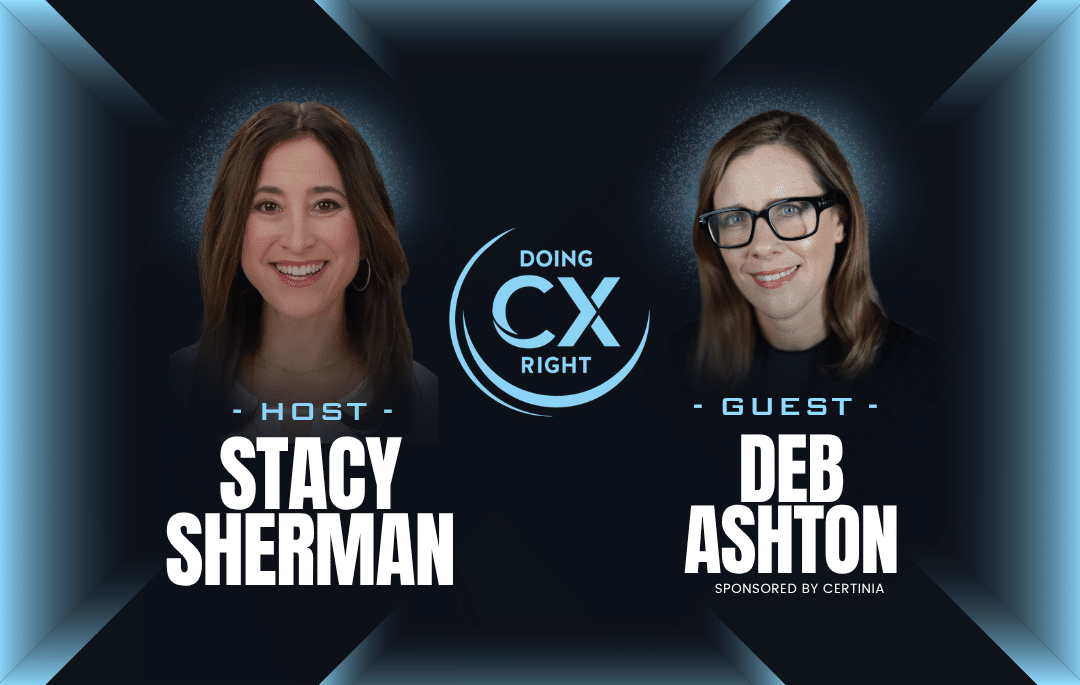




Most companies are rushing to layer AI onto customer operations without fixing what sits underneath. Deb Ashton of Certinia says that’s the wrong order. When sales, delivery, finance, and customer success work from separate systems with different views of the same customer, AI doesn’t close those gaps; it amplifies them. Clients feel the disconnect as friction: repeating themselves across departments, getting inconsistent answers, and slowly losing trust.
This episode is brought to you in partnership with Certinia.
Certinia is a professional services platform built natively on Salesforce that connects the full services lifecycle — sales, delivery, financials, forecasting, staffing, and project management — on a single data layer, so every team works from the same view of the customer, and AI can act with certainty.
Lessons From This Show:
Essential Leadership and Customer Experience Insights
- Why adding AI to customer support fails when your sales, finance, and delivery systems do not share customer data, and what customers experience when they do not
- The three layers of trust that determine whether clients renew, and which one AI cannot replace
- Where AI actually protects revenue in your business versus where it erodes customer relationships
- The difference between “human in the loop” and “human on the loop,” and when to use each one with AI workflows
- Why metrics like NPS and renewal rates hide the real problem with your AI implementation until the customer has already left
- How to identify which administrative work should be automated and which customer-facing decisions need human judgment before execution
- What to do when your customer success manager cannot answer basic questions about a contract, and why that moment determines whether you keep or lose the customer
Actionable Takeaways:
- Audit whether your teams see the same customer data. Ask your sales team, finance team, and delivery team to describe the current status of one specific customer. If the answers are different, your data is siloed. That is the problem you fix before you add AI.
- Map which decisions require human review and which ones do not. For every automated workflow you are considering, ask: what happens if this decision is wrong? If the answer involves a customer feeling ignored or undervalued, keep a human in the loop. If the answer is a minor operational adjustment, define your guardrails and automate it.
- Measure the three layers of trust on your customer accounts. Are you delivering accurate, consistent information across teams? Are you being transparent about how AI is being used? Are your people making customers feel seen and listened to? Track which layer is weakest on your biggest accounts and address it first.
- Start by automating administrative work, not customer interactions. Pick one high-volume administrative task that consumes your team’s time without adding customer value. Automate that first. Let your team experience how much time it frees up for relationships before you automate any customer-facing decisions.
- Ask your customer success manager the contract question. Before your next renewal conversation, ask: Do you know what was promised in the sales cycle? Do you know the project margin? Can you answer a customer question without transferring them? If the answer is no to any of these, you have a data problem that AI will make worse.
Press Play To WATCH On Youtube
Episode Chapters
[03:18] Defining CX right: why experience starts before the customer success team ever engages
[05:07] The “Operator game” effect: how information loses context as it moves through management layers
[06:34] The dual imperative: accelerating with AI while protecting human judgment
[07:35] Why fragmented systems let AI amplify existing silos instead of fixing them
[09:27] Why feelings and trust, not just data, drive customer sentiment
[10:44] The three-layer trust framework: operational, transparency, human
[14:07] Human-in-the-loop vs. human-on-the-loop: two models for AI governance
[16:00] A real resourcing example showing both AI governance models in action
[18:08] Favorite CX metrics: NPS and net revenue retention explained
[22:43] The one pre-QBR question every CX leader should ask their CSM
Read Full Episode Transcript
[00:00:08] Stacy Sherman: Hello, Deb. Welcome to the Doing CX Right show
[00:00:13] Deb Ashton: Thanks very much, Stacy. Great to be here
[00:00:14] Stacy Sherman: I am excited for this conversation because we are addressing some really important points about working in the AI era, but how important the human judgment is, and some of the things that you’re [00:00:30] doing are so instrumental for all companies to learn from. So before we get started, can you share a little bit about who are you?
[00:00:38] Stacy Sherman: What do you do for a living?
[00:00:40] Deb Ashton: Yes. Thank you very much, Stacy, and really looking forward to the conversation today. So I’m one of the original founders of a company called Certinia. Today I am Senior Vice President for Customer Experience and Operations at Certinia. Certinia is a professional services platform that is built natively on Salesforce.[00:01:00]
[00:01:00] Deb Ashton: I’ve spent here nearly two decades building this company from the twenty-seven people that were the founding team back in two thousand and nine into a global platform that’s used today by some of the largest services and technology companies on the planet. So my role really sits on this intersection between the customer and operations, whereas I act as the voice of the customer, understanding that end-to-end journey the customers are on, and then helping [00:01:30] translate that into actionable initiatives that we can drive in order to evolve how we improve experience for customers.
[00:01:39] Deb Ashton: So Certinia really connects the end-to-end services life cycle from sales through delivery into financials and forecasting, managing all the staffing and project management in the middle of that. It’s a single data layer, which I really realize now based on where we are in the [00:02:00] industry, how important that is for the CX conversation that we’re about to have today.
[00:02:05] Stacy Sherman: Well, before we get into the heart of the conversations, can you share a fun fact, Deb? What’s something people might not know about you?
[00:02:14] Deb Ashton: Okay, here’s one. So for fun, I like to go open water swimming in cold water, and it’s top of mind because this weekend we just did a race. I usually do the swims with my brother and my one of my [00:02:30] sons. And we went up to the Lake District in Ullswater to do this swim competition.
[00:02:35] Deb Ashton: So that’s what I like. That’s a little fun fact.
[00:02:38] Stacy Sherman: Cold water. That sounds like a challenge to me.
[00:02:43] Deb Ashton: It is, and it was funny this weekend, it actually wasn’t that cold. It was 22 degrees, which is quite warm. Which is, gosh, in Fahrenheit that must be in the 70s. But the problem this weekend, the challenge was the size of the waves, which don’t look big when you’re looking onto the lake, but when you’re in it, and you’ve just got your head [00:03:00] above water, you just get washed with the waves, so it makes breathing a challenge
[00:03:04] Stacy Sherman: Ooh. Well, we’ll have to come back to that.
[00:03:06] Stacy Sherman: Since this is a show about customer experience versus cold water, I’d love to hear from you what does doing CX right mean? When I say those words, what does that mean to you?
[00:03:18] Deb Ashton: So I think for me, Stacy, doing CX right, and I think about professional services, it means recognizing that the customer experience is shaped [00:03:30] long before the customer success team might engage with that customer. It starts with how the organization is structured, how the teams share information, how the teams show up with the customer at every single touch point from the moment that customer engages with an organization.
[00:03:49] Deb Ashton: Every single person within an organization is responsible for the outcome and the experience that customers have of the relationship and the [00:04:00] organization. I think the single most reliable source of clarity that I’ve had through the last couple of decades scaling Certinia, was direct conversations with customers.
[00:04:12] Deb Ashton: I saw early on that a pattern shows up in almost every services organization where customer feedback, it gets collected throughout the customer journey, sort of end to end. You’re always collecting information and gathering data, and it can travel through different layers of [00:04:30] management as it gets assimilated throughout the organization.
[00:04:34] Deb Ashton: And often that information, it can lose context. As it gets up to the executive level, mostly the context is gone. And you might be looking at a metric or a piece of information, but you’re not quite sure what that exactly relates to. For me, doing customer experience means seeing the world from the customer’s viewpoint, having that perspective, looking from the outside in, and then building that [00:05:00] operational foundation that enables your organization to build great experiences and deliver those to your customers
[00:05:07] Stacy Sherman: Well said. You reminded me, as a kid I used to play this game Operator, and I don’t know if in England they had this game, but you’d have to tell somebody, you would tell them a message and then they pass it on to the next person and the next person, and then by the time it gets to the end, the last person will say what they heard.
[00:05:29] Stacy Sherman: And it’s [00:05:30] wild how much the original person versus the end person, how that story changed
[00:05:35] Deb Ashton: Wow
[00:05:36] Stacy Sherman: from passing on that, and you’re whispering to the person till it gets to the end. And so what you’re telling me in even the basic terms is how it loses translation
[00:05:47] Stacy Sherman: from the originator to where the person who makes the decision and how everybody, because they’re in silos, don’t get the same message
[00:05:57] Deb Ashton: You’re exactly right. Yeah, those silos can [00:06:00] really impact the customer’s experience. And the customer can feel those silos. And we, obviously, we can get onto this a little bit more in this conversation, but yeah, I think it’s a really good point out
[00:06:10] Stacy Sherman: Yeah, the game of operator. Who would have thought that had something to do with CX? So let’s go deeper into challenges that you see facing today. What is getting in the way where companies say they’re doing customer experience, but I’m saying they’re not doing CX right, and that gap is what [00:06:30] they need to close?
[00:06:31] Stacy Sherman: So what is the challenge that’s the gap?
[00:06:34] Deb Ashton: Another good question and very poignant right now, I think that one of the biggest challenges that I’m seeing for organizations is navigating this dual imperative to accelerate everything with AI, but whilst leading with judgment and not losing the human connection. I mean, if we look at AI, it’s reshaping the world.
[00:06:57] Deb Ashton: It’s particularly the industries that we’re [00:07:00] operating in with professional services. It’s reshaping professional services faster than ever before. Like the transformation that we’re going through now, is something that we’ve not experienced for a very long time.
[00:07:11] Deb Ashton: And I think professional services is uniquely affected because it’s a people business. And AI is automating tasks that support the products in professional services. The temptation theoretically is for AI to automate the product itself. But that expertise, the analysis, the [00:07:30] recommendations that the clients pay for is exactly what AI is advancing on the fastest.
[00:07:35] Deb Ashton: But the real risk, I think, as I look at it, happens when firms layer AI onto the operations that are already fragmented, like we were just talking about with the silos. You’ve got sales, delivery, finance, and customer success. If they’re all working from different systems with different views of the same customer and different information about the same customer, AI
[00:07:59] Deb Ashton: [00:08:00] actually amplifies those gaps, and the customers feel those disconnects within the organization, whether that’s slow responses, inconsistent context, conversations that they have to reestablish with the different people that they’re speaking to within the organization.
[00:08:17] Deb Ashton: So yeah, I think that, they’re some of the challenges and I feel like there’s going to be a commoditization or a potential commoditization risk in the industry, that AI will need to automate as much as possible [00:08:30] the operational and administrative work, forecasting, staffing decisions, resource allocation, things like that.
[00:08:36] Deb Ashton: That work, that type of work has always been a tax to the client, as the client has to pay for people to do that work. And now freeing up the people from some of that administrative overhead and burden will actually be probably a genuine competitive advantage.
[00:08:54] Stacy Sherman: You said a word that really stands out to me. You probably don’t even know [00:09:00] that you said it in the moment, which is the word feel.
[00:09:03] Stacy Sherman: The customer feels it. I wanna dive into that just for a moment, because so many people say to me, “Stacy, emotions don’t belong in business.” But yet you just said they actually feel the silos, they feel the disconnects. Can you elaborate what’s your view as a leader in an organization and working with big clients, where do feelings come in?
[00:09:27] Deb Ashton: I do think feelings are [00:09:30] important and I think the feelings come into the relationships. The relationships that we build with our customers, are very important, and they are built on trust, and transparency and visibility and honesty.
[00:09:43] Deb Ashton: The sentiment that the customer will have of an organization is going to be very much based on those relationships and how the people, the humans show up when they engage with their customers. And I think that feelings drive [00:10:00] the sentiment and drive the perspective on the customer’s view, back to the customer looking in, their view of how much they trust that organization that they’re working with
[00:10:10] Stacy Sherman: Well said. And I, for those who listen to my show, they know I say this all the time, that emotion is the experience.
[00:10:19] Deb Ashton: Mm-hmm.
[00:10:19] Stacy Sherman: And so you can’t ignore that. You have to design for the emotions and the feelings you want customers to actually feel when they think about your brand and how much you control that.
[00:10:29] Deb Ashton: [00:10:30] Yeah.
[00:10:30] Stacy Sherman: Let’s get back to solutions here. So when we talked about the problems, what are some of the solutions that you have found really work, including your favorite techniques? What can people go do?
[00:10:44] Deb Ashton: Well, as I just mentioned trust. I think trust is really important. I think there’s probably three layers of trust that you can build with your clients. Number one is the operational trust, so do I run a [00:11:00] tight ship? Number two is transparency. Can I see what’s going on? Do I have visibility?
[00:11:06] Deb Ashton: And then number three is the human side. Do I actually believe the people who I’m working with? And so if we break that down a little bit, operational trust, I think that customers expect accurate information, whether that’s forecasting, billing. They expect a clean handoff, and consistent information to be [00:11:30] shared across the teams that they’re interacting with.
[00:11:32] Deb Ashton: When we have separate systems that are producing and collecting different versions of information, customers feel those gaps as friction, even when they maybe can’t quite put their finger on why. So I think of this from a simple point of view that if you are a customer success manager, and you have an interaction with a customer, whether that’s a phone call or an email, and [00:12:00] you can look at your customer information and it’s the same information that your finance team’s looking at or your delivery team’s looking at, are you all looking at the same data?
[00:12:10] Deb Ashton: And when you’ve got gaps in that sort of data layer, I think that’s the moment the customer feels that friction, and that starts to erode some of the trust that you can build with a client. The transparency piece, I think this is about the proactive communication.
[00:12:27] Deb Ashton: So when things change, and things [00:12:30] do change in organizations all the time. Being honest, and sharing visibility into what’s changed. It might be project health if I’m in a professional services world. Providing clear and concise information about maybe how AI is being used within an engagement.
[00:12:46] Deb Ashton: These are really baseline customer expectations. And customers are gonna start to ask more difficult questions about who’s doing the work, what work’s being done on their account. The organizations that can answer [00:13:00] that question or those questions clearly and articulately with transparency, sharing visibility, they’re the ones that the customers are going to stay with.
[00:13:08] Deb Ashton: They’re the ones the customers are going to trust. And then I think the human side of it, back to the relationship and the feelings that I just, I don’t think that AI can replace that or ever will be able to replace that. So this is the layer I think that determines loyalty, and it comes from, again, people who are transparent and tell the truth, hold themselves accountable, when something [00:13:30] goes wrong, and make the customers genuinely feel like they are being seen, and they are being listened to.
[00:13:37] Deb Ashton: So as AI absorbs more of this routine work, this human layer, I think is becoming increasingly important because customers are making those loyalty decisions based on those human interactions.
[00:13:50] Stacy Sherman: We spoke about human judgment.
[00:13:53] Deb Ashton: Mm-hmm.
[00:13:53] Stacy Sherman: I think that is a really important topic because as we have AI [00:14:00] exponentially increasing in use cases and infused into business, where does human judgment come in?
[00:14:07] Deb Ashton: I think that the human judgment, it comes in throughout that end-to-end life cycle with our customers and how we engage with them across that services life cycle. We’ve been referring to it as we’ve been speaking with customers, is this human in the middle or this human in the loop or human on the loop where we can create agentic [00:14:30] solutions for our clients, but we need to ensure that they are delivered in a consistent way, that you can trust the actions of the agentic frameworks.
[00:14:41] Deb Ashton: And in order to do that, you need some level of human oversight and governance. And that could be, where there’s a part of a process executed by agents and then a human may be in the middle of the process to ensure the first bit’s worked correctly, and then we can move on to the next bit, and they kick it on.
[00:14:59] Deb Ashton: And then there’s a bit of [00:15:00] automation, then another human in the loop executing the next task, is one way of doing it. And then as we see more and more autonomous agents being leveraged within organizations, you’ve still got a human judgment element. You’ve still got the human on the loop, so is observing the process, creating the guardrails, making sure that the process is executed the same way every time.
[00:15:26] Deb Ashton: So that, again, that consistency in the way that the automation is [00:15:30] delivered, that will build trust. But that human judgment, I think, is critical to ensuring that these agents are trustworthy and can deliver the same outcome every single time.
[00:15:41] Stacy Sherman: I love that. Now I wanna repeat so listeners really understand. Human in the loop, human on the loop, like they’re probably scratching their heads. So what do they go do at their workplace with the human
[00:15:54] Stacy Sherman: and the loop?
[00:15:55] Deb Ashton: Okay. I’ve got a good example for you, Stacy, here. From some of the things that we’ve [00:16:00] been talking to our customers about, where we have human, let’s say, in the loop. So I might have a scenario where I need to… I have a project, maybe somebody has gone off sick.
[00:16:16] Deb Ashton: I need to replace a resource on that, and I am leveraging agents to go and analyze my bench, look for resources with the right skills, availability, regional location, that I could put onto this [00:16:30] project at pretty short notice. So one scenario is I have the agent, they go through, they provide the recommendation, and I, as the human in this loop, would go and look at these recommendations, that are probably stack ranked by the agent.
[00:16:44] Deb Ashton: And I can say, “I agree. I want to go forward and allocate this resource to this project,” and then I can tell the agent to go ahead and perform that next step of that resource allocation. So that’s quite a simple example, and that’s [00:17:00] inserting a human into that process, into that loop.
[00:17:03] Deb Ashton: And then the more autonomous version might be where I have the same exact process, but instead of that agent coming back and making the recommendations to me based on the resources that are available on the bench and the skills and the regions and things like that, I have predefined the guardrails for that agent to work within.
[00:17:23] Deb Ashton: So if there’s a eighty percent skills match, and they have full availability to deliver that piece of work on that [00:17:30] project, and they’re in a region of this sort of district around the project where the project needs, then you can automatically go ahead and allocate that resource. So the human on the loop is defining the guardrails for the process, but it’s an autonomous process, so the agent can go forward and identify the resource and then just go straight and allocate it to the project without any human intervention.
[00:17:54] Deb Ashton: That’s the difference between the two.
[00:17:55] Stacy Sherman: Love that. Thank you for clarifying, ’cause it’s such an important [00:18:00] point, that needed to be emphasized here. So favorite metrics. How do you know you’re doing CX right? What are your favorite and why?
[00:18:08] Deb Ashton: Okay. No surprises, but probably one of my most favorite metrics is the NPS, which is the Net Promoter Score survey. That is a real sign of customer loyalty. So I do love that metric. Then I would say after that, it’s got to be net revenue retention because that metric, I keep coming back to it [00:18:30] because it tells you the full story, and perhaps is the purest measure of whether the customer’s experience, whether we actually delivered on the promise, they are renewing, they are expanding.
[00:18:44] Deb Ashton: You can see that all from the net revenue retention metric. If the customer trusts the people that it’s working with and the organization that it’s working with, they are going to continue to invest and potentially invest more as time [00:19:00] passes. I think that a lot of organizations track NRR. Some organizations might treat it more as a sales metric or a customer success metric, but I think that framing misses a bit.
[00:19:13] Deb Ashton: When the customer success team works into a renewal, goes into that renewal conversation, if they don’t know what the margin is on the project or what was committed in the sales cycle, then they’re managing that relationship reactively. So that can be a failure sometimes of the systems that are being worked upon.
[00:19:29] Deb Ashton: [00:19:30] And the customers, again, like we said earlier, they feel that. Beyond NRR, I’d probably look at the engagements, if we are engaging with our customers at a strategic level, if we have good executive-level relationships as well as the team relationships, if we are working with our customers as a trusted partner and expanding the scope and supporting them to achieve their outcomes, getting introduced to new stakeholders, building thought leadership with our [00:20:00] clients.
[00:20:00] Deb Ashton: I think that it’s very hard to put a number on that, but I do monitor and track that because that kind of behavior really signals a very tight bond with your customer, a very deep trust and loyalty between those two organizations
[00:20:14] Stacy Sherman: Yeah. And I would say to listeners, for those who work in companies that have silos, it is so essential that you’re all working from the same metrics. You can’t have different departments having different customer-centric goals because [00:20:30] then it will never drive that collaboration. So pick your favorite here, pick more than one, and make sure that it’s an aligned goal for the culture you’re building. Rapid fire questions. We’re almost at the end here. So leadership advice. What’s the best leadership advice you’ve received or given?
[00:20:49] Deb Ashton: Okay, good question. I always come back to here, mentorship and sponsorship. So knowing the difference between the two and having a mentor [00:21:00] as well as a sponsor, I think is really important. So a mentor will help guide you through your career and provide a perspective and maybe help you practice for interviews and things like that.
[00:21:11] Deb Ashton: Whereas a sponsor will actually put their own credibility behind you. They’ll open doors that wouldn’t normally have opened for you. And I’ve been very lucky in my career to have both, and have a mentor and a sponsor who helped push me outside of my comfort zone and put me in places where I wouldn’t have [00:21:30] naturally gotten to at that stage in my career and given me a grounding to build my career on.
[00:21:35] Deb Ashton: And I think that people need to be intentional about having both a mentor and a sponsor
[00:21:42] Stacy Sherman: For someone listening, they may say, “Ooh, I want that.” Is it a matter of asking? How do you get that?
[00:21:50] Deb Ashton: Yeah,
[00:21:50] Stacy Sherman: That could be a whole show in itself, so I guess it’s a quick snippet for a very big topic
[00:21:56] Deb Ashton: Okay. A quick snippet is, at Certinia we have a mentor program [00:22:00] where we match mentors and mentees, which is something the DJ, our CEO, implemented when he joined us, and it’s just been a game changer for some of our younger talent. But in the absence of that, reach out to somebody who you respect and admire and ask them.
[00:22:16] Deb Ashton: Just go and ask somebody who you would like to be your mentor, if they have the time and could support you in that regard
[00:22:22] Stacy Sherman: Yeah. We’re gonna have to come back to this topic another date because I love this. It’s so needed, and I want every young [00:22:30] Gen, I don’t know, Gen Z, after Gen Z, whoever. There’s so many generations that need to hear this now. One takeaway you want people to remember from this show that you want them to go do?
[00:22:43] Deb Ashton: Ooh, I think the key takeaway we alluded to it earlier was around the customer success managers. Before the next quarterly business review, ask your customer success manager when they engage with a customer, do they [00:23:00] know what was promised in the sales cycle? Do they know how the project is progressing, what the margin looks like?
[00:23:07] Deb Ashton: If they don’t know in any of those places, that gives you the point which you probably need to focus on some process improvement that could be impacting your customer as they interact with your organization.
[00:23:19] Stacy Sherman: I’ll add that take the time to literally map out a customer journey and design that experience, and then go validate with real customers that [00:23:30] what you designed and how you communicate to them with the human and the technology is the way that they want to be receiving that, and then go fix your journey.
[00:23:41] Stacy Sherman: So yes, and my favorite question of the whole show, and I’ve asked over 200 people, is if you could go back in time and talk to your younger self, Deb, what would you say to the younger 20-year-old you?
[00:23:57] Deb Ashton: Okay, great question, and I would [00:24:00] say embrace your uniqueness. I think that certainly from my experience, I spent a lot of my early years trying to blend in with the people around me, to be the same as the people around me, and I think you need to lean into what makes you different because it’s your uniqueness, and the differences, the thoughts and the ideas that you have that help complement and help your organization make the right decisions.
[00:24:26] Deb Ashton: Lean into your differences. They should be a competitive advantage [00:24:30] for you and assert them with confidence
[00:24:32] Stacy Sherman: Where can people reach you when they want to hear and go deeper into any of the topics discussed today?
[00:24:39] Deb Ashton: I mean, I’m on LinkedIn, so you can connect with me on LinkedIn. You could get to me via the Certinia.com website to learn more about the business as well
[00:24:48] Stacy Sherman: Okay. All the links will be in the show notes, so for anyone curious, I know that they will want to learn more. This was fantastic. Really appreciate the time together. Thank you for being here [00:25:00] today
[00:25:01] Deb Ashton: Thank you so much, Stacy. Really enjoyed the conversation
[00:25:03]
[00:25:11]
Questions & Answers: What Leaders Need to Know
Q: How does data isolation affect customer experience in professional services?
A: When divisions like sales, finance, and delivery operate on separate software systems, information loses context as it moves through management. This creates data gaps that customers experience as friction, such as repeating information or receiving conflicting answers, which ultimately reduces retention.
Q: What is the distinction between keeping a human inside the loop versus on top of the loop with AI?
A: A person operating inside the loop actively participates within the automated process, such as manually reviewing and confirming a choice generated by AI.
An operator on top of the loop establishes the criteria for an autonomous system to run independently, monitoring the process from above to ensure consistency.
Q: Why is Net Revenue Retention a critical metric for tracking customer loyalty?
A: Net Revenue Retention tracks actual customer behavior, such as renewing agreements and expanding accounts, which directly measures long-term loyalty and operational success rather than lagging satisfaction surveys
Q: How can business leaders build customer confidence when deploying automated tools?
A: Trust requires three operational layers: operational accuracy (clean billing and data handoffs), absolute transparency (disclosing how AI is utilized), and human accountability (honesty when systems error).
Prioritizing the human layer as automation increases protects brand loyalty.
Q: What is the structural difference between professional mentorship and career sponsorship?
A: A mentor provides advice, reviews career strategies, and offers perspective to guide development.
A sponsor actively uses their own leadership credibility to advocate for an individual, opening professional opportunities that would otherwise remain unavailable.
Q: What should companies automate first when implementing AI in customer operations?
A: Start with administrative work that does not touch the customer relationship: forecasting, resource allocation, staffing decisions. This frees your team to focus on relationships. Only automate customer-facing decisions after you have a human review process in place.
Q: How do you know if your customer success team actually has the information they need?
A: Ask them directly: Do you know what was promised in the sales contract? Do you know the project margin? Can you answer the customer’s question without transferring them to another department? If the answer is no to any of them, your data systems are siloed and need alignment before you add AI.
Q: Why do customers feel disconnected when your systems do not share data?
A: When a customer repeats the same problem to three different people, they feel like your organization does not actually know them. That feeling erodes trust faster than any process failure, and it directly impacts renewal decisions.
About Deb Ashton:
She co-founded Certinia in 2009 through a collaboration between Salesforce and Unit4, building the company from a team of 27 to a global organization of nearly 1,000 employees, serving approximately 1,400 customers worldwide. Over more than two decades, she has led teams across product, engineering, and customer success, giving her a firsthand view of every stage of the services journey. As SVP of Strategic Customer Experience, Deb sets the standard for how Certinia shows up for its customers. She runs the company’s listening programs and data analysis to identify what customers need at every touchpoint, then turns those findings into improvements across Certinia’s products and services. Under her leadership, Certinia has consistently achieved record levels of customer satisfaction, a direct result of the data rigor and customer focus she has built since day one.
Connect on LinkedIn.
About Stacy Sherman:
An award-winning international Certified Speaking Professional (CSP) who has delivered more than 100 standing ovation keynotes and workshops and co-authored best-selling books on Experience Management for sustainable success. She developed a proprietary framework that enables leaders and teams to enhance revenue and brand reputation. Her proven methodology is based on her MBA degree and 25 years of leadership in sales, marketing, employee, and customer experience across diverse industries, including Verizon, AT&T, Schindler Elevator Corporation, Wilton Brands, Martha Stewart Crafts, and LiveOps, generating $2.4 billion in savings and hundreds of millions in revenue. Stacy Sherman has earned widespread recognition for her award-winning “Doing CX Right” podcast, ranked in the top 2% globally with over 200 episodes, and for her courses on LinkedIn Learning, which have garnered hundreds of 5-star reviews. A multi-year Global CX Guru awardee and 2026 ICMI Hall of Fame inductee, Stacy’s insights have been featured in Forbes, Psychology Today, Yahoo News, and other leading publications.