
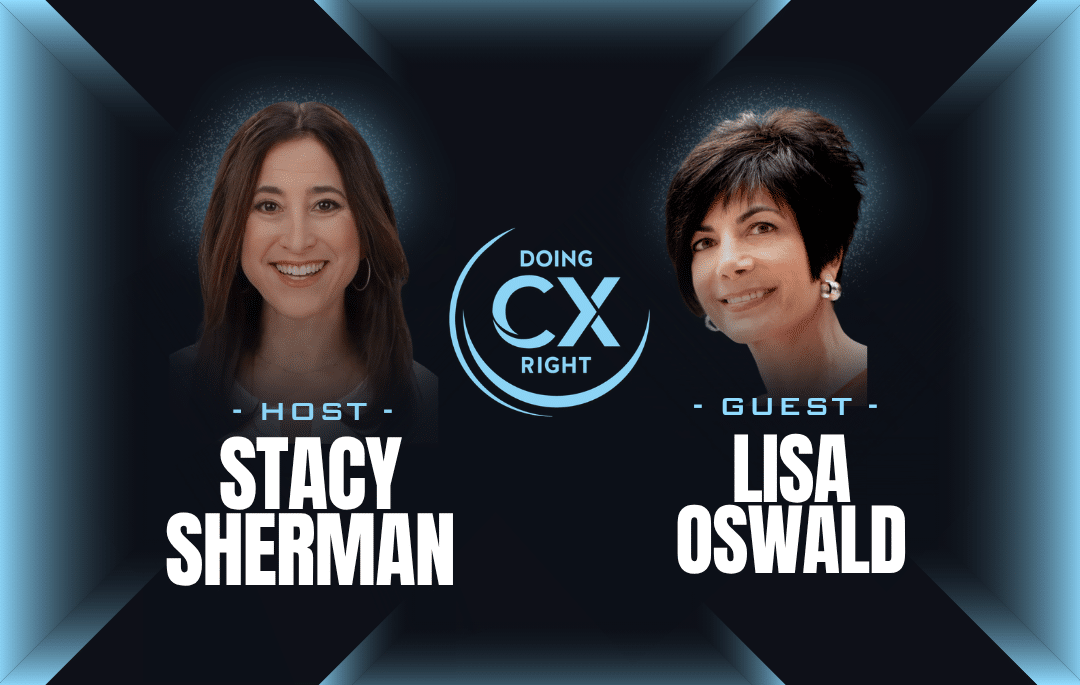




Most companies view their customer service team as a cost to reduce. Lisa Oswald of TravelZoo says that is precisely the wrong instinct. When you see the people who communicate with customers all day as an expense, you stop understanding why customers are dissatisfied, continue doing what frustrates them, and lose their business without ever realizing the real reason. By the time it appears in your data, the customer is already gone.
So what separates the companies that keep their customers, grow their revenue, and earn the budget to do more from the ones that keep losing both? You’ve come to the right place for answers.
This episode is for any leader who is tired of fighting for a budget and wants to make a case that their boss actually says yes to.
What You Will Learn:
AI, Customer Service Measurements, and The ROI of Doing CX Right
- Why CSAT & NPS get a polite nod in the boardroom, and which specific numbers make finance actually approve budget
- Whether your customers would miss you or just miss your price, and why that gap is where you lose revenue
- The gap between saying “it’s my responsibility” and feeling “I own this outcome,” and why only one stops churn
- Why attaching a name to every survey question turns feedback into action, and what happens when you don’t
- How a 30-year-old bus tour still explains why companies lose customers without knowing the real reason
- Why contact center AI delivers measurable returns in weeks, creating the data service leaders need to secure larger CX budgets
- What emotion customers feel at each stage that predicts whether they’ll stay or leave, and where most companies stop looking
Actionable Takeaways:
- Before building any AI tool for your frontline team, study the top five percent of performers. Understand what they do differently and use that to define what the tool needs to replicate.
- Run pilots with real agents before scaling any AI program. Their adoption signals, not your demo results, are the proof that the tool will work.
- Build listening mechanisms directly into your pilot process. Agents who reject a tool are telling you something specific. Find out what it is before you build further.
- Stop relying on a single post-interaction survey as your primary CX signal. Start tracking sentiment trends across every interaction a customer has had with your company.
- Create a cross-functional mechanism, like the Smooth Sailing Squad, that uses AI-generated insight to surface friction points and routes them to the team that can fix them.
- When presenting AI pilots to the C-suite, pair the vision with early results. A prototype alone does not earn budget. A prototype with data does.
- Give agents visibility into customer sentiment history before and during an interaction. A guest who has had 200 interactions needs to be handled differently from one who has had four.
- Build your AI vendor relationships as carefully as your hiring decisions. The right partners determine whether you can move at the speed your blueprint requires.
- Do not scale an AI tool until your frontline team emotionally believes in it. Adoption rate is a leading indicator of whether the tool will actually improve the customer experience.
- Set an aggressive six-month vision for what AI needs to accomplish, then build the test-and-learn muscle to pursue it without overpromising to leadership along the way.
Press Play To WATCH On Youtube
Episode Chapters
- [00:00] Introducing Lisa Oswald, Global Head of Member Services at TravelZoo and leader of 30 million travelers worldwide.
- [02:00] Why Lisa’s background as a monotype artist connects directly to how she leads service teams.
- [03:00] The Stonehenge bus story and the fundamental mistake most companies make when designing customer processes.
- [04:00] Why companies with surveys, support teams, and AI still lose customers and what the gap actually is.
- [05:00] Reframing customer service from a cost center to a value center by changing the language CX leaders use in the boardroom.
- [07:00] Why the contact center is the most measurable proving ground for AI and how that creates a new opportunity for CX leaders.
- [08:00] What the position of CX on the org chart reveals about how a company values service.
- [10:00] The difference between customer service and customer experience and why only one activates when something breaks.
- [12:00] Why every survey question needs a named owner and what happens to feedback when no one is accountable for the outcome.
- [13:00] Accountability versus responsibility and why discretionary effort is the dividing line between teams that protect revenue and teams that do not.
- [16:00] How to break down silos by positioning the service team as a source of help rather than a source of problems.
- [18:00] Introducing the “Do They Really Care” metric and why the disappearance question tells you more than NPS ever will.
- [21:00] Why measuring how customers feel produces more actionable data than tracking scores alone.
- [22:00] The one go-do from this episode: be the person in the room who advocates for the customer when no one else will.
- [23:00] What Lisa would tell her younger self about mentors, networks, and the advice that never actually served her.
Read Full Episode Transcript
0:00] Stacy Sherman: Hello, Lisa Oswalt. Welcome to the Doing CX Right show
[0:05] Lisa Oswald: Hello, Stacy Sherman. Thanks for having me. It’s great to be here
[0:09] Stacy Sherman: this is way overdue. Let me say that loud and clear. Way overdue, and I’m so happy we’re making this happen today. First of all, Lisa, who are you? What do you do for a living?
[0:22] Lisa Oswald: We’re going to take Stacy to start with the existential question. Who am I? Who are you?
[0:28] Stacy Sherman: I’m here with you, and that’s who I am today
[0:32] Lisa Oswald: We’ve known each other for a long time- Of course … and it’s really great for us to be in conversation together live like this after all these years. and for people who don’t know me, I’ll start off with that big question. I’m a leader, I’m a mentor, I’m a truth teller, I’m an artist, I’m a dog lover, I’m a New Yorker, right? Um, uh, I’m also a person who spends most of my time trying to make the lives of the people around me better: my team, [1:00] my colleagues, my customers. and that’s really inextricably linked to what I do. I am Global Head of Member Services for Travelzoo. We are the club for travel enthusiasts. We help 30 million travelers around the world find the best deals to the best places.
So Stacy, if you’re hankering for a vacation and you love a great deal, come and check out Travelzoo. We can help you out.
[1:22] Stacy Sherman: I definitely will, and others will by the time they hear this whole episode. You’re gonna definitely pique their curiosity. Before we get started, what’s a fun fact, Lisa, that people might not know about you?
[1:36] Lisa Oswald: I mentioned at the outset that I’m an artist. I make monotypes. They are like paintings on paper. I create these transformative interpretations of the figure from life model drawings. And I fell in love with monotype way back in 2003. so when I’m not working, maybe most times you can find me in the studio making art
[1:59] Stacy Sherman: That is a [2:00] fun fact. and it explains why you’re so creative
[2:04] Lisa Oswald: It explains why my office is filled with art that I’ve either collected from places I visited or received from friends that I love. none of my work hanging in the room behind me, but, when you come to visit, I’ll happy to give you the tour, Stacy. Yeah.
[2:22] Stacy Sherman: yes. So this is the Doing CX Right show, and therefore I like to start off with a question about what does doing CX right mean to you?
[2:33] Lisa Oswald: I think it’s pretty simple. most things that are good are easy. it’s really about doing what’s right for the customer. And it reminds me of a story. I’m gonna go in the way back time machine to the first time my husband and I took a trip to London, and we booked a tour to Stonehenge.
we, uh, were on a coach tour, like one of these Gray Line tours. And the bus came to pick us up at our hotel and then [3:00] proceeded to what felt like to visit every other hotel in London to pick up passengers. And then the bus proceeded to drop us off at the bus company’s depot, where we had to get off the bus and board another bus to get to Stonehenge.
And when I asked the man on the bus with the microphone why did we have to do that, he said, “Because it’s easier for us.”
[3:27] Stacy Sherman: Hmm.
[3:27] Lisa Oswald: And that is the fundamental mistake that most companies make because they design their processes and their services because it’s easier for them instead of what’s best for the customer.
And, 30 years later, I remember this because it’s a classic,example, about how things go wrong. And then on top of that, and you’ve heard me say this before, if leaders of companies used their products and services the way that their customers do, the problems that we encounter as consumers [4:00] every day, would disappear overnight
[4:02] Stacy Sherman: Yeah, very much so. I mean, I face this all the time. People are saying to me, “Stacy, we are doing so much around customer experience. We’ve got surveys, we’ve got support teams, we’ve got AI and tons of technology, but we’re losing customers and we don’t know why.” And that’s because I’m saying, “You’re doing CX, but you’re not doing CX right.
And when you close the gap, that’s your game changer.”
[4:27] Lisa Oswald: Agree, totally
[4:29] Stacy Sherman: S- so we’re gonna get into that more. Challenges in the industry. So customer service and contact centers have been treated as a cost center for many years. Do you think that mindset is shifting?
[4:42] Lisa Oswald: You know, for decades, we’ve been laboring under this perception that customer service in the contact center is a cost center, not a value center. And we’ve let everybody in the organization, CEOs, CFOs, define us by that label. [5:00] And we’re very good about complaining about it, but we’re not as good as trying to reframe the conversation.
And so I think that really requires leaders to change behavior. and I think it’s all wrap- I think it’s all wrapped up in language. So it’s not so much a mindset shift,it’s a behavior shift. And so if we think about the way that CEOs and CFOs think, what we need to change is the way we talk about the value that we provide, right?
Because it’s a given. Customer service is essential to retention, essential to revenue growth, and clearly that has value. So what if we talked about revenue at risk, or we talked about cost avoidance, or what if we talked about, lifetime value? Because leaders know that there is an ROI to service, most often they show up in the boardroom with CSAT scores or, NPS scores.
But [6:00] those are actually lagging indicators, right? They are not the business case to make itself. So we need to start talking in the way that the finance team understands. and so that’s less of a mindset shift and really more of a behavior change, on CX leader part.
[6:17] Stacy Sherman: I agree with you. And if that has to happen in order to get more budget and investments allocated to enhancing customer experiences. So for people listening who work in all different industries and they’re fighting to get their C-suite to believe, to invest in customer experience, that is the revenue driver, the value you’re talking about, what is your advice to them in getting that buy-in?
Where do they start? How do they influence that decision? What advice could they tactically do?
[6:51] Lisa Oswald: Yeah. I think in this moment that AI, is actually a great way, for us to garner more resources and more budget, [7:00] right? I think the contact center is actually the perfect proving ground for AI deployments, right? It’s very transactional, it’s high volume, it’s data-rich. It’s really easy to measure ROI almost immediately when you start an AI project.
And I think for companies and leaders who are really under pressure to show productivity gains, I think AI, and making the case for AI is a really, easy case to make. you know, like in a strange way, AI, this moment in time, is giving service leaders the opportunity to get a seat at the table. and that…
we’ve been asking for that seat for years, and, now I think we have an opportune moment to actually make that happen.
[7:47] Stacy Sherman: CX leaders, some companies have, a CX leader report right into the president. I know for myself, I’ve been in under product development. I’ve sat in CX under [8:00] marketing. where have you, found it to be most effective?
[8:04] Lisa Oswald: That’s a really good question because I think where CS sits on the org chart tells you a lot about how the company values service or how they misunderstand the value of service. and I, I think you have to work with the cards you’re dealt. and regardless of who you report to or where you sit in the organization, it’s your number one job,to deliver value, right?
and that’s really the bottom line. First, you have to know how to do your job . you have to do it right. but you also need to be able to promote the contributions of your team to the business, right? And that is equally as important as the day-to-day operational work. sitting right on top of that is your ability to communicate the value that you deliver to the organization.
That goes back to what I said a moment ago about a language shift, right? Talking in a way,that people understand. You need to connect the [9:00] value of your organization, to the metrics that, that the organization values. Um, and I think really that’s the only way to,to get seen and heard
[9:09] Stacy Sherman: Hmm. Value, I think that’s the theme of what you’re explaining. and for leaders, think about what does value really mean for your company? What is valuable to your customer? And then make sure you’re delivering products and services and communication to the value that matters to them.
[9:30] Lisa Oswald: And it’s the same thing that matters to everybody in the business. It’s really all about customer retention and revenue growth. that’s what marketing cares about, that’s what finance cares about , that’s what sales cares about, that’s what service cares about. and, we just all need to be talking the same language, right?
it’s pretty simple
[9:47] Stacy Sherman: It is simple, but it gets so complicated. So even speaking the same language, I want to pull something out you said that is such a good, teachable moment, which is I’m saying customer experience. You’re [10:00] saying customer service, right? So there are– They are– Customer service is a component of the entire experience.
So I want people to understand we’re speaking the same language, but it’s a component of it. But I want to give you a chance, Lisa. What does that mean to you of the two?
[10:18] Lisa Oswald: Well, I think you said it, perfectly, clearly, right? A service is a component of the experience, right? the experience, starts at the top of the funnel with awareness of your brand and, it, it encompasses every touch point you have with a brand if you’re buying something, if you’re shopping online.
it’s the mechanics of the purchase process, whether you’re doing it in a brick-and-mortar store, or you’re doing it through e-commerce. it’s the onboarding experience if you’re a membership organization like Travelzoo is, right? How do we introduce you to the brand? How do we educate you about the products and services we’re delivering to you as a brand?
and the service component is really at the end of the chain, right? Because service is [11:00] really a consequence of some defect that happened upstream, right? Something broke, and you forced the customer to contact customer service, and somebody in the organization owns that thing that broke, and it’s their responsibility, to fix it.
So That’s part and parcel of experience, but that puts the responsibility on the service component, right? To take that information back to the organization and hold people accountable for that fix, right? And that’s an essential part of the value that we provide to the organization is how do we, hold people accountable?
in the service part of the business, there needs to be some person, not a department, some person that is accountable for the outcomes,in the business. and the example I like to use put this in plain language and make it clear to people, if you are running a customer service survey, right?
Every question on that [12:00] survey, delivers some outcome, and there’s some person with a name in the business who needs to be responsible for that outcome. and they need to be responsible for the fix when things break. and if those things don’t line up, don’t ask that, don’t ask that question, right?
That’s a simple way to think about a survey. When I asked about something about the customer experience that a person owns, and they’re responsible for the fix, and they’re accountable, when that metric, doesn’t move, right? And it’s very easy to collect feedback. We have so many feedback sources, whether it’s through surveys or calls or emails, through third-party review sites, through social media, right?
It’s overwhelming sometimes. it’s hard to assign it. But every intent, every metric needs a name attached to it, right? That person whose job it is to own that number and who’s accountable when that number doesn’t move.
[12:53] Stacy Sherman: So there are two things you said that are really important for every company and leader to [13:00] understand, which is accountability versus responsibility. Let’s talk about that for a second. Because you can bring the customer feedback to an individual who is overseeing the experiences, including the service and support functionality of the team.
Someone being responsible versus accountable for those improvements. When I say those two words, what do they mean to you? Are they different or the same?
[13:27] Lisa Oswald: There’s another existential question, Stacy. I think you need to build the structures within an organization to, hold people accountable. and whether that’s through,goal- goals and objectives, whether it’s through, bonus plans, you’ve got to set up the collaborative structures within an organization to allow that information to flow back and forth and to gain agreement between people and departments that are gonna share responsibility for getting stuff done, for doing the fixes.
the accountability [14:00] piece really sits within the organization’s philosophy, and their willingness to, to set up a structure like that. there’s only so much, somebody can do sitting here, if the organization isn’t willing to set up the structure for that accountability, right?
I think of responsibility, for getting it done. I’m responsible for sharing the information. I’m responsible for putting forth recommendations and proposals for how to fix or improve. Ultimately, the responsibility for my colleague, for that other person to do their part, sits with- within the culture and the structure of the organization who recognizes that, right?
it, it takes the whole team to deliver the CX experience
[14:50] Stacy Sherman: Yes. I’d add that part of doing CX right, those that are doing CX are saying, “Yes, Stacy, I’m [15:00] responsible for this specific tasks. They’re in my job description.” And those that are doing CX right actually feel individually accountable to delivering excellence, and it’s that discretionary effort that they go up and beyond because they feel accountable.
Those that just say, “I’m only responsible for this segment of the journey,” I find that they are losing ground. It’s the accountability and the discretionary effort to go up and beyond is the game changer. Both are needed
[15:34] Lisa Oswald: Both are needed, but I would say it really needs to be baked into the culture and the structure of the organization. there needs to be, an explicit expectation set that service is gonna talk to marketing and service is gonna talk to product. and product is gonna listen to service, and marketing’s gonna listen, to service.
and there needs to be explicit pathways created for that [16:00] collaboration to happen. that’s the hard part. so discretionary effort is always a plus, but if the door is closed, no matter how hard you bang on it, you’re not gonna be able to open it.
[16:11] Stacy Sherman: I agree. Now, what you just said, silos is so common in companies and it’s becoming bigger of a problem because you have the human silos, you got the data silos, you got AI silos now. So what are you finding, what’s been success- for you in helping that door to open? To get people across the departments to say, “Yes, let’s work together.
Let’s stop the silos. It’s not working.”
[16:38] Lisa Oswald: In, in my experience, it’s the leader’s responsibility to help the organization understand that the service function is here to help, right? a lot of times people perceive the service department as only bringing forward problems, that our role here is to expose broken links in the system, right?
Products that [17:00] break, things that go wrong, processes that, that are broken, and that we’re the blame, we’re playing the blame game, which, maybe happens in some organizations. But again, if you think about it in terms of a behavior shift or a language change, your role is to come with hands outstretched, and say, “I’m here to help.”
I think that more and more, organizations are waking up to the fact that the service team, the call center, is just sitting on a ton of valuable information about customers and their behaviors. And quite frankly, a lot of that hasn’t been fully leveraged in the past couple of decades.
and I’m gonna point to AI again, I think as a game changer. It’s finally,going to accelerate and scale the influence that CX leaders have in the organization, and with our customers, and that’s where we should be putting our focus, right? So we’re here to help. Now we have these amazing tools and tech platforms that can [18:00] actually scale what we can do, how fast we can do it, and how much impact we can have throughout the organization
[18:07] Stacy Sherman: What is your favorite metric? We talked a lot about value. Here to help, internally, help externally, provide value. So around that, what would you say is the metric of choice or your favorite?
[18:22] Lisa Oswald: You know, in the service business, we track a lot of metrics. and most of them, are meaningless, right? a-a lot of metrics we track are lagging indicators. They tell us, what, what happened. whether it’s recurring revenue or churn or acquisition costs, and now I’m talking about that in context of a membership model li-like my business.
but it doesn’t tell you a lot about what you should do or what’s actually sustainable. So I would love to introduce, a do they really care metric, right? So not, like NPS, but instead of saying, “Would you recommend to friends or [19:00] family?” What if we could ask customers, What if this product disappeared?
How would you feel? Who would you tell?” And that would uncover a whole different set of behaviors that you could actually do something with to improve your business. So like in my case, for a travel and entertainment deal company, if my customer said to me, Oh, I really miss the deals,” that would tell me they think of us as a transactional business.
But if they said to me, ” Oh, I miss the memories I make when I go on a wonderful vacation,” or, ” I would miss the experience of traveling internationally, global immersion,” all of this, then I would know that the membership was actually a part of their lifestyle, and that’s a completely different data point and insight that I could actually, do something with.
So I suppose, in the best possible case, you could say, if your customers are only calling you with a complaint or a problem, then that tells you something about your business. [20:00] But what if customers were calling you to share compliments or to tell you about the last trip they took or, called out somebody by name who helped them, right?
then you have a much different relationship with your customer and a much stronger, brand.
[20:15] Stacy Sherman: I love that. That is gold. Everybody listen to this again, ’cause that is really what matters. And I have a saying I feel very passionate about, and I have new research launching,which proves that emotion is the experience.
[20:33] lisa oswald: I couldn’t agree more. Yeah
[20:34] Stacy Sherman: And so you said a key word, which is how people feel, and that needs to be measured, whether you call it a sentiment, a index, whether you call it what I’m saying, these emotional highs and lows. there’s g- there’s so much I could say about this, and we don’t have enough time now, but I do want to acknowledge, and I love your answer to this measurement question and, I love it.
Love, love, love it. So rapid fire questions [21:00] here because we’re coming to an end.
Leadership. Leadership. What’s the best leadership advice you’ve ever received or given?
[21:07] lisa oswald: Oh, best leadership advice. this actually goes back to the first question you asked me. Who am I? know who you are and what you stand for. live your values even when it’s risky or inconvenient, especially when it costs you something, because true leadership freedom comes from knowing that your self-respect is priceless.
[21:27] Stacy Sherman: Know your values. Know it as a business, know it personally. Definitely. And what’s the one thing you want people to remember when they think about this episode? What’s the one go-do, take action on today?
[21:42] Lisa Oswald: I want everyone who’s listening today to be the person in the room who advocates for your customers when no one else will. Because at the end of the day, no one will remember who stays silent, but everyone will remember who steps up.
[21:57] Stacy Sherman: Ooh, I got goosebumps. That’s perfect. [22:00] And finally, my favorite question. For those who’ve been listening to over 200 episodes, I ask if you could go back in time to your younger 20-year-old self, based on what you know now that you didn’t know then, what would you tell the younger you, Lisa?
[22:15] Lisa Oswald: Oh. when I was coming up, success was all about, climbing a ladder and having it all. and I was on the receiving end of some really bad advice. keep your head down, lean in, smile more, and none of that actually served me well. but I do wish that someone had, told me to get a mentor, and build my network, and I think
that’s the best advice, that I, could give and do give, to everybody around me. my network, is a living, breathing organism. It’s something I invest in, I nurture, I protect, because when I need a gut check or I need advice or, I need somebody to tell me the truth, it’s my network that’s always there for me.
[22:59] Stacy Sherman: [23:00] Hmm. Well, thank you for sharing your wisdom and knowledge and gold gems that people can go do, not just think about, not ponder, not wish for, but go do, ’cause this is the Doing CX Right show. And I will have about you and Travelzoo in the show notes for people to reach out, and just thank you. I appreciate you so much
[23:23] Lisa Oswald: Thanks for having me, Stacy. This was great fun.
[23:26] Stacy Sherman: Thank you
Q&A: Proving Customer Service Is A Revenue Driver
Q: Is customer service a cost center or a value center?
A: It becomes a value center the moment you measure and report it like one. Stop leading with activity such as tickets handled or average handle time. Report the revenue you protected, the cost you avoided, and the lifetime value you influenced. Bring one of those numbers to every leadership review.
Q: How do CX leaders get budget from the C-suite?
A: Translate the work into finance’s language before you ask. Build a one-page case showing the revenue at risk if the experience stays broken, the cost avoided by fixing it, and the lifetime value gained. Pair it with a small AI pilot that returns a measurable result inside a quarter, then use that proof to request the larger investment.
Q: What is the difference between customer service and customer experience?
A: Experience covers every touchpoint, from the first moment someone hears of your brand through buying, onboarding, and using the product. Service is one part of that chain, and it usually activates only when something upstream breaks. Treat service as your early-warning system: route what it learns back to the team that owns the defect, then confirm the fix happened.
Q: What is a better question than NPS for measuring loyalty?
A: Ask customers how they would feel if your product disappeared and who they would tell. A transactional answer, such as “I’d miss the prices,” signals a relationship you can lose on price. A personal answer such as “I’d miss the experiences this made possible” signals loyalty you can build on. Track that ratio over time, alongside the emotional highs and lows across the journey, and work to move customers toward the second answer.
Q: How do you break down silos between customer service and other teams?
A: Walk in with insight, not blame. Bring service data that points to a specific revenue or retention problem, name the owner of the upstream fix, and create a standing pathway, such as shared goals or a recurring review, so the handoff is expected rather than negotiated every time.
About Lisa Oswald:
Lisa is the global head of member services at Travelzoo, supporting its 30 million members and client network since 2011. Previously, she was vice president of operations and customer service for Priceline, where she led sales and service, as well as its affiliate partner network, from start-up through a decade-plus of transformational change. She was named to the 2024 Top Women in Travel & Hospitality by Women Leading Travel, a Skift brand.
Lisa is co-chair of the Corporate Advisory Board of Execs In The Know, a global community of customer experience executives, a founding Advisory Board member of Women Leading Travel, an exclusive community of women executives at leading travel brands, and a content and strategy advisor with SOCAP International, the customer care industry’s leading membership association.
Lisa holds a B.S. Degree in Marketing from Boston College School of Management. Lisa is a Commissioner of the Arts in her hometown of Hastings On Hudson, NY, and when she is not working, you can find her in the studio making monotypes.
Connect on LinkedIn.
About Stacy Sherman:
An award-winning international Certified Speaking Professional (CSP) who has delivered more than 100 standing ovation keynotes and workshops and co-authored best-selling books on Experience Management for sustainable success. She developed a proprietary framework that enables leaders and teams to enhance revenue and brand reputation. Her proven methodology is based on her MBA degree and 25 years of leadership in sales, marketing, employee, and customer experience across diverse industries, including Verizon, AT&T, Schindler Elevator Corporation, Wilton Brands, Martha Stewart Crafts, and LiveOps, generating $2.4 billion in savings and hundreds of millions in revenue. Stacy Sherman has earned widespread recognition for her award-winning “Doing CX Right” podcast, ranked in the top 2% globally with over 200 episodes, and for her courses on LinkedIn Learning, which have garnered hundreds of 5-star reviews. A multi-year Global CX Guru awardee and 2026 ICMI Hall of Fame inductee, Stacy’s insights have been featured in Forbes, Psychology Today, Yahoo News, and other leading publications.