
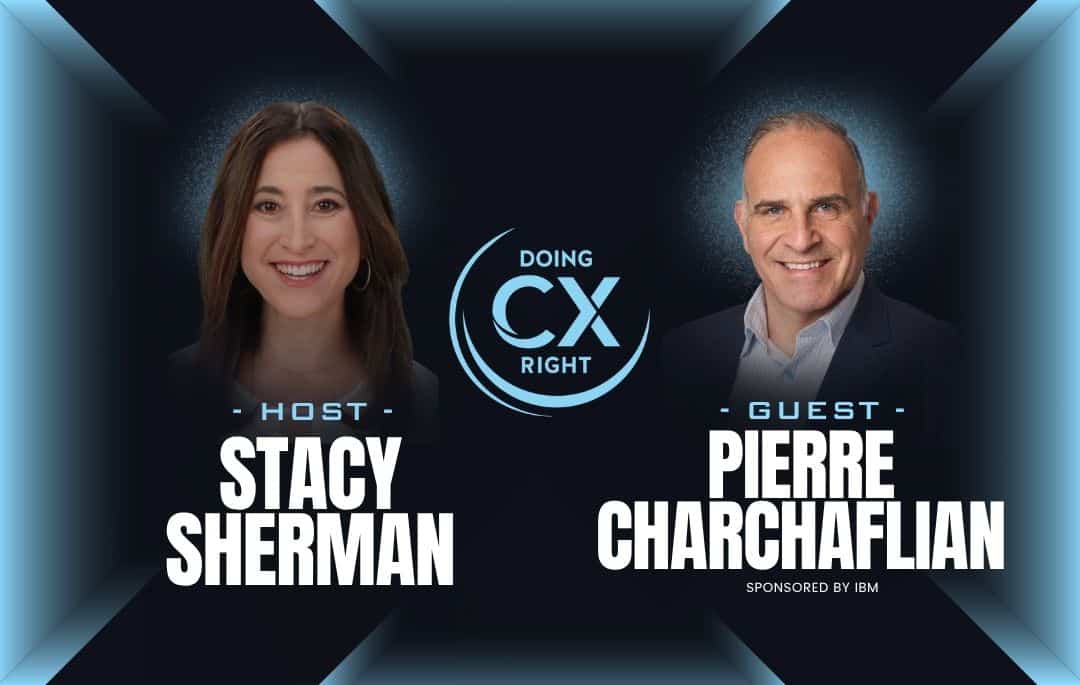




Most leaders think they are delivering a great customer experience. Pierre Charchaflian of IBM says they are delivering yesterday’s version. The new standard is not fixing problems when customers report them. It is knowing about the problem before the customer does, and solving it before they have to ask. That shift, from reactive to anticipatory, is what separates the brands that customers stay loyal to from those they leave without explanation. The technology to do it exists right now. Most companies are not using it. Pierre has spent 25 years at the intersection of data, technology, and customer experience, and he says this transformation is unlike anything he has seen before. The window to act is open. It will not stay that way. (IBM Partner.)
What You Will Learn About Agentic AI and Customer Experience:
- What agentic AI actually is in plain language, why it is fundamentally different from prior AI capabilities, and what it means for your CX strategy starting now
- Why IBM’s research found that technology stack limitations, not budget or talent, are the number one barrier preventing CMOs from delivering the customer experience they already know they need to deliver
- How agentic search engines are becoming a direct threat to brand digital presence, and what leaders need to do before their customers’ AI agents start bypassing them entirely
- Why anticipating a customer’s need before they express it is now a measurable competitive advantage, and what separates the companies building that capability from the ones still reacting
- How AI can read sentiment, detect frustration signals across structured and unstructured data, and trigger a response before a customer decides to leave
- Why conversion is the metric that tells the truth about whether your customer experience is actually working, and what NPS and CSAT consistently miss
Actionable Takeaways From This Doing CX Right℠ Podcast Episode:
- Identify one customer signal your company already has but cannot act on, and map what it would take to connect it to a customer profile.
- Audit your technology stack for silos, including AI tool silos, where different tools across different functions are not sharing data with each other.
- Track one behavioral metric alongside your current CX measures: conversion rate, repeat purchase rate, or churn by segment.
- Stop framing AI investment as an efficiency play in isolation. Make the case for anticipation as a revenue driver.
- Define what your company will do with customer sentiment data from service transcripts, reviews, and social channels before you collect more of it.
- Map which functions would need to collaborate to execute a single proactive customer intervention, and identify the executive who would need to sponsor it.
- Evaluate whether your current CX strategy is built to respond to customers or to get ahead of them. Those are not the same strategy.
- Have one cross-functional conversation this week about a specific customer situation where your company has the data to act and is not acting on it.
- Build the case for trust as infrastructure: your data privacy practices and your CX strategy are the same conversation, not separate ones.
- Start preparing your brand for the agent-to-agent economy now. The brands’ customers already trust will be the ones their AI agents are authorized to engage.
Press Play To WATCH On Youtube
Win The Moment by Mastering Customer Intent
Agentic AI makes recognition, anticipation, and confidence possible at scale, but only when orchestrated across the right data, workflows, technology, and cross-functional alignment. Download IBM”s newest report revealing how enterprises are restructuring operations around the intent economy. They explore three imperatives: turning fleeting signals into actionable intent, orchestrating personalized experiences before customers ask, and pairing speed with governance to compound advantage.

Doing CX Right Podcast Topics with Timestamps
- [02:00] What Doing CX Right means in the age of generative AI and why the definition is shifting
- [05:23] Why anticipating customer needs is the next frontier and what is blocking most companies
- [07:51] The AI silo problem and how it compounds the human and data silos leaders already have
- [10:48] IBM’s “Winning the Moment” report: competing when agentic search engines start transacting for customers
- [13:19] What agentic AI actually is, defined in plain language with a concrete CX example
- [16:15] Where emotion and customer sentiment fit into AI-driven experience design
- [19:58] Why conversion beats NPS and CSAT as the metric that connects CX to revenue
- [21:45] Why executive leadership, not technology, determines whether CX transformation succeeds
- [25:55] The vision Pierre is driving with every CMO he works with right now
- [26:11] What Pierre would tell his 20-year-old self about risk and career
Read Full Episode Transcript
Stacy Sherman: Hello, Pierre. Welcome to the Doing CX Right show.
Pierre Charchaflian: Hi, Stacy. Thank you for having me.
Stacy Sherman: I’m excited you are here, and I want my audience to know that we got to meet in person, which is a rarity for me. People on my show, I usually meet them after, not before, and so this is super special.
Pierre Charchaflian: Yeah, same here. That’s awesome that we were able to connect in person, and we get to continue the conversation.
Stacy Sherman: Yes. Well, before we dive deep into the topics, Pierre, tell everyone, who are you? What do you do for a living?
Pierre Charchaflian: Sure. Pierre Charchaflian. I’ve been at the intersection of data, technology, marketing, and customer experience my entire life. I’ve lived through several evolutions and reincarnations of marketing, digital [00:01:00] marketing, and customer experience, and now we’re living through the generative AI transformation. Lots of lessons to learn from, lots of lessons to leverage, but not a bit less excited about how we can help organizations and brands transform themselves, given the dynamics and the great opportunities that generative AI is affording us.
Stacy Sherman: Yes. So I got to learn firsthand so much good — I call it gold — of content and lessons from joining IBM at Adobe Summit, and it was… I was like a kid in a candy store, really. It was so informative. Share a little bit about what you were focused on at the summit.
Pierre Charchaflian: Yeah. So obviously you can’t have a transformation conversation today in marketing or customer experience without generative AI. And being at [00:02:00] IBM, sort of the OG of AI with Watson and now WatsonX, really our focus was to drive our point of view and our capabilities around what do brands need to do, and can and should do, to position themselves to win in the future with generative AI on two levels. How to transform your internal marketing operations and processes and operating model. But as, if not more importantly, how do you transform your customer experience and be able to derive a competitive advantage leveraging generative AI, which hopefully we’ll get a chance to talk a little bit more about in today’s session.
Stacy Sherman: Yes, and I want to, during our talk, define what is this agentic and orchestration and all these big words, because not everybody understands, but yet fundamentally they know it’s important and they’re saying, “I should know, but I don’t know enough.” So we’re going to help them out. Before I do, my question for you is, this is the Doing CX Right show, so [00:03:00] therefore I need to ask you, what does doing CX right mean to you?
Pierre Charchaflian: Really good question. You know, I joke, and I’ve been in this business for a long time, a quarter of a century at least, and I joke and I tell people I’ve been doing the same thing and selling the same thing and helping companies do the same thing: right offer, right person, right time. But I think doing CX right is very contextual based on what data you have at a given moment. I think we have an incredible opportunity to do CX right in the age of generative AI by not only delivering on what customers want, but actually anticipating what customers want. You know, generative AI has this incredible capability of understanding intent and deciphering meaning. And with that, we can not only understand what you want, but actually anticipate and really get you beyond just a blue shirt, but an entire outfit in your commerce experience, right? As a small [00:04:00] example of curating not only a seat on a plane, but curating an entire trip that you’re taking with an entire itinerary, and really be able to expand the aperture of what brands can do to round out the experience and the services that we deliver to you. And the brands that will be able to manage that and deliver on that, I think will have an incredible strategic advantage. So doing CX right today and in the future is not only the right person, right offer, right time, but anticipating the need that will drive the right person, right offer, right time. So that’s the key word that I would say in the pivot of CX today and in the future, is the ability to understand intent and anticipate customers’ needs in this really exciting age of technology.
Stacy Sherman: So anticipate, get ahead of, solve people’s needs before they even realize they have it.
Pierre Charchaflian: 100%.
Stacy Sherman: That seems so obvious, yet companies are challenged. They’re having such a [00:05:00] struggle with this. Why?
Pierre Charchaflian: Yeah, I think there are several reasons. You know, if you ask CMOs today, and even if you ask CEOs today, we just did a CMO study about a year ago. We launched it in the summer of last year, IBM did. And we asked CMOs, “What are your top concerns?” And you’d think they would talk about advertising, they’d talk about creative, or budgets, which they always talk about budgets, obviously. But the number one concern they have is their technology stack and being able to deliver that dependable, consistent customer experience, but also a technology stack that allows them to innovate. I think their hands are tied a lot of the time in that they don’t have the right modern technology to do it. So that was top of the list. I think that’s a challenge. Another challenge that was cited: over 80% of CMOs cited data privacy concerns and trust issues, right? How do I [00:06:00] deliver and how do I anticipate your needs while earning your trust at the same time? How do we collect the right data from you? So I think that’s another challenge. A third challenge that was cited is organizational silos and talent, right? How do you solve that? And for us to deliver a comprehensive customer experience, it’s beyond the personalization of a salutation. It’s beyond the personalization of an offer or content. It’s really to deliver that personalized end-to-end experience, including the product experience. So being able to personalize your hotel visit, being able to personalize your trip. I’m using a travel example. But being able to personalize how we ship a product to you, and all of that. So that requires really end-to-end orchestration across all functions within the organization. So I think CMOs don’t lack vision. I think they lack sometimes budget, and they lack also the right technology in their hands to help them [00:07:00] deliver on that promise and that vision. And that’s where IBM comes in and tries to help and solve some of that complexity for our clients. But certainly those are probably the top challenges that CMOs are having.
Stacy Sherman: Well, another thing I’m seeing as a challenge, going back to the silos statement earlier, is that we have human silos, we’ve got data silos, and now we’re almost having this AI silo problem because we’re deploying so many different tools. I remember working at a couple of corporations where they had the most sophisticated technology, but none of them interfaced with each other. And so, how do you get around that?
Pierre Charchaflian: I think it takes a couple of things. I think you need to have the vision and you need to have the leadership in place. I’ll give you a great example. Telco. I was meeting with an AT&T executive at Mobile Congress in Barcelona about three months ago, and he said the number one reason why customers leave a network [00:08:00] is the quality of the network. So being able to anticipate that Stacy had, or continues to have, a bad network connection, right? That really allows a marketer or an experienced executive to say, “I want to do something about that for Stacy.” Now that data is there. That data is residing in the logs. But to get that data out of the logs and create an insight that is attached to Stacy’s profile so we can act upon it, is a lot of work. It takes an executive that is willing to do that, that convinces the organization and marshals the organization to actually act upon that and prove the ROI around it. That is what is really needed. So I would say executive leadership and convincing the organization to become more customer-driven and really operating based on customer-driven principles is really, to me, the number one ingredient that differentiates [00:09:00] the organizations that deliver on really best-in-class CX and Doing CX Right versus others that don’t. Does that make sense?
Stacy Sherman: It does, especially because you didn’t realize that I worked at AT&T for 12 years or longer, and Verizon for five or six years. So telecom, I know it well.
Pierre Charchaflian: Yeah, yeah.
Stacy Sherman: I know it very well. Now, leadership is clearly a huge factor here, and they are the ones who need to implement the technology to anticipate needs and bring the organization together. You have a report about “Winning the Moment.” There’s a lot of really good data in that. Can you share what stands out to you?
Pierre Charchaflian: You know, “Winning the Moment” was a response to anxiety among our executives around two things. This thing called agentic: what do I do with it? What does it mean from a customer experience [00:10:00] standpoint? And the other was, “We’ve got all these agentic search engines. How do we win within that, but also how do we win despite that?” Because here’s the thing: agentic search engines are both a great opportunity for us to enhance our content and information architecture on our website so we can show up higher, but also there’s a threat. These search engines are pretty smart. They’re anticipating our needs. They’re understanding and decoding our intent. So there is a huge threat, in my opinion, that at some point they’ll take over conducting not only the search for us, but actually transacting on our behalf, and almost in a way threatening the core existence of a brand’s digital entity, organization, or store. So what do brands do in that context? How do brands win in that battle? And so the whole report was really about what do I do [00:11:00] to really win in this sort of environment, and what does the future of CX look like? And it’s really about decoding customer intent as one of the key principles. And decoding customer intent not only comes down to asking you a few questions, or looking at the log to see what products you looked at so I can give you an offer based on that. But actually it was about gaining the trust with you, Stacy, so I know from you what your favorite color is, what your favorite cuisine is, and what are some of the key preferences that you have so I can tailor the experience for you based on those preferences. That is a huge element of the future of customer experience. And how do I feed that into an agentic engine that says, “Based on Stacy’s preferences, I think she would like this outfit, or she would like this trip, or she’d like this mobile plan since she worked in telecom,” and so on and so forth. So it was really about how do brands win in the future [00:12:00] in the age of agentic and generative AI.
Stacy Sherman: So agentic, how would you define that? Because there are a lot of different people using it in different contexts.
Pierre Charchaflian: Yeah. Without geeking out on it, to me, at the end of the day, what agentic does is it allows an agentic transformation of a workflow. Think of it as intelligent workers. It’s the replacement of people that are making decisions based on inputs of data to orchestrate a process or a workflow on behalf of someone. So we are doing it today in terms of going onto a ChatGPT and trying to answer a question. But it actually goes beyond that, well beyond that. It can go in and say, “I placed an order,” and then agentic looks at the order. It is intelligent enough to go and check in the warehouse and say, “Wait a second, do I have that product? If I don’t have that product, I’ll come back and make a recommendation for Pierre about a substitute product.” Or it can say, “Hey, you’re going on vacation. I can’t get you that product on time. How about if I ship [00:13:00] that package to your destination?” So it’s the intelligent orchestration of tasks together to achieve a process and replace humans. Now imagine doing that without gen AI: a person would have to go through that process, reason, and come back. Almost like a clerk in a store: “I don’t have that product. If you give me the address of where you’re going, I can ship it to you.” But imagine doing all of that through an agentic application that does that. We are on the cusp of probably the most exciting transformation of customer experience that I’ve seen, and I’ve seen many transformations. I would say we’re on the cusp of really, really transforming how brands interact with customers. So to me, agentic is an intelligent digital co-worker, a digital worker that can make decisions and execute not just a task, but an entire workflow on behalf of you as a customer or you as an [00:14:00] employee.
Stacy Sherman: On a small scale, I’ve been using it a lot in the way of Claude Cowork. And for people that know Claude, you’ll know exactly what I mean, and for those that don’t, it’s incredible. I mean, it’s looking at my computer, and it’s doing tasks and working with me and analyzing stuff and writing comments in my documents. It truly is like I have a team of 10 people.
Pierre Charchaflian: I think it’s truly transformative, and I think we’re just merely scratching the surface of the potential of what it can do.
Stacy Sherman: Yes, absolutely. When we talk about the functions and tasks that are saved by agentic AI and it’s orchestrated across an entire customer journey, where does, in your opinion, the emotional level and the sentiments come into play? Because we know that humans are emotional beings, and we [00:15:00] can’t ignore that, but yet AI is robotic.
Pierre Charchaflian: Yeah, it’s a good question. I haven’t thought about the emotional being of a customer. I think that to me is a higher-level frontier of customer trust and intimacy. And I think customers, if we build the right trust with a customer, the customer can share that information with us, and we can be able to customize and personalize our experience based on that. But I think it’s a bit too dangerous to have gen AI try to interpret the emotional state of someone. Gen AI is very smart, but it’s also limited by the data that it can ingest and act upon. So I would say I’m going to trust that if a customer is giving a brand a certain level of data and we’re responding with that data in the context that is delivering value to that customer, that we’re going to be delivering on that emotional being or emotional state of a customer. Maybe you can elaborate a little more on that so I can answer in a different context, Stacy.
Stacy Sherman: Yeah, well, what you said is very fair. I’ll shed a little light on that in terms of using AI to look at all of your customer conversations — both structured data like the surveys and the customer service calls, feeding the system all that information — as well as the unstructured conversations on social media and rating reviews. [00:16:00] Bringing that all together, AI can actually detect the positive and negative frustrations and use that to anticipate: is someone going to leave? Are people talking about a lawsuit? And predict: this is going to be costly. We’ve got to get bells ringing.
Pierre Charchaflian: Yes. No, for sure. I did build a solution for one of the largest automotive retailers in the country of basically doing just that. Taking their customer satisfaction survey, right, and being able to take that content and feed it into a gen [00:17:00] engine and say, “Okay, what’s the tonality of that content? Is it angry? Is it happy? Is it frustrated? Is it satisfied? Is it elated?” And being able to come back and do two things. Number one, speak back to the customer in the tone that is appropriate. But also build the next action to say, “I need to route this comment to operations. I need to route this comment to marketing. I need to route this comment to store ops,” and so on and so forth. So I think gen AI could play a really, really good role in deciphering that. Again, it does have the ability to really understand intent and meaning and being able to make intelligent decisions based on it. So for sure, Stacy.
Stacy Sherman: Yeah, I recommend every person listening make sure that you are measuring the positive and negatives, you’re using the tools and technology to save you time in analyzing, and then using those insights. It’s really powerful. On [00:18:00] that note, do you have a favorite metric to measure customer experience in this day and age, outside the traditional Net Promoter Score and CSAT?
Pierre Charchaflian: Yeah. I mean, to me, I’m a behavioralist, right? Customers can say yes and no, but at the end of the day, what matters is what they do. To me, it does come down to engagement. It does come down to transactions. It does come down to visits. Ultimately, that’s what matters at the end of the day. We could have the happiest customers, but if they’re not buying from us, that’s a missed opportunity. I go back to conversion. I go back to conversion as the number one metric that matters at the end of the day, right? If I get someone to buy — price, quality, satisfaction, loyalty, all of those — that conversion is the moment of truth. And I think everything else is secondary, with all honesty. So I always have that conversion number. Again, you can drive traffic to a website, [00:19:00] and top of the funnel could be great, but at the end of the day, a brand doesn’t make money until someone buys. So I’m very keen on that conversion number because, like I said, it’s really the moment of truth in a relationship.
Stacy Sherman: Leadership. As a leader, you’ve been with many teams. You’ve also had bosses of your own. When you think about it all, what’s the best leadership advice you’ve ever received or been given?
Pierre Charchaflian: One of the things that one of my first bosses ever said to me, and I repeat it to everyone, is: “Go figure out your T model.” Right? Your T model, as in the letter T, meaning for you to be successful, you have to be good at a lot of things that your job requires. But you’ve got to pick that one thing that you’re an expert in, that you have passion around. And if you can’t find it, you’re never going to be happy in your job, and you’re going to compromise your success. So I would say the best advice that I’ve been given, and the advice that I give to everyone that I [00:20:00] work with and that works in my organization, is find your T model. It’s okay not to be great at everything, but find that one thing that you are really going to be the expert in and find that passion around it. Because at the end of the day, we all have jobs, and a lot of the tasks in our job don’t make us get out of bed in the morning. But it’s that one dimension that allows us to have passion. From a leadership perspective, I think you’ve got to do two things. One, you’ve got to give people the vision. You’ve got to tell them where you’re going. That’s always been a trait of mine — communicating the purpose of what we’re doing today and really allowing people to operate freely with that guiding light of where we’re going. And most of the time, people end up performing really well in that environment. So I would say those two things are what have always stuck with me and that I’ve always shared with everyone else.
Stacy Sherman: Currently, right now, when you’re talking about vision, and earlier in our conversation you [00:21:00] spoke about the importance of anticipation of customer needs and designing those experiences. Would you say that is the vision that you’re communicating, that you’re striving for?
Pierre Charchaflian: Absolutely. With every CMO that I’m working with right now, there are really two visions that we’re driving. One is an internal vision and one is external. The internal vision is all around how do I transform my marketing operations with this new technology that’s emerging, so I can maximize the efficiency with generative AI. We know that generative AI can create content. We know generative AI can make decisions. So with that, there are tremendous opportunities to reduce costs. With that efficiency gained, how do I take those cost savings and that incremental investment and really place it in transforming the customer experience? Because I talk to CMOs all the time, and nobody’s getting [00:22:00] significant increases in budgets. As a matter of fact, the name of the game is cut, cut, cut. So CMOs have to find a way to fund their own growth. And we’re finding the message and the passion around two things. One is how do you reduce your cost and leverage this technology to drive efficiencies in the process? But the growth is going to come from how do I take that investment and really invest it in transforming my customer experience, so I can anticipate the needs of my customers, so I can deliver that personalization, and I increase the conversion of my customers? That’s really the agenda that we’re driving, and I think it’s getting a lot of traction. And the sequence matters as well: really drive the efficiency to fuel the growth of the brand.
Stacy Sherman: And get ahead of it.
Pierre Charchaflian: 100%. Yeah, for sure.
Stacy Sherman: My last question, my favorite one. I’ve asked over 200 people. Pierre, if you could go back in time and talk to your younger 20-year-old self, based on what you know now that you didn’t know then, what would you say [00:23:00] to the younger you?
Pierre Charchaflian: I would say take more risks. When you’re young, you can afford to take risks. Take risks with your career, take risks with endeavors, take risks even within your job. And if you have your passion driving that risk, I think you’re going to be okay. In your 20s, you’re going to have a lot more time to make up. Even if you make a mistake, you’re going to be so much smarter from the mistake that you made and the lessons that you’ve learned. So I would say take more risks, and with hard work, and as long as the risks are coming from the right source — from passion — you’re going to be more than okay.
Stacy Sherman: I’ll need to play this for my young adult children in their 20s.
Pierre Charchaflian: Maybe they can talk to my young children in their 20s, because they don’t listen to me.
Stacy Sherman: Well, that is true. I think about what I knew then and I didn’t look at time in that I had so much more going forward, [00:24:00] and that I could take the risks. But yeah, it’s a really good topic. It could be an hour conversation.
Pierre Charchaflian: Yeah, for sure. For sure. I wish I took more risks, whether that’s starting my own business, or taking an idea to my boss that I was just too afraid to do, or actually going and building something on my own time and sharing it. There are a lot of ways to take risks without being foolish, obviously, that I think could have some good rewards and really good learning experiences as well.
Stacy Sherman: Yeah. And to kids who are in college, I heard a saying which is really good about risk, and that is: be really smart when you’re doing dumb things.
Pierre Charchaflian: Yes. That would be a risk. Yes, that’s a good idea of a risk.
Stacy Sherman: Yes. Well, thank you, Pierre, so much for being here, and I will share more about the Winning the Moment report and you and all about IBM’s [00:25:00] newest, latest, greatest things in the show notes. So thank you for being here.
Pierre Charchaflian: Thank you, Stacy, and thank you for having me.
Customer Experience Questions & Answers: Anticipation, Agentic AI, and What Leaders Need to Know
Q: What is agentic AI, and why does it matter for customer experience leaders?
A: Agentic AI refers to systems that execute entire workflows autonomously, making decisions at each step rather than answering a single question or completing a single task. In a customer experience context, that means a system that detects a customer signal, reasons through the appropriate response, decides on an action, and executes it without a human approving each step. A customer places an order, the product is out of stock, and instead of returning an error, the agentic system checks the customer’s travel schedule and offers to ship the order to their hotel destination. That chain of detection, reasoning, decision, and action is what makes anticipation at scale possible. No human team can replicate that manually across an entire customer base.
Q: What is the difference between personalization and anticipation in CX?
A: Personalization looks at what a customer did and serves up something relevant to that behavior. You browsed running shoes, so the next page shows running shoes. Anticipation looks at what a customer is trying to accomplish and builds the full experience around that intent before the customer has to express it. It is not recommending a blue shirt because someone browsed shirts. It is curating an entire outfit because the system understands what the person is building toward. Personalization responds. Anticipation gets ahead. The customer experience that results from anticipation is emotionally different, and that difference is what drives the loyalty, referrals, and retention that show up in revenue.
Q: What is IBM’s “Winning the Moment” report and what does it tell CX leaders?
A: The report addresses how brands can compete and win in an environment where agentic AI tools and agentic search engines are fundamentally reshaping customer experience. It covers how to use generative AI to transform internal marketing operations, how to build customer-facing anticipation capability, and how brands need to think about trust and data when AI agents begin transacting on behalf of customers. The central argument is that brands which earn customer trust now will be the ones those customers authorize their AI agents to engage with. Brands that have not built that trust will not be in the consideration set when the transaction happens.
Q; What is blocking most companies from anticipating customer needs even when the data exists?
A: IBM’s CMO research identified three primary barriers. Technology stack limitations ranked first: most companies do not have the modern, connected infrastructure required to take data from one system and act on it in another in real time. Data privacy concerns ranked second, with over 80% of CMOs naming it as a genuine barrier to how they can use the data they have. Organizational silos ranked third, with human silos, data silos, and now AI silos, where different AI tools deployed across different functions are not connected to each other, all compounding the problem. The data to anticipate customer needs often already exists. What does not exist is the chain from that data to a person or system authorized and equipped to act on it.
Q: Why is conversion the most important CX metric, and what are NPS and CSAT missing?
A: NPS and CSAT measure what customers say about their experience. Conversion measures what they did. A company generates no revenue until a customer completes a purchase, and that behavioral signal is the actual test of whether the customer experience is working. A brand can have strong satisfaction scores and still be losing customers to competitors who are doing a better job of anticipating what those customers need at the moment of decision. Tracking conversion alongside behavioral metrics such as repeat purchase rate and churn rate by segment gives a more complete picture of what your CX is producing in revenue terms, which is the language leadership teams fund.
Q: How can AI detect customer emotion and use it to prevent churn?
A: AI systems can analyze structured data from surveys and CSAT scores alongside unstructured data from service call transcripts, chat logs, social media comments, and online reviews. Generative AI can read the tonality of that content at scale: identifying whether a customer is frustrated, satisfied, or at risk, in ways that no human team could replicate manually across thousands of interactions. Once those signals are detected, an agentic system can trigger the appropriate response, route the case to the right internal team, or initiate a proactive outreach before the customer decides to leave. The technology to do this exists. The gap for most companies is the workflow to act on what the technology surfaces.
Q: What role does executive leadership play in CX transformation when the technology already exists?
A: The technology to anticipate customer needs is increasingly available. What determines whether a company deploys it in a customer-driven way is executive leadership. Pierre’s example is precise: the data showing that a specific customer has had poor network quality for six weeks is already in the system logs. What does not exist in most companies is an executive willing to cross the organizational lines required to connect that data to a marketing or service action. That requires someone who will make the business case, fund the infrastructure, and hold functions accountable for acting on customer signals rather than keeping data in the system it originated in. Technology does not do that. Leaders do.
About Pierre Charchaflian:
Pierre is a marketing thought leader at the intersection of customer strategy, Customer experience, digital transformation, data, and technology. With over 25 years experience in helping fortune 500 companies define, design, and execute their marketing and customer strategies across an ever evolving digital landscape, Pierre is a seasoned business executive who always delivers client results. Connect with Pierre on LinkedIn.
About Stacy Sherman:
An award-winning international Certified Speaking Professional (CSP) who has delivered more than 100 standing ovation keynotes and workshops and co-authored best-selling books on Experience Management for sustainable success. She developed a proprietary framework that enables leaders and teams to enhance revenue and brand reputation. Her proven methodology is based on her MBA degree and 25 years of leadership in sales, marketing, employee, and customer experience across diverse industries, including Verizon, AT&T, Schindler Elevator Corporation, Wilton Brands, Martha Stewart Crafts, and LiveOps, generating $2.4 billion in savings and hundreds of millions in revenue. Stacy Sherman has earned widespread recognition for her award-winning “Doing CX Right” podcast, ranked in the top 2% globally with over 200 episodes, and for her courses on LinkedIn Learning, which have garnered hundreds of 5-star reviews. A multi-year Global CX Guru awardee and 2026 ICMI Hall of Fame inductee, Stacy’s insights have been featured in Forbes, Psychology Today, Yahoo News, and other leading publications.