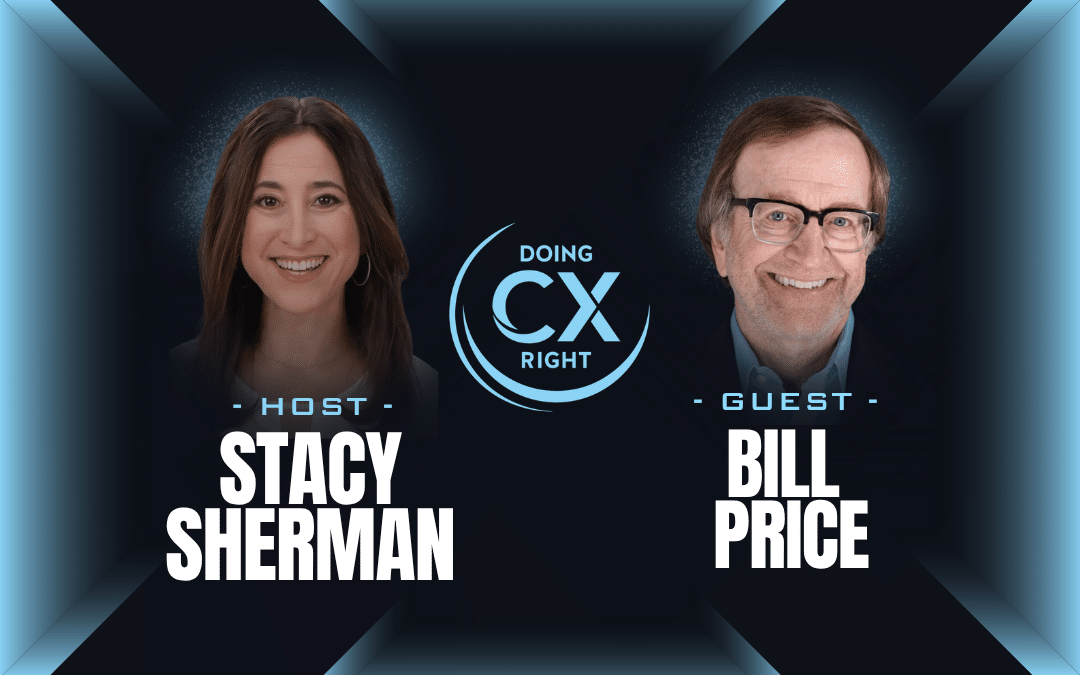
Creating a Frictionless Organization & Better Customer Experiences



Being frictionless has become a strategic necessity.
What does frictionless even mean? What are simple steps to remove customer pain points and get to a frictionless state based on learnings from the most reputable brands?
Whether your company is a small start-up, mid-size or large corporation, the principles are the same, and it is in your control to improve experiences for everyone who interacts with your brand. In fact, customer loyalty depends on it.
Customer Service and Experience Topics discussed:
- The definition of frictionless.
- Why should business managers and leaders care?
- Practical advice from Bill’s book: ‘The Best Service Is No Service,’
- Proven ways to reduce customer complaints by removing friction.
- Bill’s step-by-step methodology to remove customer pain points and sustain a frictionless state.
- Doing CX Right examples from companies all over the world, including Airbnb, Amazon, Tesla, Zoom, etc.
Episode Timestamps
[04:18] Defining friction and the goal of becoming a frictionless organization
[05:31] Why managers must listen to live calls, chat threads, and recorded calls
[07:13] Asking “Has this happened before?” to identify repeat contacts (snowballs)
[08:18] The “best service is no service” philosophy from MCI and Amazon
[09:57] Splitting contacts into reasons and assigning ownership outside customer service
[11:27] Closing the loop by charging costs back to owning departments
[14:08] Omnichannel friction when online and retail teams have different metrics
[20:52] Journey mapping across website, app, chatbot, IVR, store, and contact center
[24:51] Preempt: sending two-way updates before customers chase status
[27:00] Leverage: using cancellation requests to learn root causes
Press Play To WATCH Interview:
Read Full Episode Transcript
Full Transcript:
Creating a Frictionless Organization & Better Customer Experience
[00:00:00] Stacy Sherman: Welcome to the Doing CX Right show. I’m your host, Stacy Sherman, a professional speaker and advisor, educating business leaders how to boost revenue and brand reputation the right way. Too many companies are losing customers and top talent and don’t know why.
[00:00:17] Stacy Sherman: Well, by listening to this show, you’ll gain valuable insights and precise strategies to close the gap and make experience management your competitive advantage. I’m diving deep into new research [00:00:30] and case studies to help you differentiate your brand in this high-tech era. Think of my show as your personal masterclass.
[00:00:38] Stacy Sherman: By the way, if you’re looking for a speaker at your next event, a content partner, or someone to ensure that your team is doing CX right for better results, contact me at Doing CX Right.comNow, let’s get started. Hello, Bill Price. Welcome to the Doing CX [00:01:00] Right show.
[00:01:01] Bill Price: Thank you, Stacy. I’m delighted to be here. I love doing CX right as well, so I’m happy to be joining you for this purpose.
[00:01:08] Stacy Sherman: And it’s kind of funny that as I’m getting to know you and talking about CX, I’m even defining what CX is, and I realize- Yeah … wait, look who I’m talking to. No, I don’t need to do that with you. Sure. So on that note, who are you? What do you do professionally? Tell my audience.
[00:01:25] Bill Price: Sure. No, thank you. I, um, I set up a, uh, boutique [00:01:30] customer experience and customer service consulting firm called Driva Solutions.
[00:01:34] Bill Price: Driva is a Swedish word that stands for to propel, to move forward. Uh, do that out of, uh, uh, Seattle, Washington, and I’ve got a crew of really experienced consultants and, uh, former practitioners around the United States, and I work with, uh, business partners in eight other countries as well, so we support global clients, too.
[00:01:53] Stacy Sherman: Hmm. Why your passion around this topic?
[00:01:58] Bill Price: Um, I [00:02:00] am fed up with poor customer service, poor customer experience. Some I face, I keep getting stories from friends who pour them over to me saying, “You need to look into this,” or, “Why is this happening?” And in some cases I can reverse engineer why it happened, but I’m still not pleased with, with the, the, uh, impact on friends and family.
[00:02:21] Bill Price: But, but moreover, it’s just that I, I’ve been fascinated with how customers interact with organizations and, and how it’s [00:02:30] almost like a, a, uh, different communication layers. The commun- the company or organization thinks it’s doing this, and the, and the customer doesn’t get it. They’re on a different wavelength, so trying to basically bring those two into sync is what’s one of my passions.
[00:02:43] Stacy Sherman: Hmm. What’s one fact that people may not know about you?
[00:02:49] Bill Price: Okay. Uh, one fact that you may not know about me is, um, uh, I grew up in Baltimore. Uh, I’ve been on the West Coast for a long, long time, but I grew up in Baltimore, and I’m a [00:03:00] 12th-generation Marylander. So I actually did my genealogy research when I was a kid.
[00:03:04] Bill Price: My cousin, Jay Geyer, we used to call each other cousin. We didn’t know whether we were cousins or not, so we, we traced back, and our great-grandmothers were sisters, so indeed we were cousins. And I just kept going. I kept going further and further back and, uh, so it’s, uh, fascinating to see the Price family so deep in Maryland.
[00:03:20] Bill Price: But I got away. I, I moved away to California in my 20s and, uh, and have stayed out on the West Coast. But that’s one thing you probably don’t know is I grew up on the East Coast.
[00:03:29] Stacy Sherman: [00:03:30] Hmm. And did you have any friction in moving to the West Coast?
[00:03:36] Bill Price: Um, you know, it was interesting question. No, because at that time I was still, uh, in the US Navy, so the US Navy took care of that for me.
[00:03:42] Bill Price: There was friction to get to the West Coast. The Navy wanted me to stay on the East Coast to finish out my tour of duty. Uh, this was between college and grad school, but I really wanted to get to the West Coast, so I kept pushing for them to get me an assignment on the West Coast, and I finally got one.
[00:03:56] Bill Price: So the friction was one of getting the position, [00:04:00] but once that happened, the Navy came in and grabbed all my stuff and shipped it out, and I drove out in my little car and it was fine. No. That, that, that was actually… It actually worked out pretty well
[00:04:10] Stacy Sherman: So you’ve stated that being frictionless- Mm-hmm … has become a strategy, a really important one for companies.
[00:04:18] Stacy Sherman: First, define what friction means to you.
[00:04:22] Bill Price: It’s, it’s, the question has come up a lot when, when we, when we reached out to about 15 or 20 companies, Stacy, who were, who are still very [00:04:30] well-respected for their customer experience and customer service. We, we asked them, “How do you do it?” Uh, and they gave us many stories.
[00:04:37] Bill Price: They talked about some technologies. They talked about some key individuals. But what they kept talking about was friction. In other words, they kept talking about their goal was, to your po- previous point, how do you identify and get rid of friction? It was only later on that we came up with the flip side of it that said, well, what they really were saying is they wanted to be frictionless.
[00:04:57] Bill Price: So we, um, we decided to flip [00:05:00] the title around and call it, uh, the frictionless organization, and, and it’s hard to know that you’re frictionless, but it’s easy to know that you cause friction. So what we talk about in the book is how do you define, measure and remove friction in order to become frictionless.
[00:05:16] Stacy Sherman: Mm. So why do you feel that managers, leaders should care- Mm-hmm … about focusing on friction? Because there’s so many competing deba- [00:05:30] demands on them.
[00:05:31] Bill Price: Sure. Well, o- one litmus test that we always do as consultants, I always used to do when I was running customer service at Amazon and back at MCI before that was, was listen to what the customer is telling you.
[00:05:44] Bill Price: And when you listen to, either listen in on live calls or look at chat threads or listen to recorded calls, you hear a great amount of frustration from customers. You hear it in their voice. They, they go through a problem, and then the agents, customer agent, customer [00:06:00] service agent says, “Well, I can’t help you today.
[00:06:02] Bill Price: You have to call me back later.” Well, that, that adds even more friction. And so most managers don’t listen to their customers anymore. They read reports, and they look at Pareto charts, they look at histograms, they look at summary data points, averages for things like customer sat or net promoter score.
[00:06:21] Bill Price: They don’t take the time to listen to what the customer’s actually saying. And what customers are saying is, “We’re frustrated with a lot of things that [00:06:30] your company does.” When managers do hear that, it’s like a light bulb goes off, and they, they start getting really action-oriented, but they’re not quite sure where to go.
[00:06:37] Bill Price: How do we fix that? So that’s what we try to address in the book, is try to catalog how to deal with it. But most managers just don’t take the time anymore, unfortunately. C- certainly senior managers, even less so, don’t take the time anymore to listen to customer, uh, direct customer, uh, inputs to what’s going on
[00:06:55] Stacy Sherman: So there’s a lot of questions when they are listening and they are getting [00:07:00] feedback.
[00:07:00] Stacy Sherman: There’s a lot of questions that you can ask customers. What are some of your favorite and, and your recommendations to be able to dig into is are you creating friction for your customer?
[00:07:13] Bill Price: Well, one, one way is, is to ask, “Has this happened before to you?” Because that starts leading down a whole path of, of repeat contacts, repeat issues.
[00:07:21] Bill Price: Mm-hmm. We, we use the term snowballs. It was a term we invented back at Amazon for repeat contacts. So w- snowballs, repeat [00:07:30] contacts are, are really serious. They’re, they’re damaging to the brand. Uh, they take a lot of time and effort. So one of the questions we ask is, “Has this happened to you before?” Now, in fact, the company should know whether it happened to the customer before, but it’s still useful to engage in a dialogue because customers will say, “No, this is the first time I’ve had it.
[00:07:48] Bill Price: I’ve had perfect experience ever, uh, in the past. This is the first time it’s been a problem.” Or they may say, you know, “Every time I deal with this particular product or this bill or this shipment type [00:08:00] issue, I always run across this.” Hmm. So that’s what– that’s a key question to start asking, and then, and then you can kind of go down the, the logic path of first time versus repeat or snowballs.
[00:08:10] Stacy Sherman: Hmm. You’ve written about the best service is no service.
[00:08:16] Bill Price: Right.
[00:08:17] Stacy Sherman: What does that mean?
[00:08:18] Bill Price: Well, back in the ’90s when I was running, uh, uh, some operations at, at MCI, at MCI Telecommunications Company, it, it, it struck me that the companies we work with, uh, and [00:08:30] the, the both… We was on, on the business customer side.
[00:08:32] Bill Price: The business clients we work with were ones that were– they were striving to reduce the need for contact. So I came up with this expression, “The best service is no service.” The best service is no need for service. In other words, things should work clearly. They should work smoothly. Uh, customers shouldn’t have to bother to contact themselves for a lot of the issues.
[00:08:52] Bill Price: And so when I, when I was interviewed by, by Jeff Bezos for this position, uh, at Amazon, which became Worldwide Customer [00:09:00] Service, VP Worldwide Customer Service, he asked me at the end of the i- actually beginning of the interview, at the end of the day, but beginning of his interview, he asked what was my philosophy for customer service.
[00:09:10] Bill Price: And I said, “The best service is no service.” And he said, “Yes, that’s what we wanna do at Amazon. We wanna make things simple, easy. They work well. When we make mistakes, we fix them, but we don’t wanna make mistakes.” So the concept of best service is no service is figure out what are some of those problems that, that, that are [00:09:30] causing mistakes and confusion, and just attack them and, and just get rid of them.
[00:09:35] Stacy Sherman: Hmm. How do you recommend people do that? It sounds so lovely. And e- and sounds simple, but we know it’s not.
[00:09:45] Bill Price: It isn’t. It is not simple. The, the, the first thing to do is to figure out what are those frustration points? So we call them reasons. Intense reasons. They go by different names, but let’s call them customer service reasons.
[00:09:57] Bill Price: So you split the whole range of why [00:10:00] customers are contacting you into reasons, and then you figure out which reasons are good for them and which reasons irritate them or frustrate them. And when you start splitting them like that, then you start zeroing in on the ones that frustrate them. And for the ones that frustrate them, and I’ll give you a couple of examples in a moment here, figure out who within the organization, outside of customer service, either caused that to happen and/or will lead the charge to fix it.
[00:10:26] Bill Price: So for instance, why is my bill so high? Well, that could be [00:10:30] because promotions were offered early on, uh, in the subscription period or early on in the relationship. Those, those promotions were, uh, uh, rolled off, and for some reason, the company did not tell the customer or the customer was meant to remember it, that in fact their bill is gonna go from $30 a month to $36 a month.
[00:10:48] Bill Price: Well, they’re, they’re watching their dollars, and they’re saying, “Why is my bill so high?” And that’s ’cause the company forgot to or didn’t even think about alerting them that your promotion is rolling off. It’s gonna go from [00:11:00] 30 to 36. Love having you as a customer. Hope this works for you. That might have allayed some high percentage of those reasons, but that’s not a customer service problem.
[00:11:10] Bill Price: That’s a billing or product or marketing responsibility. So get that particular reason over to the correct department so they can go, “Aha, well maybe we do have some ways we can reduce the need for that issue.”
[00:11:23] Stacy Sherman: Well, and then how do you get them to close the loop?
[00:11:27] Bill Price: Uh-huh. Close the loop is so important. [00:11:30] At, at Amazon, I was really helped by a CX metric, but the CX definition, Stacy, back there was actually called customer ecstasy.
[00:11:39] Bill Price: That’s how it was called at Amazon in the late ’90s, uh, late ’90s, early 2000s. CX meant customer ecstasy, and that’s what Jeff wanted. He wanted customer ecstasy, not just happiness, not just satisfaction. So in the CX orientation, what, what I was lucky to have around me with, within Amazon was once we had those [00:12:00] reasons, we could count them, we could cost them out, and then what we did is we charged them back to the owners.
[00:12:08] Bill Price: We charged them back to the head of billing or to the head of IT or to someone on the web- website design or someone in outbound shipping. So they actually bore the cost of it, and when they… Internally. And when they bore the cost of it, they became much more engaged to provide feedback to us to go back to the customer so that we could close the loop within the company, but [00:12:30] also back to the customer.
[00:12:32] Bill Price: With clients that I’ve worked with now over the years, some of them have gone that far, others have used a thread of it, which is usually enough, and others have just said, “Look, we have to work together on this.” This is a, as we call it in the book, a whole of business problem. Customer service is like the big catcher’s mitt.
[00:12:47] Bill Price: The rest of the organization has to then get that ball thrown to them so they can deal with it. And, and, and then the expectation, the requirement is then you have to analyze it, research it, and then come back either through [00:13:00] customer service or maybe even go directly to the customer. Mm-hmm. So, uh, a, a good friend of mine used to work at Costco, and, and he was an executive at a Costco warehouse before costco.com even came around.
[00:13:11] Bill Price: He said every morning he had to respond in person to customer complaints in the warehouses around the United States about his responsibility in the morn– the next morning, every one of them. And so he personally would then find out, “Well, what’s really going on? I understand you had a problem with this, that, or the other thing.
[00:13:28] Bill Price: I need to get more information. Tell [00:13:30] me more about it.” This was twenty-five years ago. So that type of, of orientation, culture, expectation is, is really what we’re talking about and trying to achieve to become frictionless too.
[00:13:42] Stacy Sherman: Mm-hmm. You talk about a lot of topics in that. I love it. One thing that stands out is around accountability.
[00:13:52] Bill Price: Mm-hmm.
[00:13:53] Stacy Sherman: And even though there’s a lot of different departments, that you’ve got to break [00:14:00] silos and get people to work together, including their goals, their common goals.
[00:14:07] delete: Right.
[00:14:08] Stacy Sherman: And w- it’s funny you mentioned MCI, uh, at that time. So I had worked for AT&T- Mm-hmm … and Verizon for half my career. Mm-hmm. And something that was really, that stood out to what you’re talking about is that our digital properties that people would buy online and then pick [00:14:30] up at store.
[00:14:30] Stacy Sherman: Mm-hmm. Well, what happened was your retail store had different goals and metrics- Right … than your online team.
[00:14:37] Bill Price: Exactly. Exactly.
[00:14:38] Stacy Sherman: Ouch.
[00:14:39] delete: Right.
[00:14:40] Bill Price: Well, and, and the thing is, it, it, it comes to… And I look at it, that type of story in this way, your customers know everything about your organization. Do you know what they experienced?
[00:14:50] Bill Price: In other words, and they may fill in the blanks and, and extrapolate or get a little more emotional than might be needed, but they, they are the ones who went on the [00:15:00] website, they ordered something, they went to the store, it wasn’t available, or someone couldn’t help them. Uh, uh, they’re the ones that have the history.
[00:15:07] Bill Price: Do you know their history? And that, that’s really it, the rhetorical question we’re trying to get companies to really ask themselves and try to figure out.
[00:15:15] Stacy Sherman: We, yes, and that’s where then personalization comes in- Right … because we would know, back when- Right … I was at Verizon, that- Right … if you came to the site and you logged in-
[00:15:24] Bill Price: Mm-hmm
[00:15:24] Stacy Sherman: you’re an iPhone user, I’m not gonna show you Android products.
[00:15:29] Bill Price: Right. [00:15:30] Right. Right.
[00:15:30] Stacy Sherman: Right?
[00:15:31] Bill Price: No, and, and it, it’s frustrating for a customer, and, and I’ll use, I’ll use that example. If you, if, if, if you’re a Verizon customer, you just bought a new phone, uh, and you’re excited about it, and, and you were instructed by the retail store or the telesales rep, whoever it was, to use the website for customer support or for i- issues you might have.
[00:15:49] Bill Price: If the first thing you saw when you come on the website is a promotion for a new phone, you just bought a phone. You say, “Well, wait a minute now. Is my phone not good anymore?” Or, “What happened here?” When in [00:16:00] fact, that was just sort of brochureware on the website that was not personalized. The personalized version would say, “Welcome to our club.
[00:16:07] Bill Price: Thank you, Stacy, for coming on board. Here are some f- FAQs for you. Here’s what you may see in your next,” we’ll call it journey. They don’t call it… You know, “the next step in your journey, you may need to do this or this or this.” And th- then you feel much more engaged in the whole process.
[00:16:22] Stacy Sherman: Yes, and when that customer who bought online now goes to the retail store-
[00:16:28] Bill Price: Right
[00:16:28] Stacy Sherman: that retail store [00:16:30] knows who that customer is, what they bought.
[00:16:33] Bill Price: Mm.
[00:16:33] Stacy Sherman: What a great opportunity to show them some accessories-
[00:16:37] Bill Price: Right …
[00:16:37] Stacy Sherman: because they know what they bought. Right. Right? Or-
[00:16:40] Bill Price: Well, and accessories are, are a wonderful thing, and also family members. You know, maybe-
[00:16:45] Stacy Sherman: Yes …
[00:16:46] Bill Price: your, your spouse or friend or son or granddaughter, whatever, they’re still on, pick another brand.
[00:16:53] Bill Price: And, and if they get you happy enough with Verizon, with whatever service that is, then maybe there’s also that big [00:17:00] move of, of, of an account over. But it’s only really knowing who you are, knowing what you’ve done with, with us so far. That’s, that’s what’s really important.
[00:17:08] Stacy Sherman: Well, going back to friction, so take that same customer, they go to the store, they pick up their product.
[00:17:16] Stacy Sherman: Most people are not technical in the way of knowing how to transfer their old phone data into their new one. Right.
[00:17:24] Bill Price: Right.
[00:17:25] Stacy Sherman: So what an opportunity for a company to say, “Oh, you just picked up your [00:17:30] phone. Let me help you- Mm-hmm … transfer it. Here’s what we can do together.” What an opportunity.
[00:17:37] Bill Price: It, it, it would, it would be such a game changer for that.
[00:17:41] Bill Price: And, and yet, as you said a few minutes ago, most retail store operations have a different metric, which is sales productivity, uh, or, or some other sales-type speed metric, when this is much more of a care concept. But they’re there in your store. You have them, they have a new, they have a new phone. A, a [00:18:00] related, you know, benefit for a customer, we can, can we give you some instructions how to make sure you can sync this up in your, in your car?
[00:18:06] Bill Price: And they might go, “Wow. Yeah.” So by the time you leave the store, not only is your, is your phone functioning, but you actually can make calls from your speaker in your car, or at least you can upload data. I mean, that type of value add is what most companies say they do, but they don’t necessarily follow through with it.
[00:18:23] Bill Price: And so customers notice when that does not happen, and that’s part of friction. But what they [00:18:30] love is when it does happen, and they may not even know that it’s frictionless. That’s the cool thing about this word we came up with is, is you know when friction is there, but you don’t necessarily know when it’s frictionless because things just work right.
[00:18:41] Bill Price: They just work smoothly.
[00:18:43] Stacy Sherman: Mm. That’s a great example. And I will say another point of friction, and an example for those who I guess are in a retail space or any company where you have omni-channel [00:19:00] That I get so frustrated, friction, that- … frustrated, whatever the word is, that when I go to return a product- Mm-hmm
[00:19:09] Stacy Sherman: I bought online, I go to bring it to the store to return, same company, they won’t let me return it. Wow. I have to leave and go send it back online. Mm-hmm. Mm-hmm. W- you’re one brand.
[00:19:22] Bill Price: That’s right. That’s right. What is this? Yeah. I- we work with a client, Stacy, in, in, in a, um, in the healthcare industry, and they did an offsite [00:19:30] meeting.
[00:19:30] Bill Price: They asked me to come down to talk a l- with them, which was really fun. Then they fanned out to a, um, to a shopping mall. Uh, and, and each person was, was equipped with a product to return, or an item to return to a particular store, and there were high-end stores like the Tiffany’s, there were, there were general retail stores like Macy’s, and there was Nordstrom, and a lot of other places were there.
[00:19:51] Bill Price: Lululemon, I mean, a whole bunch of different retail stores. And they came back afterwards, and their experiences were largely what you described. “This was something I bought. I had the [00:20:00] receipt. They still wouldn’t do it.” Or, “I bought it, and they didn’t have the receipt, and they wouldn’t let me do it.” But conversely, some of the other companies they went to said to them, “Well, it doesn’t matter if you don’t have a receipt.
[00:20:11] Bill Price: Let me look it up for you. Let me just get some information. No problem, you can return it.” So that A/B comparison is so useful to, to try to… And in this case, the company did it as their, as their, as their own, uh, example. But that, that, that’s the sort of thing where returns are, are very frustrating. It can be very frustrating, but when companies do it right, then you start [00:20:30] hearing the positive stories.
[00:20:31] Bill Price: They, they re- they took it back even though I didn’t have a receipt. Wow, I’m, I… Next time I’m gonna try to get a receipt, but at least they took it back for me.
[00:20:38] Stacy Sherman: Yeah. In the CX space, we talk a lot about journey mapping. What’s your perspective on journey mapping and- Mm … identifying those friction points?
[00:20:52] Bill Price: Thankfully now there’s some pretty good software out there that allows you to do journey mapping, but even if it’s traditional spreadsheet, [00:21:00] whiteboard, Visio diagrams, w- we think it’s really useful. I think it’s very useful to do it. The, the, the challenge always is going from channel to channel, the omni-channel point that you mentioned a little bit earlier, because a lot of journey mapping tends to be within a channel.
[00:21:15] Bill Price: Once you get to the, to the IVR in front of a contact center, what do you do? But most customers start way before that. So if you can capture in the journey what they actually did, which might be browsing online, [00:21:30] checking an app, navigating or dealing with a chatbot, and eventually an IVR, and eventually talking to someone in a store or a customer service center.
[00:21:38] Bill Price: So if it’s really true journey, then that’s really important. So it’s, it’s often good, it’s often useful, I think really important, to ask customers once they reach you at a retail shop or a customer service center, you know, basically, “Where have you been?” Again, the company should know, but most companies don’t know, and if you phrase it the right way, they’ll say, “Oh, this is, I, this [00:22:00] is my first time.”
[00:22:00] Bill Price: It’s almost like the first contact resolution example for, uh, uh, uh, snowballs and so forth. But they might say, “Oh my gosh, I tried this. I tried this. This didn’t work.” And, and, and so the frustration mounts up, so it can be, that it can be, uh, confronted. But I, I think journey mapping is, is very useful. Now, one, one, one PS on that one is, is different customers have different journeys, so there is no single journey.
[00:22:26] Bill Price: So as long as it represents different variations on the [00:22:30] theme, then you can start seeing what the real impacts are for the customer and what you can do about it.
[00:22:34] Stacy Sherman: Oh, very good point, and I do like to take a small number of personas and map out their experiences. So that’s true. You can’t do it for everyone.
[00:22:44] Stacy Sherman: It has to be that more typical representation. Right. The other thing about journey mapping is that it not only does it give appreciation of walking in that customer’s shoes and problem-solving- Mm-hmm … but it really drives [00:23:00] internal buy-in and internal solutioning together, breaking those- Mm-hmm … silos and the domino effect.
[00:23:08] Stacy Sherman: You agree?
[00:23:09] Bill Price: Oh, y- I really do. I really do. We, we, w- we did work for, for a client once that was in the, um, in, in, in the retail business. Uh, and, uh, they, they had retail shops, and they had online. So almost to your point earlier about Verizon in a way. And so we, we, we came up, one of my, one of my teammates came up with a- Uh, the life of a [00:23:30] return.
[00:23:30] Bill Price: It actually took the position of a box being returned by the customer and where that return had to go, and where it was basically being inspected or where it got held for a while, and, and what triggered the refund to the customer, and how late was that after the customer actually returned the product to them.
[00:23:47] Bill Price: And, and it was such a complex Visio diagram that took, that took up so much time, it was inevitable the customer was gonna, was gonna ask frequently along that path, “Well, where’s my refund? [00:24:00] Where’s my money?” Or, “Where’s my replacement?” If in fact a replacement would be possible. And only when that was displayed on the board did those executives go, “This is really complicated.
[00:24:09] Bill Price: We had no idea that we were putting this return, this box, through all those different issues.” So you can do– you can do journey mapping of, of boxes too. It’s, it’s, it, it really can be quite illustrative
[00:24:22] Stacy Sherman: You have a methodology that you talk about in your book, and it’s really that step to s- step-by-step [00:24:30] guide.
[00:24:30] Stacy Sherman: Right. Um, as we’re coming to the end, do you want to share any examples or-
[00:24:36] Bill Price: Sure …
[00:24:36] Stacy Sherman: uh, a preview to the movie, the preview to the book?
[00:24:40] Bill Price: I’ll, I’ll, uh, there, there are nine steps, but let me just, let me talk about one of them, because it’s, it’s, it’s one that we have found to be incredibly powerful and, and not, not well understood, and that’s one we call preempt.
[00:24:51] Bill Price: And, and, and it, it- at the basics it is, if you know something that your customer does not know yet, then let them know. Put them in [00:25:00] charge of what to do about that. Don’t just let them wait to figure out that a flight is delayed, or a product’s not gonna arrive on time, or the promotion is being rolled off, as I mentioned earlier.
[00:25:11] Bill Price: Let them know, and, and with permissions, I mean, you need to have the right permissions to text them or to call them or email them or however you want to communicate with them, maybe post something on their app. But let them know. That preempt is a way to kind of dull the, the frustration. It doesn’t get rid of it, but it [00:25:30] dulls it some, and if you make it two-way, so the key thing is not just a one-way s- SMS or a one-way email that says, you know, “Cannot be return,” you know, “You cannot respond to this email.”
[00:25:42] Bill Price: So it needs to be a two-way street. Open up that communication to say, “We’re gonna let you know something that’s important for you, and, and we’re gonna allow you to give us some feedback on that if you want to.” Most customers go, “Okay, thank you. I’ll wait until you give me the final update.” So preempt is one of the nine steps we’re really got some great examples of that in the book, too.[00:26:00]
[00:26:01] Stacy Sherman: I love that example, and communication- Mm-hmm … the emphasis on communication because of, I can’t even say how many thousands of surveys and focus groups- Mm … and all those that I’ve been involved in, how communication, or lack of, is the number one pain point.
[00:26:22] delete: Mm-hmm. Mm-hmm.
[00:26:23] Stacy Sherman: It is. And that’s in our control.
[00:26:25] Bill Price: Just let me know.
[00:26:26] Bill Price: That’s right. And, and, and customers are saying that, too. They’re saying, “Just let me know. [00:26:30] Just let me know and, and I’ll feel better about it.” So, uh, if, if products are gonna be delayed, if multiple, if, if an entire batch are gonna be delayed, you let the customer know. Mm. And, and they can either make other arrangements or they can wait, but at least they won’t be sitting there tapping their foot calling you or firing off a chat message to, to find out what’s going on.
[00:26:48] Bill Price: Just, just let them know.
[00:26:50] Stacy Sherman: All right, one more. Give us one more. That was the first one. Tease us with the second.
[00:26:55] Bill Price: All right. Sec- second one, second one I’ll, I’ll tease you with is, is, is called [00:27:00] leverage. So leverage is, is one where on the surface it’s, it’s good for the customer and it’s good for you to talk to each other.
[00:27:08] Bill Price: So it, it, it… There aren’t too many of these examples, but one of them would clearly be, “Tell me more about your products.” Another one would, would be, “I, I’m not sure if this really works for me. Can, can you tell me if, if this really fits my needs?” Those are great questions to have, and you should basically get rid of all timestamps and, and, and all limits and just, and do, have a good conversation, whether it’s done [00:27:30] electronically or, or in person.
[00:27:32] Bill Price: But another one that I’ll put in the leverage category, which is a confusing one to some, is, “I wanna cancel my product,” or, “I wanna cancel my account.” Some companies make that real easy. Punch this button and you can cancel. But other companies make it really, really hard by putting you through a saves queue and making it really hard for you to leave and, and not giving your, you know, not g- letting you cancel your account or whatever it is.
[00:27:55] Bill Price: The middle ground is what we’re seeking in leverage, which is, “We’re really sorry to hear about that, Stacy. You know, [00:28:00] why, why is it that, that you need to cancel your product? Maybe we can, we can do something about that.” But inside of it, they, they take that as, as the beginning of, like, a root cause analysis.
[00:28:10] Bill Price: So if cus- if, if a number of customers say, “I need to cancel my account because my bill’s always wrong,” or, “Because my system keeps dropping,” or, “Because you’re always late,” then you can start forming these patterns. So not just try to save that customer, which is really important, but deal with [00:28:30] other customers who may be similarly situated by really having that engagement of why.
[00:28:34] Bill Price: Why is this going on? Not to stop them from canceling necessarily, but to learn from, from what’s going on. Again, communication. It’s, it’s… So you could have them push a button that says cancel. That could be very simple, very easy, digitally click, you know, easy sol- uh, e- slick solution, but you’re not learning from it.
[00:28:52] Bill Price: So how can you learn from it?
[00:28:54] Stacy Sherman: So my head goes to communication again, and really good training [00:29:00] of your agents to ask the right questions to get to the why.
[00:29:04] Bill Price: They need to know that they can ask that, because some agents feel- Yeah … pressured that they have to get to the next call or the next chat session.
[00:29:11] Bill Price: Mm. But for the le- So it’s going back to these, this differentiation among reasons. For certain reasons, you deal with them a certain way, but for leverage reasons, basically take the time it needs and, and, and really have a, have a good conversation.
[00:29:26] Stacy Sherman: All right. Well, getting to the end, my final questions for you.
[00:29:29] Stacy Sherman: Mm-hmm. [00:29:30] If I had tons of leaders and CEOs in my room right now- Mm-hmm … at reputable brands, what’s the one takeaway you want them to remember?
[00:29:42] Bill Price: I would say to them, experience your own products as a customer does, either by literally experiencing them, by buying things incognito or by watching things, uh, uh, that, that happen in your, in your organization, or listening to [00:30:00] calls that are live from customers, uh, going into retail shops and, and, and listening to the conversations that happen when, when someone walks into your shop.
[00:30:07] Bill Price: So get that personal experience, whether you’re CEO, whether you’re a director of marketing, whether you’re a, a product manager, just get out there. One of my first white papers I wrote a long time ago when white papers were the thing was get out there. Just get out there. Move away from your office environment, or if you’re working from home, even move away from your home office and just get out there and experience it [00:30:30] from the customer point of view as much as possible.
[00:30:32] Stacy Sherman: Hmm. Absolutely. And in your employee’s shoes and agent’s shoes, too. Oh, yeah.
[00:30:38] Bill Price: Oh-
[00:30:39] Stacy Sherman: But that’s another- It be- … that’s another episode.
[00:30:41] Bill Price: It is another episode, but you learn about that as well at the same time,
[00:30:44] Stacy Sherman: right? Yes. And leadership advice, what’s the best-
[00:30:49] Bill Price: Mm-hmm …
[00:30:51] Stacy Sherman: that you’ve received or given?
[00:30:53] Bill Price: It was actually a long time ago.
[00:30:55] Bill Price: I started my career with McKinsey and Company, the big international consulting firm, and I worked with Tom [00:31:00] Peters. And Tom was very, very bubbly. He had lots of great quotes and examples, but he kept saying to clients of ours, and even to us as consultants, “If it’s not broken, break it.” Meaning, if you think things are working well, it may be a slippery slope down.
[00:31:18] Bill Price: So you have to keep challenging what’s going well to make sure that it continues to go well, and you have to reinvent what you’re doing so you don’t become complacent. So we have an example in the [00:31:30] book of the, the, the founder of Zoom was actually an executive at Webex, which is inside of Cisco, and he wanted a simpler Webex when he was working there back in the mid-2000s, maybe 2010, ’12 or something.
[00:31:46] Bill Price: And Webex said, “Nah, you know, everything’s working great, you know, we’re, we’re top of the game. Webex is a great system. People are buying it.” And he couldn’t convince them, so he left and formed Zoom, and he wanted to have a simpler product. So the idea was [00:32:00] just he, he wanted to reinvent it. He wanted to shape it up.
[00:32:03] Bill Price: He wanted to break it, even though at that time, Webex was doing perfectly fine. Now Zoom is one of the leading brands, and everyone’s trying to chase after them. So if it’s not broken, break it would be my point of view, uh, because you’ll learn a lot about that in the process.
[00:32:18] Stacy Sherman: Final question. If you could go back in time to your younger 20-year-old self, based on what you know now that you didn’t know then, what would you tell younger Bill Price?[00:32:30]
[00:32:30] Bill Price: I would say get my hands dirty. Get out of the, uh, consulting, which I did do after a few years, but actually go out there and, and run something. Figure out how- Mm … it works from the inside. Um, I was glad I did that. I became CFO for a startup company that MCI acquired, which is how I got into the telecommunications world, uh, as, as well as the customer experience world.
[00:32:53] Bill Price: But, but it was only because of that, um, well, the CEO, Ken Jones, who hired me in that position, that I was able to then [00:33:00] move away from what I’d been doing and, and actually got my hands involved in things, and I, I learned so much by being directly involved.
[00:33:07] Stacy Sherman: Great advice. Well, I know people are gonna wanna reach you and find you, and where’s the best place?
[00:33:13] Stacy Sherman: I’ll add it to the show notes.
[00:33:15] Bill Price: Well, we have, uh, my coauthor and I have a, a book site called frictionlessorg.com, and that’s a good place to learn about the book. Uh, you can find links over to, to me and to my coauthor, David Jaffe, who lives in Melbourne, Australia. Uh, and, uh, that- that’s a [00:33:30] good way to, to get ahold of us.
[00:33:31] Bill Price: And my email address is always available, bill@drivasolutions.com. Uh, so both of those are good ways to reach me.
[00:33:38] Stacy Sherman: Well, thank you for sharing such great wisdom today. I know people are gonna benefit, and I appreciate you.
[00:33:46] Bill Price: Thanks, Stacy. It was a really, really fun time. Thanks for your great questions and, uh, and, and, and the conversation.
[00:33:50] Bill Price: Loved it.
[00:33:51] Stacy Sherman: Thank you so much for joining today. I hope you’ll take what you’ve learned and put it into action, because it’s about doing CX right, not [00:34:00] just talking or thinking about it. If you found this valuable, leave a review wherever you listen to podcasts, as it helps others discover the show, and continue learning by subscribing to my newsletter and scheduling time with me to discuss anything on your mind.
[00:34:17] Stacy Sherman: Reach out at doingcxright.com. Thank you again. To be continued
Customer Experience Questions & Answers: What Leaders Need to Know
Q: How do we separate first-time issues from repeat contacts that signal a deeper problem?
A: Ask customers during live calls and chat sessions whether this issue has happened to them before. Record the answer in the contact reason field so you can count how many customers report the same problem in previous cycles. Customers who say this is the first time indicate an isolated incident. Customers who say they run into this every time with a particular product, bill, or shipment type indicate a snowball that requires a process fix. Use that count to prioritize which reasons to assign to billing, product, marketing, or operations for resolution.
Q: How do we assign ownership for customer problems that originate outside customer service?
A: Split all customer contacts into reasons such as billing surprise, promotion roll-off, website confusion, shipment delay, or return refusal. For each reason, identify the department that caused it or can fix it. Examples include billing for promotion notifications, marketing for offer terms, website design for navigation issues, outbound shipping for delivery delays, and retail operations for return policies. Assign the cost of each reason to that department in your weekly operating report so the owner sees the impact and participates in the fix. Require that department to analyze the cause, implement a change, and communicate the outcome back to customer service or directly to the customer.
Q: How do we map journeys that reveal friction across online, app, store, and service channels?
A: Build journey maps that start before the customer reaches the contact center. Include browsing on the website, checking the app, navigating a chatbot, interacting with the IVR, visiting a store, and speaking with an agent. Map variations for key personas instead of trying to capture every possible path. Add operational steps such as inspection, approval, and refund triggers for processes like returns. When executives see the full sequence of handoffs, they recognize where customers will ask for status and where delays occur. Use that map to remove unnecessary steps and to add proactive updates at points where customers would otherwise chase information.
Q: How do we prevent customers from contacting us about delays, price changes, or shipment issues?
A: Send two-way updates before customers need to ask for status. Notify customers when a flight is delayed, a product will not arrive on time, or a promotion is rolling off. Use channels where you have permission to reach the customer, such as text, email, phone, or in-app message. Design the update so the customer can respond, not just receive a one-way notice. That reduces the number of calls and chats where customers ask what is happening and gives them a chance to make other arrangements or confirm they will wait.
Q: How do we turn cancellation requests into learning that improves retention for other customers?
A: When a customer requests cancellation, ask why they need to cancel and record the reason in a structured field. Look for patterns such as bills that are always wrong, systems that keep dropping, or deliveries that are always late. Use those patterns to initiate root-cause analysis in the departments that own billing accuracy, system reliability, or delivery performance. Fix the underlying process so other customers in similar situations do not encounter the same problem. This approach treats cancellation requests as data that improves the experience for the broader customer base, not just as saves opportunities for the individual customer.
About Bill Price ~ The Frictionless Organization
Bill Price started Driva Solutions in September 2001 to help companies achieve the delicate balance between cost containment and greater customer loyalty, co-founded the 9-country LimeBridge Global Alliance in early 2002, and is the lead co-author of three books: The Best Service is No Service, Your Customer Rules!, and The Frictionless Organization. Bill served as Amazon’s first Vice President of Global Customer Service and before that was Vice President & General Manager of MCI Call Center Services, COO & CFO with a start-up software company in San Francisco, and a Senior Engagement Manager with McKinsey & Company in San Francisco and Stockholm. Bill received his undergraduate degree from Dartmouth College and his MBA from Stanford University, and lives in Bellevue, Washington.
Learn more about Bill Price on his website. Connect on LinkedIn
About Stacy Sherman: Founder of Doing CX Right℠
An award-winning certified marketing and customer experience (CX) corporate executive, speaker, author, and podcaster, known for Doing CX Right℠. She created a Heart & Science℠ framework that accelerates customer loyalty, referrals, and revenue, fueled by engaged employees and customer service representatives. Stacy’s been in the trenches improving experiences as a brand differentiator for 20+ years, working at companies of all sizes and industries, like Liveops, Schindler elevator, Verizon, Martha Steward Craft, AT&T++. Stacy is on a mission to help people DOING, not just TALKING about CX, so real human connections & happiness exist. Continue reading bio >here.