




What is the Experience Economy, and why should it change how you compete? Services save customers time. Experiences are time customers want to spend with you, and that’s what they pay more for.
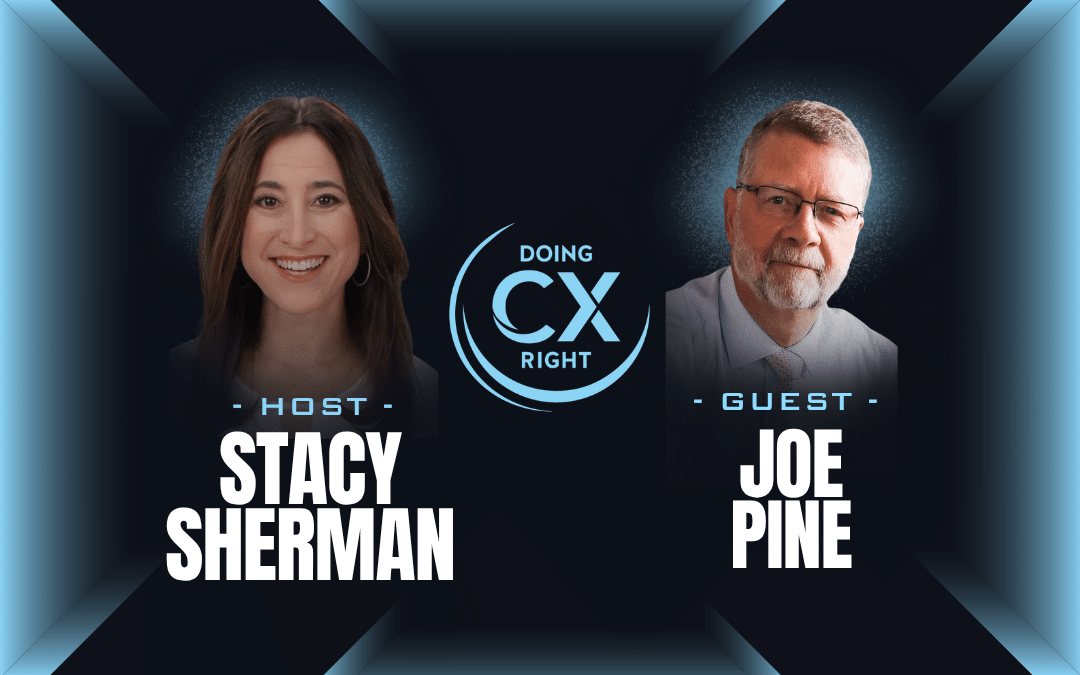
In this episode of Doing CX Right®, Stacy Sherman and Joe Pine explain why experiences are a different offering from services, and what that means for any company that wants customers to choose it and come back. Examples range from the Ritz-Carlton’s guest preference notes to a local sandwich shop that remembered extra buffalo sauce for Stacy’s son, and a child’s birthday party that shows how a memorable experience is built.
What You Will Learn
- Why making every interaction nice, easy and frictionless gets you great service, but not an experience customers remember
- The difference between time customers want to save and time they want to spend with you, and why only the second earns a premium
- How wasting customers’ time lowers what you can charge
- How the progression from commodities to goods, services, experiences and transformations shows why customers pay more at each step
- Why customizing a service for one person turns it into an experience
- How to use the five E’s (enticing, entering, engaging, exiting and extending) to give an experience a high point and an ending people talk about
- The question every leader must answer: what business are you really in?
Episode Timestamps
03:56: Why convenience alone does not create a memorable customer interaction.
06:00: The difference between time saved and time spent.
09:00: Why customer perceptions affect price comparisons.
10:25: How wasted customer time reduces the value a company provides.
12:55: What the coffee example explains about customer choice.
15:28: How mass customization serves individual preferences.
17:33: How recorded guest preferences support personalized service.
19:27: What a sandwich shop example reveals about employee recollection.
21:16: How the five E’s organize a memorable customer journey.
27:03: How leaders can identify what customers are actually purchasing.
Watch Stacy Sherman’s Interview on Youtube
Questions & Answers: What Leaders Need to Know about the Experience Economy
Q: What is the Experience Economy?
A: The Experience Economy describes a shift in what customers buy. In fact, experiences are now an economic offering of their own, as different from services as services are from products. Services save customers time, while experiences are time customers value spending, and they remember them long after.
As a result, the question you ask about every interaction changes. Not only “How do we make this faster?” but also “What would make this worth our customer’s time?”
Q: What is the difference between customer service and customer experience?
A: Great customer service is nice, easy and convenient. Customers expect it, and they should. But it rarely becomes something they remember. An experience, however, is personal. It engages people, rises to a high point and leaves a memory.
You still need frictionless service underneath every experience. On its own, though, it won’t set you apart.
Q: How do you personalize the experience for every customer?
A: Customize the service for each person. When a service fits exactly what one customer needs in that moment, it becomes an experience. To do it efficiently, build the pieces once and then combine them for each customer, the way a coffee shop builds every custom drink from the same ingredients.
Then write down what customers tell you they prefer and make it available to everyone who serves them. One employee who remembers a regular’s order creates a great moment. However, a shared record creates that moment no matter who is working.
Q: What are the five E’s of customer experience?
A: Enticing, entering, engaging, exiting and extending. First, enticing is everything before the visit that makes people want to come. Entering is the first impression, so it sets the stage for what follows. Engaging is the reason they came and the high point of the experience. Finally, exiting is the last moment, which people tend to remember most. Extending keeps the memory going afterward, so customers tell others and come back.
So design each stage on purpose. Otherwise, a flat experience, where nothing rises and nothing ends well, is easy to forget.
Q: How can a company stop competing on price?
A: When customers see you as a commodity, they care about two things: the lowest price and the most convenience. Therefore, the way out is to offer something they value beyond the product or the task itself.
For example, think about a cup of coffee. The beans cost pennies. Brewed at a corner diner, the same beans sell for a dollar or two. And when they’re served in a café where people want to sit and enjoy it, they sell for several dollars. The beans didn’t change, but the experience around them did.
On the other hand, wasting customers’ time lowers the value customers get from you. Asking for an account number twice, or handing someone a form with information you already have, works against you.
About Joe Pine- Expert on Competing For Customer Attention, Time and Money in an Experience Economy
An internationally acclaimed author, speaker, and management advisor. The co-founder of US-based Strategic Horizons LLP, Joe’s many books include Mass Customization, Authenticity, Infinite Possibility, and The Experience Economy: Competing for Customer Time, Attention, and Money, which was twice named one of the top 100 business books of all time.
About Stacy Sherman: Founder of Doing CX Right®
Stacy Sherman is an award-winning international customer retention keynote speaker and Certified Speaking Professional (CSP®). She works with leaders and teams to design experiences that stop churn and boost revenue from existing buyers. Stacy has delivered hundreds of standing-ovation presentations and workshops, and co-authored best-selling books on customer excellence. She is widely recognized for her Doing CX Right® podcast, ranked in the top 2% globally with more than 200 episodes, and for her LinkedIn Learning courses, with hundreds of five-star reviews. A multi-time Global CX Guru awardee and ICMI Hall of Fame inductee, her insights have been featured in Forbes, Psychology Today, Yahoo News, and other leading publications.
Download The Distinctive Business Advantage research report to discover exactly what top-performing companies are doing to drive customer loyalty and sustainable growth, and what you can do as well.
Bring these insights to your company. Stacy Sherman is available to present the findings and proven strategies at your events, workshops, podcasts, and training sessions. Contact her now.