
Best Career and Leadership Advice from 30 Women Across Industries

Best Career and Leadership Advice from 30 Women Across Industries


Doing CX Right podcast show on Spotify with host Stacy Sherman
DoingCXRight-Podcast-on-Amazon-with-host-Stacy-Sherman.
Doing Customer Experience (CX) Right Podcast - Hosted by Stacy Sherman
Doing CX Right podcast show on iHeart Radio with host Stacy Sherman

What is the best leadership advice you have ever received or given? Ask enough women leaders that question, and you will collect answers that no MBA program, management training, or business book has ever captured.

For the new season of the Doing CX Right℠ podcast, I gathered some of the best answers, and I am sharing my own, too. Whether you are reading this in March, when the world pauses to honor International Women’s Day, or in any other month, none of what follows expires.

We need more women supporting women. We need more men supporting women. And maybe the next generation will finally reach a world where we stop adding a qualifier before the word leader and simply recognize great ones. That belief is personal for me, and it starts with my mom.


What My Wall Street Mom Taught Me About Leadership

The best leadership advice I ever received came from watching my mom, Eileen, one of the first women options traders on Wall Street. She walked onto a trading floor where every face around her was male, where no one made room for her, and where the assumption was that she did not belong.

She showed up anyway. And she excelled.

One of my favorite stories is that she took screaming lessons so the men on the trading floor could hear her. Who takes screaming lessons? My mom did. She learned to be louder in a room that was not built for her, and she excelled because of it. I watched that, absorbed it, and brought it with me over 25 years of leadership in corporate America. It still guides how I work today.

My Leadership Lessons:

Believe in yourself. If you do not, no one else will.

Ask for what you want. If you do not ask, the answer will always be no.

Have a plan, but stay open to detours. Some of the best moves I made looked like setbacks at the time and ended up changing my life for the better.

Take nothing personally. From The Four Agreements, one of my favorite books: people may not welcome you with open arms, but show up anyway and do your best.

Do not make assumptions. Also from The Four Agreements: assumptions create problems that did not exist yet.

Feel the fear and do it anyway. If you do not read the book, at least print the cover and put it on your desk. It is not a motivational phrase. It is a survival skill.

Follow your gut and listen to the whispers. They are telling you something. My transition from corporate America to entrepreneurship happened because I bet on myself. I wish I had done it sooner, but it is never too late.

What Women Leaders Across Industries Shared

The insights below come from authors, executives, and leaders I deeply admire in the customer experience field and beyond. This article captures many of their ideas, but not all of them. The full conversations, including the stories, the context, and the moments that are better heard than read, are waiting for you in the episode.

Surround Yourself With People Who Can Do Your Job Better Than You

Early in a leadership career, the instinct is to be the most knowledgeable person in the room. Laurie Guest’s advice is to let go of that entirely. When you hire someone who can genuinely cover for you, you can take a vacation without your phone attached to your hand. You can clock out at five and be fully present at home. You can sleep, think clearly, and come back the next day with enough left to actually take care of your customers and your team.

Claim Your Agency Without Asking for Permission

Agency, as Lisa Oswald defines it, means you do not need permission to be who you are or to move things forward. It is your right to speak, to be heard, to be seen, and to be paid what you are worth. For those who never had a model of that growing up, the starting point is simply deciding that you no longer require approval to take it.

Build Your Employee Experience First, Because Your Customer Experience Depends on It

The best advice Brittany Hodak ever received came from her father, a customer service practitioner who told her: always go out of your way for your team, because you are nothing without them. The logic holds directly in CX. When employees feel cared for and equipped, they become advocates. When they do not, customers feel it in every interaction.

Don’t Mimic Other People. Be Authentic in Your Leadership Style

A senior executive, Michelle Musgrove worked with at AARP, gave advice she has never forgotten: whatever you do, be authentic in your leadership style. You always have a voice. You have thoughts. Do not ever sit in a room and keep them to yourself. Say them with confidence and in a way that feels comfortable to you. Because when you stop performing a version of yourself that was never real to begin with, something shifts. You can actually take the weight off.

Michelle adds something very practical: women can get in their heads about being pigeonholed. If you want to plan the office party because it brings you joy, plan it. Do not get too wound up in stereotypical expectations about what ambition is supposed to look like.

Choose to Be Unique, Not Just Better 

Competing on being better keeps you in a comparison trap. Sylvie Di Giusto’s advice is to make an intentional choice to be unique instead. Do something that has not been done before. That decision applies to individual leaders and to the organizations they build.

Bring Your Passion Every Day and Set the Energy of the Room

In large organizations, it is easy to hear “we tried that” or “that will never happen here.” Katie Webb’s advice is to separate yourself from that noise and stay connected to what you are truly passionate about and bring it every day. She holds herself to a simple standard: she wants people to see her passion, because she wants to work for passionate leaders herself.

The flip side of that is energy. Katie always wants to be the energy in the room that she wishes she could walk into. Whether you are a leader or an individual contributor, energy is contagious, negative or positive. If you walk into a room where everyone is frustrated and closed off, it shapes everything that follows. As a leader, you set that starting point.

Believe You Can Do It Before You Ask Anyone Else to Believe It  

My Mom Eileen’s advice starts with what happens in your own mind before you say a word to anyone else. You have to believe you can do it first. Not perform confidence. Actually have it. Then you go to the people who doubt you, and you say: Give me a chance. I know the work. I know what has to be done. Let me prove it. If I fall short, I will know it and so will you.

She frames the choice as two paths. One path is deciding not to try, which ends the conversation before it starts. The other path has a chance. And if you take that path and succeed, she asks you to sit with what that actually means: look at the world that opens up to you. That is what it is about.

Enable Your People to Bring Their Best, Because That Is What CX Leadership Actually Is

Jeanne Bliss reframes what customer experience leadership actually means. It is not a department. It is not a set of metrics. It is about listening to good humans and enabling people to bring the best version of themselves to work. When that does not happen, you end up with an organization of people ticking boxes and showing up because they have to, versus uniting people around a purpose and elevating their soul and their spirit.

Model the Standard You Expect, Because You Cannot Ask for More Than You Give 

The standard you accept becomes the standard everyone else lives up to. Lisa Ford states the leadership lesson so well: you have to be doing the thing, not just saying it. If you want accountability, model it. If you want honesty, practice it first. The ceiling for your team is set by where you are willing to go yourself.

Lead With the Intention to Make a Positive Impact, Not Just a Profit

Jackie Yeaney is direct about what leadership responsibility actually means. We are not in these roles just to make a profit, not for the organization, and not for ourselves. We are here to make a positive impact on the world and on the people around us. When you concentrate on nurturing the people who look up to you so they can achieve more than they ever thought they could, that leaves a lasting impact on the world.

Change the Question Before You Try to Solve the Problem

The problem is not the problem. The problem is how you are thinking about the problem. Wendy Smith’s framework, built around both/and thinking, starts with one shift: stop asking “should we do this or that?” and start asking “how can we accommodate both?” IBM used this to hold customer retention and innovation at the same time. Unilever used it to pursue both social mission and profit growth. The reframe works because it stops the brain from treating competing priorities as a zero-sum choice.

Choose Every Day to Let the Brave Voice Lead, Not the Negative One

Blake Morgan’s message is simple: every day is a choice. You can choose to bring the energy, to be positive, to embrace hardship and change, and to be more positive than you are negative. The negative voice will show up, and that is okay, but do not let the negative voice lead your decision-making. Let the brave one lead. And if you are wondering what the worst that can happen is, Blake puts it plainly: you will probably feel bad or cry, and that is okay. You are not going to die.

Refrain From Emailing Your Team After Hours, Because They Will Feel Compelled to Respond

Marcey Rader’s advice can’t be said enough: when you are in a position of hierarchy, you are the role model people are looking at. It does not matter how many times you say, “I work long hours, I work at night, I work on weekends, but I don’t expect you to.” If they know that you do, they will feel compelled. Most people will feel compelled. So if you choose to work off-hours, good for you, but refrain from communicating with your team during those times. Refrain from emailing on Saturday evening. Because in a position of hierarchy, people will feel compelled to respond.

Do Work You Genuinely Like With People You Actually Care About

Do what you genuinely like and build your work around people you enjoy and respect. Time spent in rooms that drain you is time you cannot get back. I couldn’t agree more with Jacqueline Brassey.

Disseminate Your Purpose to Every Level, Not Just the Top

Sharon Weinstein’s advice comes in two parts that build on each other. The first is something she gives to others: you have the capacity within you to make this happen. Share that across the board so that everyone believes in the same purpose and understands that we are all here for the same reason. The second is advice she received and passes on every chance she gets: make sure you are all singing from the same sheet music. Do not tell one version of the story and have somebody else tell another version. That same value statement that is up on the walls needs to be disseminated at every level of the organization.

Allow for the Fact That Your Way May Not Be the Best

Miya Gray’s approach to leadership is about sitting back, listening, and allowing for the fact that your way may not be the best. And even if your way is the best, it may not be the way the project or the experience goes, because everyone has a say. Being open to that is critical, especially in CX. That is where culture does its real work: making it safe for people to speak up.

Ask for the Raise, the Promotion, and the Opportunity Without Apologizing for It

Be fearless. Don’t fear rejection. Do not worry about appearing too ambitious. Do not worry about looking imperfect. And do not be afraid to ask for a leg up, for that raise, or for that promotion. Too many women sit on what they want because they are concerned about how the ask will land. Catherine Sugarbroad’s point is that staying silent guarantees nothing changes.

Stop Viewing Your Employees as Cogs in the Wheel and Start Caring for Them as Humans

You can take a horse to water, but you cannot make the horse drink. You cannot make people care, but it makes all the difference in the world if they do. Annette Franz has seen what happens when leaders forget that. Remember to view your people as the humans that they are and care for them. Because a leader who sees their team as a means to a business outcome, rather than as people worth investing in, will never get the discretionary effort, loyalty, or care that exceptional customer experience requires.

Define Your Customer Experience Mission, Because It Makes Every Other Decision Easier

Without a clear customer experience mission, every person on your team is working from a different definition of what good looks like. Jeannie Walters identifies this as the single most important starting point. Not a tagline. Not a vision statement written by committee and filed away. A clear, specific mission that every person in the organization can reference when a decision needs to be made. I have seen what happens when that mission does not exist: teams fill the gap with their own assumptions, priorities compete, and the customer experience becomes inconsistent. Those assumptions rarely match, and customers feel it before leadership does.

Go for It, Because All They Can Do Is Say No

Nicole Donnelly’s most influential mentor was a fierce entrepreneur who built her wellness company to over fifty million dollars in annual revenue. The advice she gave Nicole was simple, and she has never forgotten it: all they can do is say no. So just go for it. Do it. Nicole loved that advice because it reframes the entire risk of asking. The no is not the end. It is just an answer, and the only way to find out is to ask. This is one of my personal favorites, as my Mom has said this to me my entire life!

Don’t Build for Us Without Us

Vannessa LeBoss’s guiding principle applies far beyond her industry: don’t build for us without us. Do not design something you think is going to resonate with a community without that community leading the design. Her company is truly deaf-led, which means nothing is built or designed for the deaf community except through the deaf community. Vannessa is one of the only hearing people on her team, which makes her the minority in those conversations. So in the meetings where the community’s experience is being shaped, she does not have a lot of input because it is not her lived experience. Her leadership style in those situations is to take a step back. Recognizing where your experience ends and someone else’s begins is not a weakness. It is how you build something that actually works for the people it is meant to serve.

Train Yourself to See What Is Good, Not Just What Needs Fixing

Monica Amadio’s colleague Deepa, a lead trainer for an international company with more than 160,000 employees, drew a single small dot in the center of a large blank page and held it up to the room. She asked: What do you see? Everyone said the dot. No one mentioned the rest of the page surrounding it. That was her point. When leaders face a problem, they fix their attention on the issue and lose sight of everything that is functioning well around it. Deepa used a wall-sized Post-it note to make this visual, so the contrast was impossible to ignore: one tiny dot, surrounded by an enormous amount of white space. Monica took that image into her leadership practice. The advice is simple: focus on the good. The problem is still there, but it takes its actual size when you stop letting it fill the entire picture.

Leave Silence in the Conversation and Watch What Happens Next

Most leaders fill every pause in a conversation because silence feels uncomfortable. Kate Bradley’s advice is to do the opposite. Leave silence in the conversation. Stop talking and let the quiet sit there. When you do, people lean forward. They fill the space with what they were actually thinking. It is, as Kate puts it, a very sneaky, powerful tool. Try it.

Pay Attention to Your Side Pursuits, Because They Are Telling You Something Worth Hearing

Joanne Lipman makes the case that the phrase “side hustle” is almost a misnomer. It trivializes something that is genuinely a passion, something that matters enough to you that you keep returning to it. Do not give up on it. Think about where it might take you in the future.

I would add this for anyone who says they do not know what their passion is: ask yourself what people consistently come to you for. The answer to that question is usually where your passion lives.

Lead With Your Heart and Coach People in the Moment, Not Weeks Later

Tia Graham was fortunate to go through a leadership program when she was 26 years old, in her first leadership position. Two pieces of advice from that week-long program have stayed with her for over fifteen years. The first: lead with your heart. The second: coach people in the moment. If you see someone doing something that needs to be corrected, do not wait for a meeting. Do not make it a big deal. The process she was taught is simple: address it, keep it from being demotivating, and move on quickly. Both pieces of advice served her very well throughout fifteen years of leading teams.

Never Compromise the Truth of What Really Matters to You

Never compromise the truth of what really matters to you. People do it because they want to be accepted, they want to be seen, they want to be validated, they want to be heard. But when you keep giving up those parts of yourself, you shrink. You withhold. And then everyone feels it, even if no one says it out loud. Thanks for this gem, Cynthia James.

Give Direct Feedback With Compassion, Because Clarity Is Kindness

Early in her career, Jennifer Lee thought she was being kind by not addressing a performance issue with an employee. A mentor corrected her way of thinking: You can be kind and still be clear. In fact, people need to understand specifically what they need to change and why, rather than to sit back and let them believe they are meeting the standard when they are not. That is your job as a leader. Jennifer calls the approach compassionate candor. You underpin the feedback with empathy, kindness, and a true desire to see the other person succeed. Then you give the direct feedback. As she puts it, you can be direct and compassionate at the same time. Both and, not either or.

When the News Is Hard, Say It Anyway

Similar to Jennifer Lee, Leslie O’ Flahavan’s emphasizes that every leader needs to be a person who can say difficult things out loud and put difficult decisions in writing, with candor, courage, and kindness. Here is what that looks like in practice. You have a staff of a hundred people, and starting after Labor Day, they need to be in the office four days a week. They are furious. They do not want to do it. Candor means telling them clearly why it needs to happen. Courage means believing that being honest about the decision will lead somewhere better. Kindness means bringing empathy to how you deliver it. Think of the friend in your life who always knows what to say when someone dies. They never say, “I didn’t speak to you because I didn’t know what to say.” They find the courage, and they say the words that need to be said. That is what leadership asks of you, because the line between workplace communication and human communication is completely tangled, and the leaders who navigate both are the ones people trust.

Give Your Team a Reason to Care That Goes Beyond the Job Description

Focus on the why. In order to really connect with your team members, getting them to feel that deeper sense of purpose is so important. Being able to connect their role to the deeper impact they are making on customers and on the world changes everything. It does not have to be something dramatic. But when an employee can see that they are not just filling out a form, that their work is actually changing someone’s life, that is a pretty different way to show up every day. Great wisdom by Lauren Herring.

Listen Before You Speak, Because Your Customers Are Already Telling You What They Need, Especially On Social Media

Listening is so incredibly important, and many times it is better to listen before you speak. Madalyn Sklar reminds us that too many brands just get out there and talk, talk, talk on social media. But are they really listening to their customers and addressing the issues being brought to them? And it is not always about the negativity. When a customer takes the time to tweet something nice and share it with their community, make them feel really appreciated. It is not just good manners. It is how you build the kind of relationship that keeps people coming back.

Fix Problems Before They Become Emergencies

Whether you fix a problem now or fix it later, you will spend the time. Address it early, and you can involve the right people, test your solution, and communicate the change on your own schedule. Wait until it becomes damage control and you are on a hamster wheel, trying to push through a brick wall, reacting under pressure with everyone watching. The problem does not get smaller by waiting. It just arrives with fewer options and more stress attached to it. Well said, Vicki Brackett.

Stop Treating Employee and Customer Experience as Competing Priorities, Because They Are Not

High-performing organizations do not choose between employee experience and customer experience. They treat them as connected. A decision that benefits customers at the expense of employees creates a gap that closes itself, usually through attrition or inconsistent service. Tiffani Bova’s practical test for any CX leadership meeting: ask who is responsible for keeping the customer experience promise, then ask whether those people have what they need to deliver it. That question surfaces the real conversation.

My Final Leadership Thoughts Within The Customer Experience Industry and Beyond:

Every piece of advice came from a woman leader who learned it through experience, not theory. Some of it came from a parent. Some from a mentor who cared enough to be direct. Some from a mistake that cost something real. And across all of it, the pattern is the same: leadership that produces exceptional customer experience starts with how you treat people, beginning with yourself.

Not one of the 200 women I asked named a framework, a technology, or a budget. They named people. How you see them, how you speak to them, how you show up for them, and how you create the conditions where they can do their best work. That is what Doing CX Right℠ is built on. And it is what separates the organizations that genuinely deliver exceptional customer experience from the ones that only talk about it.

This article covers the highlights, but the full conversations are richer and more personal. Listen to the complete episode of the Doing CX Right℠ podcast on Apple Podcasts, Spotify, or wherever you listen. If it resonates with you, please subscribe and leave a review. It helps more leaders find my content.

Doing CX Right podcast show on Spotify with host Stacy Sherman
DoingCXRight-Podcast-on-Amazon-with-host-Stacy-Sherman.
Doing Customer Experience (CX) Right Podcast - Hosted by Stacy Sherman
Doing CX Right podcast show on iHeart Radio with host Stacy Sherman

About Stacy Sherman: Founder of Doing CX Right℠‬

Stacy Sherman is an award-winning international keynote speaker, author, and Customer Experience advisor with an MBA and 25+ years leading sales, marketing, and CX initiatives for brands like Verizon, AT&T, Schindler Elevator Corporation, Wilton Brands, Martha Stewart Crafts, and many more.

Drawing on practitioner experience in these roles and academic background, Stacy created the Doing CX Right℠ methodology, educating companies to boost revenue and brand reputation by creating positive experiences at every interaction.

Stacy has delivered 100+ standing ovation speeches and workshops, hosts a top 2% global podcast with 200+ episodes, and is a Certified Professional Speaker (CSP) and ICMI Hall of Fame Inductee. Her insights are featured in Forbes, Psychology Today, Yahoo News, and more. 

Need help? Schedule time.

Keyword themes: Doing CX Right podcast business  sales customer. ROI    customer service and AI customer loyalty employee experience and company culture

Disruptive CX Strategies: Insights From A Woman Who Blows Sh*t Up!

Disruptive CX Strategies: Insights From A Woman Who Blows Sh*t Up!

Press Play ▶️ To LISTEN To Podcast

Doing CX Right podcast show on Spotify with host Stacy Sherman
DoingCXRight-Podcast-on-Amazon-with-host-Stacy-Sherman.
Doing Customer Experience (CX) Right Podcast - Hosted by Stacy Sherman
Doing CX Right podcast show on iHeart Radio with host Stacy Sherman

How can open communication and respect revolutionize your business? What if the key to reinventing the future is creating what doesn’t exist and deploying disruptive CX strategies as your brand differentiator?

Stacy Sherman, host of DoingCXRight, interviews Cindy Gallop, known for “Blowing Sh*t Up* shares her unique insights on these questions.

They discuss the power of designing businesses that reflect our values and the necessity for a zero-tolerance environment for sexual harassment. Gallop’s perspective encourages leaders to foster valued employees and enhance customer experience through a culture of respect and open communication.

Listen and learn how to drive innovation and customer experience reinvention through valued employees in your organization. 


What You’ll Learn About Disruptive CX Strategies

  • The meaning of customer experience and doing it right.
  • How someone actually creates what does not exist and “reinvent the future” of better experiences.
  • Brand story/case study about CX disruption, reinvention, and creating the next unicorn.
  • Fun facts about Cindy Gallop
  • Best leadership advice  
  • Recommendation to younger 20-year-old self that Gen Z can learn from.

Press Play ▶️ To WATCH On Youtube

About Cindy Gallop: “Blowing Sh*t Up. The Michael Bay Of Business”

“Out of adversity comes opportunity. It’s only when things break down as completely as they are currently that new models and ways of doing things are enabled to emerge that never could have previously. I work remotely (and in-person when that comes back into fashion) as a brand and business innovator, available for clients who want to seize this opportunity to change the game in their sector, and who are looking for radical, breakthrough, innovative and transformative ways to do so. My consulting approach can be summarized as ‘I like to blow shit up. I am the Michael Bay of business.’

Diversity consultant and speaker, available to work with companies who want to lead the diversity agenda in their sector and are committed to identifying and implementing effective strategic and creative approaches to drive real change in this area.

Founder & CEO of MakeLoveNotPorn – ‘Pro-sex. Pro-porn. Pro-knowing the difference’ – launched at TED in 2009: https://www.ted.com/talks/cindy_gallop_make_love_not_porn MakeLoveNotPorn is the world’s first and only user-generated, human-curated social sex videosharing platform, socializing and normalizing sex to make it easier for everyone to talk about, openly and honestly, to promote consent, communication, good sexual values and good sexual behavior. MakeLoveNotPorn helps end rape culture by doing something very simple: showing you how wonderful great, consensual, communicative sex is in the real world; role modelling good sexual values and behavior; and making all of that aspirational versus what you see in porn and popular culture.”

Learn more on her website, LinkedIn

About Stacy Sherman: Founder of Doing CX Right℠‬

Customer experience and marketing global keynote speaker, journalist, co-author of two books, coach and host of the award-winning DoingCXRight podcast. Known for her Heart & Science℠ framework that produces profitable clients and brand loyalty–fueled by an empowered workforce. Stacy’s been walking the talk for 25 years as a strategist and practitioner at companies of all sizes and industries, i.e., Liveops, Verizon, Schindler Elevator Corp, Wilton Brands, and AT&T. She’s also a board advisor at multiple universities, featured in Forbes and other top-rated publications. Her Why/ Mission: Cultivating meaningful, authentic relationships and experiences so people have more fulfillment in business and life. Contact Stacy for DOING CX RIGHT, not just TALKING about it. Continue reading bio >here.

Inspiring Women in Customer Experience

Inspiring Women in Customer Experience

Do you work with inspiring women or have female role models as friends and family members? How would you describe their impact and what makes those women stand out? This is the theme of what Clare Muscutt (CMX) and I speak about on her Inspiring Women of CX podcast. We dive into the lessons we’ve learned from our mothers, share advice on female leadership now, and tactics to “rise to fame” as Clare kindly speaks about me.

After watching the “Inspiring Women In CX” show, tell me what you think.

What resonates most? What might you do differently having listened to the heart-felt conversations?


An important lesson from Mom:

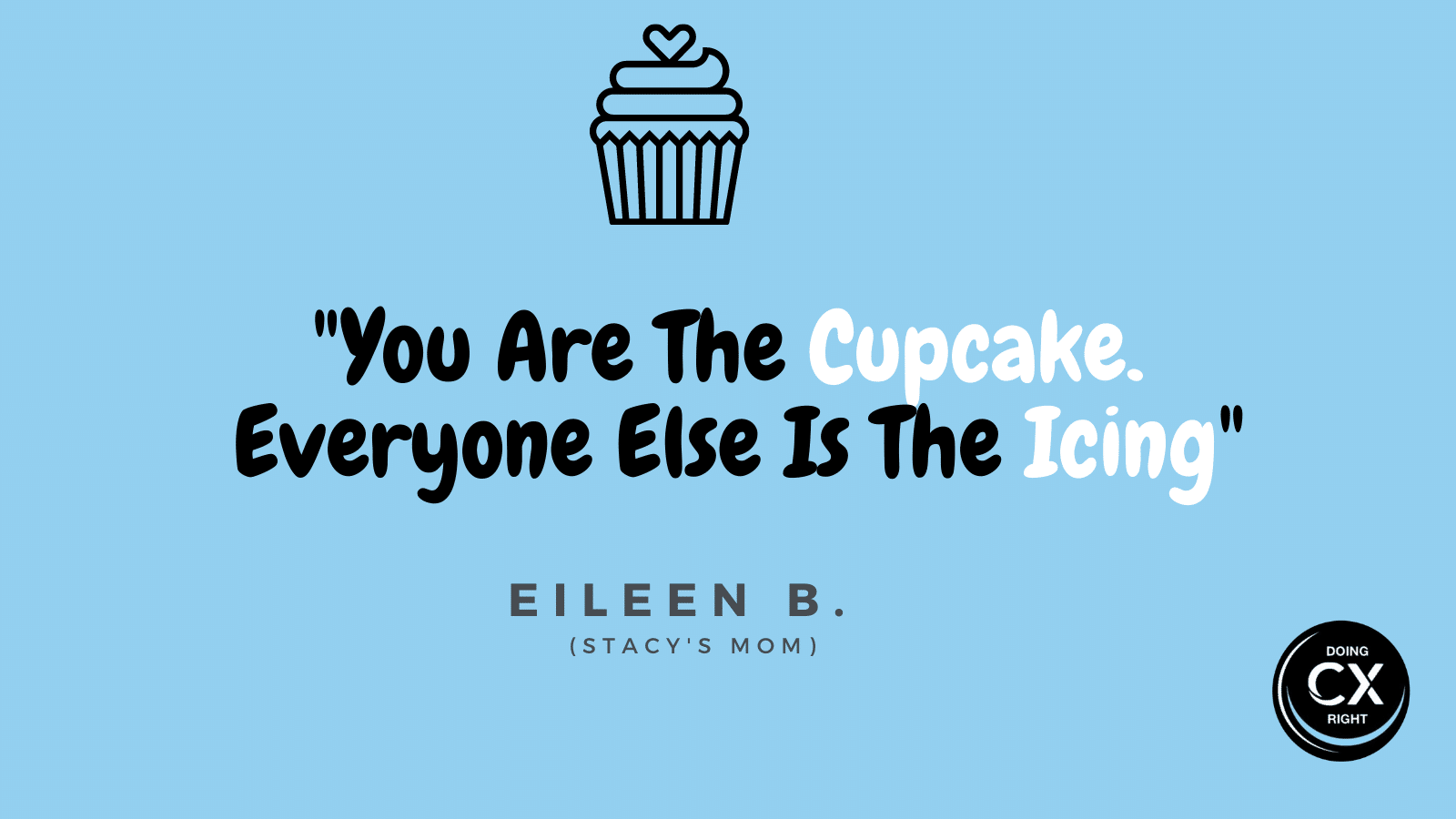
Don’t rely on anyone else to make you happy. Not a boss, colleague, friend, children, a spouse, or a life partner. They enhance your life like sprinkles on a cupcake, but that’s it. No one can own your happiness but you!

Happiness and leadership tips from inspiring women

“Inspiring Women In CX” Show Notes:

Episode #203 .

Clare Muscutt – host:

Hey, Stacy!

Stacy Sherman:

Hello. Good morning to me and afternoon to you.

Clare Muscutt – host:

Yeah. Where are you joining me from today?

Stacy Sherman:

I am in America, in New Jersey.

Clare Muscutt – host:

Ah! The view from across from Manhattan. I know that place. Battery Park. I used to look out over at New Jersey.

Stacy Sherman:

Oh, yes, it’s a little foggy today, but yes, it is a Garden State. We get a little bad rap sometimes, but it’s home.

Clare Muscutt – host:

Aw, and how are things in America? It’s a big election coming up for you, isn’t it, in the next few days?

Stacy Sherman:

It is. It is, and I look forward to becoming back the United States because right now, there’s a lot of un-united things happening, including families. It’s sad. But look, we vote. We do what we can control and…

Clare Muscutt – host:

Democracy.

Stacy Sherman:

Exactly! And then, focus on where we can make a difference.

Clare Muscutt – host:

Yeah, and by the time this podcast comes out, we’ll have found out the results, so yeah, I hope it’s a good one for America.

Stacy Sherman:

Yes.

Clare Muscutt – host:

Anyway, so today – you and I have spoken before, and I had one of the most amazing conversations with Stacy, and I’m going to ask her some questions today, listeners, so you can hear her incredible stories, too. We’re going to talk a lot about female leadership, and we’re going to talk about our mums, and the influence our mums have had on our lives and on Stacy’s life as she became a working mum. So, I hope that’s all good with you guys. So, Stacy, shall we just crack on then?

Stacy Sherman:

Absolutely.

Clare Muscutt – host:

Let’s begin at the beginning. Tell me about little Stacy growing up. What was your family life like, and how did it bring you to this point?

Stacy Sherman:

Yeah. Wow, what a journey. So, I lived in a suburb, lived a very – I figured – normal life, but when I look back, it may be not so normal in that my parents were divorced when I was very young, and I had a working mom who, at the time, I didn’t really realise how amazing she was in being a mom but also working in a field that was not traditionally for women. So, she’s an Options Trader. She was on the American Stock Exchange, and she was among the first women there. I remember being little and visiting her on the Stock Exchange and the men lifting her up in the air, and she’s doing all the hand signals, and it was complete chaos. And she’s petite like me, so you can imagine this powerhouse in her, and that was my role model. But again, I didn’t understand it the way I do now – about her at least, yeah.

Clare Muscutt – host:

Yeah, wow. Stock Trader! And at that time? So, I’m guessing the 80s.

Stacy Sherman:

Yeah. Yeah, 70s, 80s. She was also – and still trades now, but it’s certainly different with technology today. But also, my grandmother was a certified accountant, and so that was unusual then where there were mostly nurses and more traditional jobs. So, you could see how my mom ended up being who she is, and the apple doesn’t fall far…

Clare Muscutt – host:

Far from the tree.

Stacy Sherman:

… from the tree.

Clare Muscutt – host:

Yeah. It is so similar to my experience. So, I come from a line of very, very strong women, similar to you, however I don’t look like my mum or her mum; I look like my dad’s side of the family. But yeah, my grandmother was one of the first women to ever work in laboratories and was part of the team that developed penicillin for the war effort.

Stacy Sherman:

Wow!

Clare Muscutt – host:

So, I always say my grandma helped us win the war.

Stacy Sherman:

Definitely! Yes, big contributor.

Clare Muscutt – host:

Yeah, and my grandad was so happy for her to work, as well, which was quite unusual in that time of the world, after the Great Depression and stuff. Then, I guess, in my mum, she wanted more for her. So, she brought my mum up to believe she could do anything, and my mum went to university, became one of the first educational psychologists and went onto lead her field in what she did. So, yeah 100 per cent, passes it down from generation to generation. And how about your husband? How did he feel about you and your career? Has he been supportive to you?

Stacy Sherman:

Extremely. When I met him – we actually went to high school and junior high school together, but never said, ‘Hello’. It wasn’t until we graduated college, and came and lived in an apartment complex after college that we really met and spoke, and I believe that was what really attracted me to him was that I was really independent-minded…

Clare Muscutt – host:

Ooh, is that your dog?

Stacy Sherman:

Yes. He’s not very quiet, so he’s not helping.

Clare Muscutt – host:

It’s okay. It’s okay. I took Small’s collar off, so she isn’t jingling, but she’s sat right next to me too. Carry on, carry on your story.

Stacy Sherman:

Yes, I forgot that little heart. But yeah, so I think that really was a big factor that he – I believe that really was a piece, a part, was attractive. And then for me, having someone who would be really loyal and committed was something so important to me having grown up as an only child in my house, with a father not in the house and my mother working. You know, I had a lot of people, caregivers, come and go. And so to me, that was – conscious or unconscious – I wanted someone who I knew would just always be there.

Clare Muscutt – host:

Mm. No, that’s understandable. And what does he do?

Stacy Sherman:

He works in a family business, which is a 60-year-old company. They distribute burlap bags, plastic bags, industrial supplies. But what’s more exciting is that about 12, 15 years ago, he was doing home theatre work installing TVs for people, and plasma TVs, and surround sound, and it turned from a hobby into a side business, and that’s really his passion. So, one day, when we don’t have college bills to pay for, we will make that happen to be his full-time.

Clare Muscutt – host:

Aw, to be fellow entrepreneurs together. That sounds amazing.

Stacy Sherman:

Yes.

Clare Muscutt – host:

Now, I have to go back to your mum because she sounds like one awesome lady. So, tell me more of Stacy’s mum’s life lessons. What did she teach you?

Stacy Sherman:

Yeah, so sounds similar to your upbringing, and that is that a couple things: one, women can do anything. Here, they were in traditional male jobs, and that didn’t stop her – or your mom – I think that’s very powerful.

So, having worked in corporate settings for over 20 years, I had to learn how to get a seat at the table, have a voice, and that’s what I learned from her. So, that’s one thing professionally. Secondly is personally, always being able to take care of myself. So, even though I have a husband – and earlier in my life I didn’t, of course – but being able to be self-sufficient. And my most favourite saying that we’ve spoken about is, my mom taught me that, ‘You’re the cupcake. You are the cupcake. Everybody else in your life are the sprinkles. You can’t make someone else the cupcake.’ And so, when you’re looking for a partner, or even a best friend, you can’t make them the cupcake. They add, they enhance your life.

Clare Muscutt – host:

Yeah, you’re so right about that. And I think as a young woman, I just didn’t know that. My whole life was about me not being the cupcake and trying to please everybody, and it wasn’t until probably my 30s that I was like, ‘Hang on a minute.’ When you start being right with yourself first and foremost, different experiences, I think, come to you. And once you own that, and own your own experience, and just look after yourself before anyone else, you’re able to look after others and work with others far better too. So, that cupcake story will always ring in my mind, and whenever I see you, I always give a little cupcake emoji.

Stacy Sherman:

Yes! So, now when others see that, they’ll know what that means. We’re not just hungry!

Clare Muscutt – host:

Yeah. Well, we do love cupcakes too.

Stacy Sherman:

Yes.

Clare Muscutt – host:

So, it must be quite a balancing act, now, so you’ve got college-aged kids? What’s your daughter’s aspirations? I’m intrigued. I’ve seen lots of photos of her on Instagram with you. What’s she up to?

Stacy Sherman:

So, she is in the business school at University of Delaware. And I’m so proud of her because well, one, she did choose the major herself, but I really hoped that she would go that path because I believe that a business degree you could apply to anything in your life. And the beautiful thing is she’s very, very into community service. So, she’s marrying that giving and helping the world, but also, you need money to do that. So, she’s marrying that, and who knows where her destiny will go, but I’m so proud that she’s going after her dreams and doing something very meaningful and be able to afford that, as well.

Clare Muscutt – host:

Yeah, that sounds great. I think it’s something very true of the latest generation: even though they’ve been brough up probably with the most pressure – they’re probably going to be the most stressed and with the most anxieties, every generation seems to be getting harder – but what I am seeing is Generation Z growing up with a much stronger sense of purpose. The Millennials kind of got it, but Generation Z – like wanting to be able to earn money but do it with a purpose, and a soul, and to bring to life things like social enterprises, not just profit-making businesses. It’s brilliant. And I’m sure any daughter of yours is going to be highly successful, Stacy.

Stacy Sherman:

Oh, thank you. Yes. But also, I will say for all the guys out there listening and boys (because I have, well he’s basically turned into a man, now), but I do reinforce for him – and I think he’s going, I predict he will marry a working woman who makes herself a cupcake, and that he can be the sprinkles, and support whatever she bakes.

Clare Muscutt – host:

Yeah.

Stacy Sherman:

Because that’s – you need that. You need more of those men out there, too.

Clare Muscutt – host:

Yeah, yeah. And as someone who’s still single in 30s, I just – there aren’t many men who are happy for a woman to take the lead, or any of the guys who might be, I guess, more equal to me already got married and had kids; it happened earlier for them. So, I think for a lot of women, if we’re working towards our careers in our 20s, we don’t have that typical opportunity to meet somebody, pair up, and then go off together. Whereas I think guys, it seems to be a little bit easier to pick a woman, whichever your preference is, but for me, it always was going to have to be somebody who was as strong as, if not stronger, than me, and I’ve yet to meet that man.

Stacy Sherman:

Well, there’s a lot of divorces…

Clare Muscutt – host:

Yeah.

Stacy Sherman:

… there’s a lot of divorces, so you get round two; you get the better version.

Clare Muscutt – host:

Yeah, when they’ve learnt all their lessons. That would be amazing. But yeah, I’m putting it out to the universe.

Stacy Sherman:

Yes, yes. They’re going to come with all their mistakes done…

Clare Muscutt – host:

Yeah, ready for me. Ready to be my sprinkles!

Stacy Sherman:

Absolutely.

Clare Muscutt – host:

Bring on the sprinkles. Oh, bless you.

So, I also know you’ve got so much going on right now because you’re still director of customer experience at Schindler and you started your side business, which isn’t really a side business anymore; it’s your passion of doing CX right. And I’ve seen you appearing everywhere, like every time I look on LinkedIn, Stacy’s been on a podcast, or Stacy’s published a book, or Stacy’s published a blog, or she’s been in Forbes. I’m just really, really intrigued at your view on customer experience and where we’re heading. I know you talk a lot about CX and EX from what I’ve been seeing and reading. Where do you think we’re going on that one? I’m interested to just get your thoughts.

Stacy Sherman:

Well, first of all, for those who are not even in the CX field, for all people listening to this, the number one thing I could say – and this is why I really believe that I’m more successful now than prior years – and that is when you do what you love, the magic happens. It’s not work.

Clare Muscutt – host:

Yeah.

Stacy Sherman:

Right? And you’re a perfect case of that, as well. So, that’s the first thing I say as like for everybody, figure out what you love because the amount of hours that we put into it, again, it doesn’t feel like work. It’s fun. And then, you do more, and you do better.

Clare Muscutt – host:

Yeah.

Stacy Sherman:

That’s the difference.

Clare Muscutt – host:

It’s infectious, isn’t it, when you’re passionate about something?

Stacy Sherman:

Yeah.

Clare Muscutt – host:

People want to be around you. They want to listen to you; they want to be led by you and walk alongside you. If you really love what you do, it’s an easy leadership job.

Stacy Sherman:

Yes, and also, when – and I think this also – I did it wrong many years in my youth, okay? In my age, wisdom. And another thing that’s different, which again I feel we share in common, is that when you do what you love and it’s authentic, people follow because I’m not selling…

Clare Muscutt – host:

No.

Stacy Sherman:

… I’m never selling. I’m sharing what I know works, and then people will choose to embrace it, follow it, talk to me. That’s what it is. Forget all the rest of the fluff. People who are selling, selling, selling, it’s just a turn-off.

Clare Muscutt – host:

Mm. Yeah.

Stacy Sherman:

So, back to CX.

Clare Muscutt – host:

Sorry. We’ve technically done the ‘women’ bit, haven’t we? But the ‘in CX’ bit we probably have to just touch on it slightly…

Stacy Sherman:

A little bit.

Clare Muscutt – host:

… amongst the sprinkles.

Stacy Sherman:

Yes, yes. So, we’ll add a little nuts or candy to this.

So, I love CX. I fell into it. I was always in marketing, digital marketing and sales, for my career. I was very consistent. I’m probably one of the few that I know of my friends who actually went to college and graduated with what – like they do what they intended with a degree. I know a lot of people who, they didn’t know. It’s very hard to know at a young age what you want to do. So, I was lucky to know that at an early age.

So, sales and marketing many, many years, different corporations, different sized companies. And then, about 2013, I was working at Verizon headquarters, and I remember my boss said to me, ‘There’s this CX thing. It’s big. You need to own it now.’ And I said, ‘Well, but I have all this other stuff,’ and I’m like, ‘I don’t even know what CX is. What is CX? What is VOC? All these terms?’ He said, ‘I don’t know.’

Clare Muscutt – host:

There’s a lot of acronyms in CX.

Stacy Sherman:

Yes! Yes, like any medical field. Every field, right, has their acronyms. So, the point of my story is that he didn’t know. I didn’t know. I figured it out. And this is also important, I had a boss – and I believe this for whether kids had bad teachers or tough bosses – he wouldn’t help me when I needed it. His answer was, ‘Go figure it out,’ and I didn’t like him at the time, but now I look back and I say, ‘You know what? Thank you!’ Because now, when I’m in a situation and I don’t know what something is, I figure it out. So, realise there’s blessings in people who are not good leaders so that you become a better one.

Clare Muscutt – host:

A bit of tough love goes a long way to teach you, or you learn by your own mistakes rather than someone telling you to avoid them, and when you learn from your own mistake, oh my god, it hurts! But you have learnt it. For sure. So, I’m with you on that one, as well. So much to agree on today.

Stacy Sherman:

Yes. I’m sure we could go over so many more stories. But anyway, so CX, I continued on in three different areas of CX, and I’ll just highlight the three quickly because each one can be an hour long, but it was customer experience within a channel, so e-commerce; how do you make people who go to a website, make it easy for them to buy online and accomplish their goal, online experience? Then, I moved over to CX within new product development, so infusing the customer voice before products launch. That’s huge. Not enough companies do that; they launch and hope it sticks. No, doesn’t work that way.

Clare Muscutt – host:

Or the CX experience is a by-product of a new proposition not that the experience, as you said, was baked into the cupcake of the offer in the first place.

Stacy Sherman:

Exactly.

Clare Muscutt – host:

Well, I’m in CX design, so you’re preaching to the choir here, sister.

Stacy Sherman:

Yes, yes. It’s so intuitive but how you do it is, really, where a lot of conversation can happen.

Then finally, where I am now at Schindler is that customer experience means a lot through employee engagement. We have over 60 sales offices just in America – we’re in all different continents – but how you deliver customer excellence through the frontline. That’s a whole other approach in addition to getting customer feedback directly.

So, there’s a lot of different facets to it, but bottom line is that CX has a role in many different areas, and the reason why I stuck with it and I love it is because what we do is really driving more happiness and satisfaction as employees and customers. If you really like peel the onion, here, that’s what it’s about. So, this job is here to stay.

Clare Muscutt – host:

Ah, lovely. I do like what you said there about especially employee experience because I guess they are customer experience manifestation, right? The customer experience lives through the service that people provide. It’s one of the hardest things to get right, but when you’ve got a culture that engenders that naturally, it makes your proposition so much more powerful. And I just have to say, every time I see Schindler on a lift, I always think, ‘Stacy’.

Stacy Sherman:

It is the funniest thing because I get – in the past before I worked at Schindler and I never was in this industry before – people would send me pictures of their pets and their kids; now, I get pictures, ‘I’m in an elevator. One of your elevators on a cruise,’ not now a cruise but before Covid. It’s so funny. I get all these elevator pictures.

Clare Muscutt – host:

Selfies.

Stacy Sherman:

Yes!

Clare Muscutt – host:

That’s so cute. Oh, bless you. Right, so, we’ve run out of time, unfortunately, but I could absolutely talk to you all day, and I’m sure we’ll end up doing a podcast again in the future, where we focus more on some more of those CX topics that you just brought up there. But if you could leave your parting words of advice for women in CX, what would your top three takeaways be?

Stacy Sherman:

Yeah, they are sum-upped in one of my favourite books; it’s called The Four Agreements. There’s four agreements – I’m going to tell you even though you only asked for three, but maybe I’ll…

Clare Muscutt – host:

Four is fine.

Stacy Sherman:

… entice people to read the book and…

Clare Muscutt – host:

Extra value. And we’ll put that blog article on the Women in CX website, as well, when your episode goes out. I loved reading it. So, go for it, Stacy. You tell us your four.

Stacy Sherman:

Oh, okay. Yes. So, one is, ‘Don’t take things personally,’ number one. Number two: ‘Be impeccable with your words.’ People know when you’re authentic. People know when you’re speaking from your truth, and then they listen. Three: ‘Don’t make assumptions.’ It is easy to assume, and so often we get it wrong, so pick up the phone, communicate and communicate with your employees, with your customers, with your colleagues, and your family. And then finally, ‘Do your best.’ And this one sounds interesting. You say, ‘Do your best? What does that mean?’ And the thing is we often, especially as women, try to do more than 100 per cent.

Clare Muscutt – host:

Yep.

Stacy Sherman:

How many times do I say, ‘I did 125 per cent today’? But there’s only 100 per cent. So, figure out, prioritise, do your best, and manage your energy.

Clare Muscutt – host:

Yeah. And it’s so hard right now. I know before we started this call, we were just discussing the fact that I’m still in my gym gear because I’ve been so busy today, I don’t have time to get changed. And what are you wearing on your bottom half?

Stacy Sherman:

Yes. Yes, I have a nice business attire on top, and then I got my workout pants on bottom. And that’s what we do. We’re wearing a lot of hats, and we’re on the go, and we’re just doing. I have a feeling if we stop to think about, ‘How do you do it all?’ I don’t know what could, but…

Clare Muscutt – host:

No. No, it just means you make a compromise in the way you turn up to a podcast wearing your gym gear, which is fine! It is totally fine. I’m good with it.

Stacy Sherman:

Absolutely. Yes, keep doing. We can’t just talk; we gotta do.

Clare Muscutt – host:

Yeah, women of action. So, I’m just curious about one tiny little thing, and it was when you say you’re petite, I’m just trying to visualise you in real life. How petite are you?

Stacy Sherman:

Oh, I am 5’1” and if I come across bigger in social media, that’s cool because I…

Clare Muscutt – host:

I never ever would have thought. My mum’s 5’1” and I never, ever would have thought you were 5’1”. I imagined you to be really tall.

Stacy Sherman:

That’s great because you know what? This is another podcast, but this has been a bias growing up being petite: people make judgments and I feel like I had to work harder. Looking young at that age and being petite, I had to work extra hard. So, good. I’m glad I appear big.

Clare Muscutt – host:

Digital removes all that. Being small and perfectly formed is just fine, too. So, you’re an absolute pocket rocket, Stacy, and you’ve got so much energy.

I’d just like to thank you so much for coming on the show, for sharing your stories, for telling me about your mum in the first place, the cupcake will always be with me, and now it will be with the listeners too. So, you take care of yourself. I really do hope things turn out well with the election, and I’ll catch up with you very soon.

Stacy Sherman:

Wonderful. Thank you.

Clare Muscutt – host:

Thanks, everyone! Take care. Bye, Stacy!